


Mohd Arbaaz is an Editor and Writer at Fitnessison.com with 5 years of experience in SEO and digital content creation. He creates informative, reader-focused content covering fitness, workouts, nutrition, health, healthy lifestyle, technology, and computers.

Shashi Teja is a Reviewer at Fitnessison with over 6 years of experience in SEO, content strategy, digital publishing, and content optimization. He reviews content for clarity, research quality, topical relevance, readability, structure, and overall usefulness to readers.
Last Updated: September 27, 2026
What is burnout prevention? Burnout prevention is not just about taking a vacation every time you are totally drained. On the contrary, it is about detecting chronic stress at work, guarding recovery time, drawing appropriate boundaries and beginning to address the problem before you become exhausted. We all have busy times. A hectic week in the office does not necessarily lead to burnout. It is when work stress becomes chronic that we have to start identifying our warning signs.
What means burnout?
Burnout, as defined by the World Health Organization (WHO), is “a syndrome conceptualized as resulting from ongoing workplace stress that has not been successfully managed.” The organization considers three dimensions behind it: exhaustion; the cynical or negative attitude toward one‘s job; and the professional efficiency that suffers. However, burnout is unique to the work life as opposed to any other. You may simply require the everyday refreshing after an overly stressful week. But constant exhaustion without time to recover warrants a closer look.
Possible warning patterns can include:
- Tropic of Exhaustion. Feeling emotionally or physically drained by work
- Growing to dislike work more and more
- First we will look at the problem in so far as it relates to barrier a, ‘difficulty switching off after hours,’ and we will then combine it with the rest of the issues on barriers a, c and e to provide us with a comprehensive view of our problem.
- Less effective than usual.
- Drop in motivation for now-acceptable tasks that were previously handled by you/your team.
- Permitting work to constantly interfere with sleep or recovery
There‘s a wide range of possible reasons for these feelings, so don‘t attempt to self-diagnose solely from a checklist.
Why Burnout Prevention Matters
If you wait until you are totally exhausted then pain is in the post. Prevention is about consciously managing your workload, boundaries, recovery and emotional health on an ongoing basis. Work is like exercise: train like a demon every day and your performance will suffer. Work is like this too: you need to recover between periods of high effort. Burnout prevention therefore isn‘t about avoiding work altogether; it is about making periods of high work capacity sustainable.
7 Practical Burnout Prevention Strategies
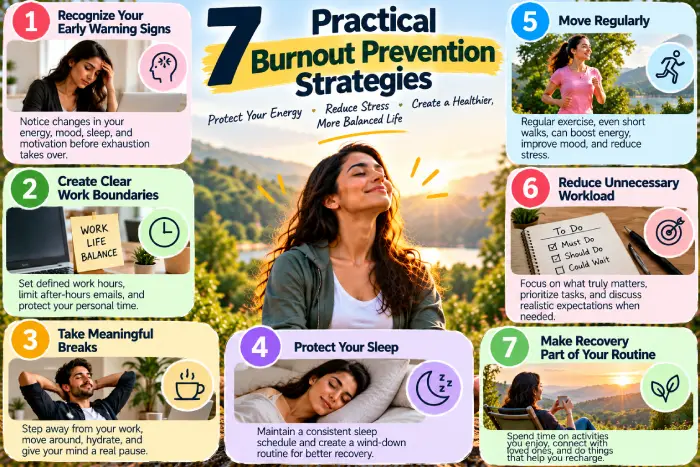
1. Recognize Your Early Warning Signs
People react to chronic stress in different ways. Begin to become aware of the ways in which your usual pattern of conduct is changing. Are you getting unnaturably annoyed? Has physical exercise been replaced by “thinking about work all the time’? Is it becoming hard to focus, and are things that used to be easy now unacceptably frustrating?
Ask yourself once a week:
Given in what way my work has been influencing what consequence on my energy, mood, sleep, life away from work?
The sooner you recognize a change, the more time you have to react.
2. Create Clear Work Boundaries
Today‘s work, unfortunately, gets carried home too easily. Thanks to emails, messaging applications and remote access, you can stay working long after the time you left the office. When you can, set a point when you can or want to finish work:
That might mean:
- e. disable other work notifications
- Skip the mandatory emails at meal time.
- Can enforce clear working hours1.
- Reserving some personal time to be free of work
- Indicating Clearly How You Will Communicate Your Availability
Boundaries will feel different for each position however, being constantly available shouldn‘t necessarily be the goal.
3. Take Meaningful Breaks
All day long, you can work for hours and not stop. You will feel productive, but resting attention and focus is finite.
Take mini break whenever the work permits.
- Stand up.
- Drink water.
- Walk around for a few minutes.
- Turn your eyes away from the monitor.
A helpful pause, however, is not just moving from your computer screen to your phone and on to consuming information. Let your mind truly rest.
4. Protect Your Sleep
Work stress can follow you to bed. You work late, remain consumed with thoughts of the following day, catch up with work email in bed, and wake up already behind the eight ball. Consider making a transition from work to sleep.
Jot down what needs to be completed the next day before leaving work. Minimize work-related communication in the evening and aim for a reasonably solid sleep. schedule. Sleep cannot fix an unhealthy workplace, but sacrificing sleep usually makes an already difficult situation harder.
5. Move Regularly
Being active offers variation and relief from work, which can be very mentally tasks. There‘s no need for a really energetic session in the gym every night.
Try:
- A walk this lunchtime
- Sessionsofstrength training right after sessions of endurance training to really deplete the energy stores or glycogen.
- Cycling
- Yoga
- Swimming
- Recreational sports
- Walking after work this can be aneasy additional form of exercise after a long day at work. It will help you meet yourdaily activity goals, and adds minutes and miles. You can also use walking as a way to get where you need to go. Instead of grabbing your car keys, slip onyourwalking shoes.
Depending on your energy and schedule, choose movement accordingly. Working out should be a helpful part of your healing process not a burdensome added task that makes you feel bad.
6. Reduce Unnecessary Workload Where Possible
The issue isn‘t always ineffective stress controls. Workloads are sometimes overwhelming.
Review your responsibilities and identify:
- Must have: work that truly matters.
- What students should do: useful but possibly alterable.
- Can do now.: these are the not so urgent tasks.
If your work is never realistic, talk to your manager, if you can, about priorities, deadlines, resources or responsibilities. Prevention of burnout requires not just individual effort. It is also a matter of the circumstances at the workplace.
7. Make Recovery Part of Your Routine
Don’t wait until you are shot to get a lift. Integrate out, doing positional work to make some space from your work.
That might include:
- Family or friends getting together
- Exercising
- Cooking
- Reading
- Going outdoors
- Practicing mindfulness
- Enjoying hobbies
- Having true leisure
Recovery can be unproductive. Sometimes the only reason I did things was because I enjoyed them.
Common Burnout Prevention Mistakes
The first mistake is believing that a weekend can compensate for 3 months of a chronically stressful job and the second mistake is trying to make up for an excessive workload by working even harder.
While effective at helping to structure activities, tools alone can not compensate for the unrealistic expectations. Do not make the mistake of taking burnout as a personal weakness; it is the result of stress occurring over a period of time due to workplace factors such as workload, lack of support, lack of control, lack of clear role expectations and ongoing conflict. Changing the environment may be necessary.
When to Seek Additional Support
Symptoms resembling burnout may also be caused by other physical or mental health issues. If you experience exhaustion, sleep problems, low mood, anxiety, concentration difficulties or other symptoms for a long time or to an extreme degree, or it affects your day-to-day life, speak to a suitable health-care or mental-health professional. Support from your workplace may also be helpful if work is the primary problem.
Conclusion
Prevention of burnout should start long before the end stages. Notice the early warning signs, set healthy limits, take breaks, prioritize sleep, be active, evaluate your workload, and normalize recovery in your week. However, don‘t forget that burnout is associated with longer-term work stress. While healthy behaviors can help counteract burnout, they cannot always compensate for unhealthy working conditions. For a broader wellness approach, explore our Mental Well-Being pillar and related guides on Emotional Wellness, Healthy Mental Habits, Mindfulness for Beginners, and Work-Life Balance.