

Mohd Arbaaz is an Editor and Writer at Fitnessison.com with 5 years of experience in SEO and digital content creation. He creates informative, reader-focused content covering fitness, workouts, nutrition, health, healthy lifestyle, technology, and computers.

Shashi Teja is a Reviewer at Fitnessison with over 6 years of experience in SEO, content strategy, digital publishing, and content optimization. He reviews content for clarity, research quality, topical relevance, readability, structure, and overall usefulness to readers.
Last Updated: September 27, 2026
To be building self-esteem, you don‘t have to trick yourself into believing that there‘s nothing wrong with you, that you are perfect. It is to develop a better, and more balanced perception of yourself your good and bad qualities, your achievements and progress, your errors
Self-esteem can influence how well you respond to difficulties, relationships, work, exercise, and everyday matter. If your self-esteem is low, one mistake may tell you that you‘re not a strong person. When you have a good self-esteem, you are able to just observe the setback and then release it without individualizing it.
Luckily your Self-esteem is not set in stone. The following, or any combination of it, could help you to identify yourself in a more positive light: the language you use to describe and think about yourself; the route you take with your goals; how you deal with adversity; and the support and nurture you seek.
What Does Building Self-Esteem Mean?
Self-esteem is really how we value ourselves and feel about ourselves. And good self-esteem is not being snobbish or the arrogant attitude that you feel like you are better than everyone else. It‘s more like acknowledging that you are worth something but still have some room for improvement.
Now think of this; That first time you hit the weights and it just wasn’t happening.
Low self-esteem might turn the experience into:
I‘m no good at this. So much stronger than me.
A more balanced response would be:
“I am not much experienced in this. It takes time to build strength.”
The workout was rough; it didn‘t change. How you perceived it did. That‘s one small adjustment to give you a step towards building your self-confidence.
Why Is Healthy Self-Esteem Important?
Our conception of ourselves can influence your behavior.
Healthy self-esteem may make it easier to:
- Attempt new activities
- Tell us what you are feeling and thinking.
- Set within reasonable limits
- When errors have been made, the student should be able to recover, explanation3. However, this may not be the best strategy, especially if it leads to complex tutoring4.
- Except for one case, be willing to accept critical comments.
- Acknowledge existing progress.
- Develop, maintain, and build healthier relationships
In addition, a healthy attitude toward oneself is related to overall mental health, as self-acceptance is related to one’s ability to cope with stress and adversity. But enjoying high self-esteem doesn‘t mean feeling entirely confident at all times. It‘s natural to experience momentary feelings of insecurity. The important thing is not to let these fleeting moments turn into lasting beliefs about yourself.
7 Practical Ways to Build Self-Esteem
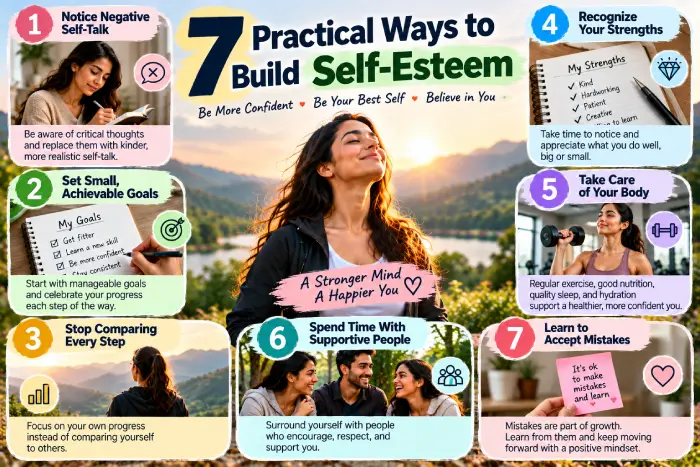
A rudeness is no confidence trick over night. Try small practices all together!
1. Notice Negative Self-Talk
Begin to notice the negative way you refer to yourself.
Would you talk to a friend like this?
If you catch yourself thinking:
I can‘t do anything right.
Pause and make the statement more accurate:
This didn‘t work how I wanted it. What else can I do next time?
You‘re not putting on a front that it never happened. You‘re just taking out the needless personal attack.
2. Set Small, Achievable Goals
Often confidence grows by doing. Rather than contemplate a huge goal, select one you can actually do.
For example, rather than:
I‘m going to work out each day this month.
Try:
Here, a person would specify the time period over which they will perform the behavior. For example, this could be “I‘ll walk for 20 mins three times a week.”
Cross off doable tasks you develop confidence in yourself. And then step it up.
3. Stop Comparing Every Step
Comparisons do tend to cloud your appreciation of your progress. And nowhere is it such a problem as in fitness. Comparing your first month in the gym with someone who has been training five years only tells you a tiny bit about your progress.
But rather, compare where you are to where you began.
- Can you get farther?
- Are you carrying dust too far?
- Gaining weight?
- Are you more comfortable exercise?
Is reflected in how far one has come personally speaking.
4. Recognize Your Strengths
People with low self-esteem may be very perceptive to flaws and blind to strengths. write a couple of simple positives of yourself. They need not be anything special.
- Perhaps you are:
- Dependable
- Patient
- Curious
- Hardworking
- Supportive
- Creative
- Willing to learn
If this exercise feels uncomfortable, start with something factual:
I continue when something is hard.
That counts irrespective of that.
5. Take Care of Your Body
Physical self-care can contribute to your general health. Moving, eating well, sleeping well, drinking in moderation, and having rest are not a means of earning one‘s own value – see it rather as bodycare.40 Sport sometimes opens possibilities to acquire, learn or notice one‘s capabilities, rather than one‘s faults.
6. Spend Time With Supportive People
Your relationships shape your opinion of yourself. Pay attention to how you feel when you are with others. Good relationships feel respectful, genuine, caring and maintain boundaries. If someone is intimidating, manipulative or constantly putting you down, try setting some boundaries. You don‘t have to be validated by everyone.
7. Learn to Accept Mistakes
In this world, we all make errors. An error is an event, not a person.
Instead of:
I‘m just a failure because I failed.
Try:
That didn‘t work. What have I learned?
It can be especially helpful when creating personal goals for fitness, careers, nutrition or lifestyle. We don‘t make progress in a straight line.
Building Self-Esteem Takes Time
Common mistakes are not taking action until you are confident. The truth is that confidence usually arrives with action. Take a small step, learn something, discover that you can do a lot more than you thought you could and confidence will simply arrive.
Try this simple weekly practice:
One small goal. → decide to do it. → finish it. → recognize. → think. → now what?
Repeat.
In time, these small learning moments may serve as evidence that you are learning, adapting, and getting better.
When Low Self-Esteem Needs More Support
Self-help has its boundaries.Consider talking to a suitably qualified mental-health practitioner in the event that persistent low self-esteem is painful or disrupting relationships or the ability to carry out normal functions or is associated with persistent anxiety, depression, or other mental-health problems. This will allow you to address patterns of thinking rather than attempt to “think positive”.
Conclusion
Developing self-esteem isn‘t about being perfect, fearless or confident in every situation. It is about creating a more equal relationship with yourself. If you are beginning to develop your self-esteem, consider the following. Be mindful of the negative self-chatter. Set achievable goals. Do not engage in unhealthy comparisons. appreciate the good in you. take care of your body. cope with negative people. learn from your mistakes.
Even the tiniest task, when done consistently, will eventually alter your perspective of yourself. If you want to learn about feeling better physically, you can check out our Health pillar and related guides on Exercise and Sleep.