


Mohd Arbaaz is an Editor and Writer at Fitnessison.com with 5 years of experience in SEO and digital content creation. He creates informative, reader-focused content covering fitness, workouts, nutrition, health, healthy lifestyle, technology, and computers.

Shashi Teja is a Reviewer at Fitnessison with over 6 years of experience in SEO, content strategy, digital publishing, and content optimization. He reviews content for clarity, research quality, topical relevance, readability, structure, and overall usefulness to readers.
Last Updated: September 27, 2026
Mental health has an impact on our overall satisfaction with our lives. It can influence our ability to manage stress, form relationships, make choices, attain objectives, get through tough days, and treat ourselves kindly. However,13 mental health doesn‘t mean being content with each dawn.
A mentally healthy person can experience such feelings of worry preceding an important appointment, frustration after a hard day, disappointment over something that has gone wrong, sadness after a bereavement. The distinction is that these feelings do not overshadow the overall context.
The World Health Organization defines mental health as “a state of well-being in which each individual realizes his or her own potential can cope with the normal stresses of life, can work productively and fruitfully, and is able to contribute to his or her community.” and as “a positive concept focusing on social and individual functioning.” They further elaborates the mental health as a “contiuum that can fluctuate over time in response to varying circumstances.”
This demonstrates why mental well-being needs to be built throughout the course of life not discarded when nothing is wrong. This guide sets outs the foundation; explore our more detailed guides to particular aspects of mental well-being from here.
What Is Mental Well-Being?
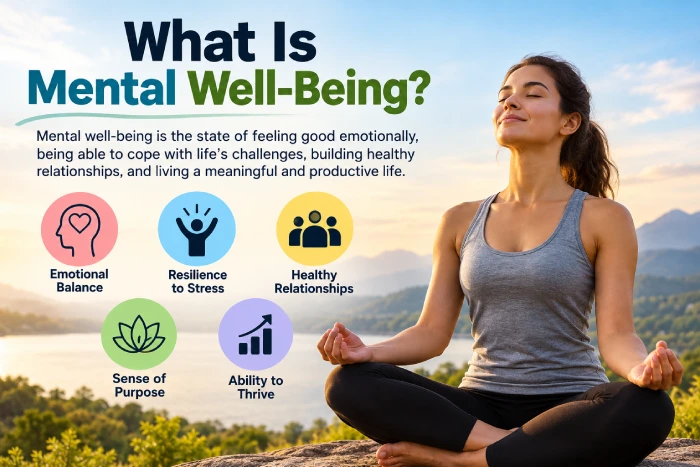
Mental health is the state of well-being in which every individual realizes his or her potential, can cope with the normal stresses of life, can work productively and fruitfully, and is able to contribute to his or her community.
It involves several overlapping areas:
- Emotional well-being
- Psychological functioning
- Relationships and social bonding
- Resilience, in other words, ability to cope with daily strain.
- Self-acceptance
- Independence and decision-making
- Meaning and purpose
- Life satisfaction
This summary is further strengthened by a recent expert consensus report discussed by the American Psychiatric Association. In this report, experts showed high levels of consensus regarding dimensions such as meaning and purpose, life satisfaction, self-acceptance, connection, autonomy and happiness.
So mental well-being is not simply:
“Am I happy?”
A better set of questions might be:
“How am I feeling, functioning, connecting and coping?”
Mental Well-Being vs Mental Illness
Yet another difference is that mental well-being is a state that can be achieved regardless of whether an individual has a diagnosed mental-health disorder. Someone with a mental-health disorder can experience meaningfulness, connection, good relationships, accomplishment and periods of positive mental well-being. Someone without a diagnosed mental-health disorder can experience loneliness, ongoing stress, negative or unhappy moods, or dissatisfaction with oneself or life. It is something that can move around and fluctuate..
Key Takeaways
- Mental well-being is much more than happiness.
- It comprises of senses and functions.
- Relationships matter, purpose matters.
- Is subject to variation from time to time.
- Being faced with difficult emotions does not necessarily equate with poor mental health.
Practical Check-In
Instead of asking only, “Am I happy?” try asking:
- What have I been dreaming?
- Am I in touch with other people?
- Am I able to maintain a focus on day-to-day obligations?
- Do I have something to look forward to?
- Nalingapup15]How do I respond to stress?
- Am I able to do the things I want to do?
These are not diagnostic questions. They just give a better image of where you are now.
Looking to delve a little deeper? Read our guide to What Is Mental Well-Being?
Signs of Positive Mental Well-Being
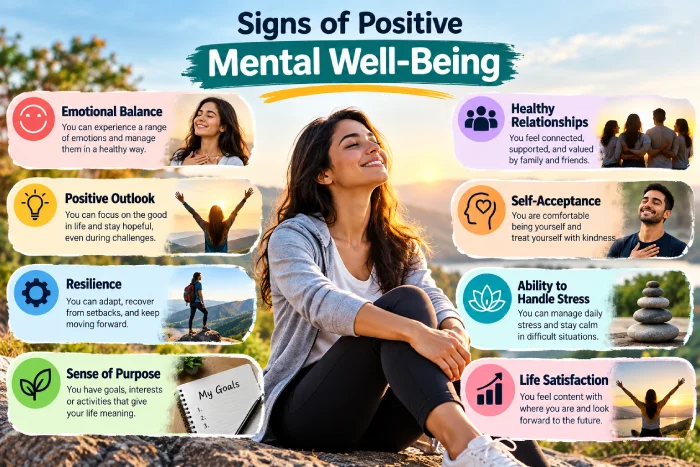
No one personality or mood is a comprehensive indicator of positive mental health. One individual may have an offbeat outgoingness whatever that means. Someone may have natured an independent reserve. A one person may derive satisfaction From family life while for another satisfaction may come from employment, art, volunteer work, learning, religion, sport or community. Positive psychological well-being can be indicated more clearly by patterns.
You Can Experience Difficult Emotions
You do not get rid of sadness, anger, stress, frustration or disappointment with sound mental health. Good emotional health involves being able to identify your feelings and deal with them you should not need to always be happy!
You Can Usually Handle Everyday Responsibilities
Other things that take up mental energy include work, housework, exercise, friends and family, and personal goals. It is helpful to have the capacity to balance “day to day” responsibilities most of the time. We all have days that seem less than successful; the key is pattern.
You Have Meaningful Connections
It isn‘t necessary to have hundreds of friends for your social well-being. Even a handful of friendships in which you feel secure, valued, understood or uplifted can be useful. And connection is one of the factors highlighted in the recent consensus development study on positive mental health.
You Can Recover From Setbacks
Resilience does not mean that things don‘t ever get to you. It means you allow yourself to transition gradually after setbacks, stress, doubt or modifications. For example, having a week off from exercise due to an overwhelming workload doesn‘t mean you have failed at a healthy routine. A resilient response may be to relax a little about the strain on your goals, and then to try again with two short outings.
You Have Some Sense of Direction
Purpose should not have to consist of providing a ‘grand life task’ for oneself.
Purpose can come from:
- Having a family
- Building friendships
- Helping yourself do the best you can: If you are unwell or exhausted prior to the exam, neither your brain nor your body will be able to function effectively.
- Learning
- Creating something
- Helping others
- Career planning.
- Participating in your community
You Can Set Boundaries
There is awareness of your mental state when you feel your energy is being pulled too thin. That will mean declining an additional responsibility, shutting off the phone when you are dining, safeguarding your sleep hours, or accepting recovery as an important part of being a hard charging athlete.
Mini Summary
Having positive mental health does not mean always feeling happy. Instead, more accurately, showing positive mental health can be seen through your adequacy to interact, manage, function, find meaning, and having the regular fluctuations of your emotional state.
Next: Discover our comprehensive guide to the Signs of Good Mental Well-Being.
Daily Habits That Support Mental Health
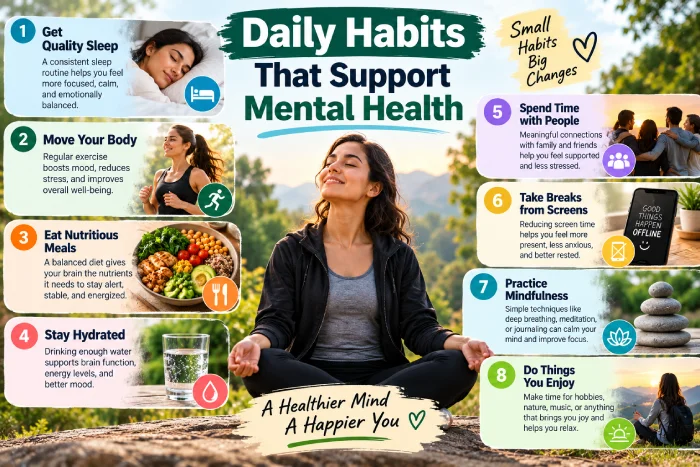
Mental health is affected by many things other than an individual’s actions. Including but not limited to: one‘s situations in life, one’s physical health, one‘s relationships, one‘s money, one‘s environment, one‘s biology, one‘s access to care, etc. With that said, the behaviors can still serve as a starting point. The goal shouldn‘t be designing a “perfect” wellness routine. Build on repeatable basics.
1. Protect Your Sleep
Sleep and mental health are linked. As an initial step it can be helpful to establish a fairly regular sleep/wake cycle rather than implement a complex nighttime routine.
Other simple habits include:
- Establishing a more relaxed pre-bed routine
- Maintaining a comfortable environment in the bedroom
- Minimize leisure stimulation before asleep.
- Fully time yourself to sleep.
- Access to daylight and physical activity during the day
2. Move Regularly
Exercise is not necessarily a grueling session at the gym! Going for a walk or bike ride, doing some resistive weight work, swimming, practicing yoga or aerobics, taking up dancing or other active hobbies, playing sports for fun anything that keeps you moving.
3. Eat Regular, Balanced Meals
Food is not a remedy for emotional and mental-health issues. But eating three meals a day, drinking plenty of water are fundamental dietary ways of nurturing your body.
A practical pattern might include:
- Fruits and vegetables.
- Whole grains
- Protein-rich foods
- Healthy fats
- Adequate fluids
The goal is consistency.
4. Maintain Human Connection
Good five minutes conversations are sometimes more realistic than randomly planning a two hours social gathering,
Try:
- Talking to a closer friend.
- Spending time with family while eating.
- Participating in a workout group
- Having a conversation and going for a walk with a friend.
- Participating in a hobby group
- Reaching out to someone you haven‘t had recent contact with
5. Create Small Moments Without Constant Input
Our modern world is flooded with buzzes, beeps, whistles, video clips, packets of instant messages and updates, and posts on a social newsfeed. Challenge yourself to a few moments at a time when you may be reached.
For example:
10-minute reset
Put the phones away, stand outside, stretch, take deep breaths, sip water, and just learn to do one thing at a time.
Make Space for Enjoyment
Not everything that is enjoyable has to be eliminated. A healthy routine can include reading, cooking, gardening, music, sport, art, games, contact with nature, and so on.
Use Simple Stress-Management Skills
Each methods suits each person.
You might experiment with:
- Slow breathing
- Meditation
- Journaling
- Stretching
- Walking
- What is preceded by: progressive muscle relaxation
- Time outdoors
Best strategy is not guaranteed to be fashionable.
It is one that is made life stressful.
A Simple Daily Mental Well-Being Routine
| Time | Simple Action |
| Morning | Really bright in the daylight and make sure to not go hungry or thirsty. |
| Morning/day | Have a balanced meal |
| Workday | Take a brief of movement. |
| Afternoon | Take a walk or do the exercise you have planned. |
| Evening | Connect with someone. |
| Night | Dampens stimulation and get ready for sleep |
You don‘t need to do this every day. Have yourself select one or two of the habits.
Common Mistake: Changing Everything at Once
Imagine someone who decides on Sunday night that starting Monday they will:
Get up at 5, meditate for 30 minutes, train six days a week, cut out all processed foods, journal every day, quit Facebook, sleep impeccably. By Thursday, I am exhausted with the task.
A better starting point could be:
- Week 1: Wake time kept constant.
- Week 2: include a 15-minute walk.
- Week 3: put away the phone 20 minutes before going to sleep.
Small routines are more commonplace.
Mini Summary
While some aspects of mental health are beyond the influence of daily habits, sleep, physical activity, diet, social connection, pleasurable activity and time for relaxation are important.
Proceed with our comprehensive instrucion on Daily Habits That To Aid Mental Health.
How Physical Activity Supports the Mind
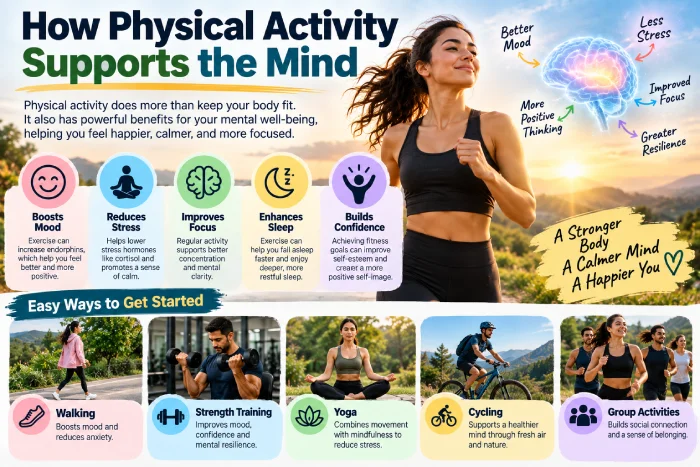
Part of the picture that tends to be ignored is the mental health benefits of movement. Interventions focused on improving calorie-count,build a person‘s strengthening, or slimming downbody fail to appreciate that movement is also essential for sound mental health. According to the CDC, a single bout of moderate or vigorous exercise can quicken a person‘s recovery from feelings of anxiety and allow for better sleep. Nevertheless, moving bestows a lowered risk of depression.
This is not to say that exercise is a substitute for treatment provided by knowledgeable professionals. It‘s to say that exercise can be a support of general health.
Exercise Can Give Your Day Structure
Imagine having finished work completely exhausted. Sitting on your phone for an entire hour might not have reenergized you.
A 20-minute walk creates a transition:
Work→ movement→ home/evening
That structure is useful even if the workout has no complicated exercises:
Movement Can Also Create Social Connection
Exercise doesn‘t need to be lonely.
Consider:
- Walking groups
- Recreational sports
- Group fitness
- Hiking
- Cycling clubs
- Working out with a friend
In those instances, movement and social connection occur simultaneously,
How Much Exercise Do You Need?
You do not have to wait to achieve an ideal program. Existing American instruction states any activity is preferable to no activity, and federal recommendations suggest that all adults should strive to reach approximately 150 minutes of moderate-intensity activity each week.
Someone starting from inactivity might begin with:
- Monday: walk 10 minutes.
- Wednesday: 15 min walk
- Friday: a quick strength workout45 minutes
- Having fun outside on the weekend
Apply to build up gradually, be driven by your health, fitness level, and situation.
Exercise Should Support Well-Being, Not Become Another Source of Punishment
Watch out for mindsets of all-or-nothing. You do not need to feel wipedout after your workout to include it.
Movement can be:
- Challenging
- Restorative
- Social
- Recreational
- Structured
- Unstructured
The best routine is the one that suits your health, preferences, strength and endurace and schedule comfortably enough to keep up with.
Mini Summary
Physical activity is beneficial for many things beyond physical fitness. The benefits of physical activity are mental, social and structural. It can help with sleeping, feeling less anxious, creating social bonds, providing daily routine and improving general health.
Want to know more? Covering all you need to know about how physical activity affects the mind, go to our factsheet: How Physical Activity Helps the Brain.
Mental Well-Being and Stress
Stress is not in itself a sign of something being wrong. Deadlines, parenting, relationships, financial issues, health problems, major life changes and even positive occurrences all cause stress.
The goal therefore cannot be:
Never feel stress.
Where we should really aim to get to for ourselves is: it‘s good to learn to find out ‘what I do when I have this feeling’ and to respond appropriately.
Try the Reduce-Recover-Respond Approach
- Reduce: Can this start off further to cut down on the people needed to deliver.
- Recover: Do you need sleep, food, movement, quiet or time away from screens?
- Antwort: what would be a gesture you could give to the real problem?
Let‘s say you have a huge project on your hand.
Instead of thinking about the entire project repeatedly, your response might be:
- Have a short rest.
- G10. Write the subsequent three tasks.
- Clearly, do the smallest one.
- However, do not hesitate to ask if something is not clear.
- Stop you don‘t have to work late into the night.
This however does not do away with all the causes of stress. It simply refers to the first step being more defined.
Mental Well-Being: Myth vs Fact
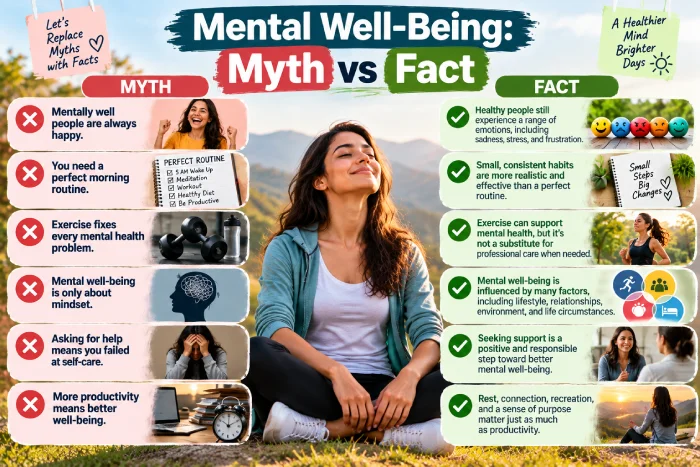
| Myth | Fact |
| Mentally well people are always happy. | Healthy people also experience difficult emotion. |
| I require a flawless morning routine. | Small repeatable habits will be more realistic |
| Exercise solves all mental health issues. | Exercise can help maintain good mental health but should not replace the treatment that you require, such as therapy medications or talking treatments. |
| Mental well being is all about attitude | Therefore all the possible etiological factors biological, social, environment, economic and lifestyle factors may be relevant. |
| 16. Asking for help means you failed at taking care of yourself. | The need for professional support is a genuine, occurring aspect of health care. |
| More productivity means better well-being.. | Rest, connection, recreation, and meaning also count. |
When to Seek Professional Support
Self-care can only reach a certain point.
Sometimes, a walk, a meditation, a sleep routine better, or a conversation with a friend may be helpful, but these should not be offered as substitutes for professional help when symptoms are severe, persistent, worsening, or interfering with everyday life.
The National Institute of Mental Health recommends seeking out a professional for serious or prolonged symptoms occurring at least over a period of two weeks, such as trouble sleeping or eating, gaining or losing weight, trouble concentrating, experiencing an overwhelming lack of enjoyment for usual activities, trouble completing normal tasks, and feeling chronically irritable or anxious.
Think about consulting with a qualified health-care professional if any of these are true of your thoughts, feelings and/or behaviors:
- Persistent
- One of the things is hard to control
- Becoming worse
- Disrupting work or school
- Affecting relationships
- Disrupts sleep or eating.
- Overload on tasks. Push people to limits.6 Achieving on time will be difficult. Ullah notes that the feeling of given excessive workload can lead to stress.
You do not have to get a definitive diagnosis before seeking help. If you are not sure where to start, a primary-care provider can be a first step.
What If You Need Immediate Help?
If you are in the United States and you or someone you know is experiencing emotional distress right now, or contemplating suicide or self-harm, call or text 988 to reach the Suicide & Crisis Lifeline. For life-threatening emergencies, call 911.
Mini Summary
Although healthy routines are helpful, some situations require seeking additional assistance. Symptoms that are not self-limited or severe and impair functioning should be addressed.
Read our comprehensive guide on When to Get Help for Mental Illness.
Common Mental Well-Being Mistakes
Treating Self-Care as Another Competition
There are no bonus wellness points for longest morning routine. If your self-care routine makes you feel guilty if you happen to skip it for a day, make it shorter.
Ignoring Sleep While Optimizing Everything Else
We sometimes become more concerned about the supplements, productivity tools, complex diets, and workout routines, to name a few, while we continually sacrifice sleep. Begin with essentials.
Using Exercise Only as Punishment
It can also be hard to move around without it feeling like punishment for eating or missing a workout before. If I can recommend forming a better relationship with exercise based on strength, mobility, energy, health, recreation, and pleasure.
Expecting Instant Results
Healthy routines take time. One walk isn‘t going to fix years of chronic stress. one meditation session isn‘t going to change your entire life. Do the good habits long enough so they become routine.
Trying to Handle Everything Alone
Independence is not the same as isolation. Support can be provided by friends, family, the community, a coach who can direct a person to proper fitness goals, a primary-care provider or licensed mental-health worker as needed.
A Simple 7-Day Mental Well-Being Reset
This is not a treatment or a mental-health program. It is just a way to see how you are doing in your basic life.
Day 1 – Sleep
Establish a reasonable time to go to bed, as well as getting up.
Day 2 – Movement
Go out for a walk or do a satisfying workout.
Day 3 – Connection
Get in touch with someone who you trust.
Day 4 – Digital Break
Design 1: Avoidance period, create one of the asps, poles, or phone free.
Day 5 – Stress Check
state your single, largest source of current stress and one immediate, actionable step you can take.
Day 6 – Enjoyment
Something nice. Don‘t turn it into an item for your to-do list.
Day 7 – Reflect
Ask:
- What assisted?
- What did not seem natural and easy to ch2 to?
- Which of these habits would I actually carry on?
Keep the stuff that is helpful. Drop what is not fitting. That is usually much more sustainable than having to begin yet another “perfect” routine.
The Future of Mental Well-Being
The debate about mental well-being are changing, moving away from the notion that mental health only matter if somebody has a disorder. Positive mental health is now commonly discussed in relation to functioning, relationships, meaning, autonomy, life satisfaction, self-acceptance and adaptation. Most recently, work by experts also suggested that mental well-being can occur alongside a mental-health disorder.
More generally, this broader perspective impacts health and fitness. Physical and mental health shouldn‘t be entirely bifurcated spaces. Movement, rest, recovery, diet, family life and other relationships, stress management, and even where we turn for expert care, can all be integral to the broader healthy-lifestyle paradigm.
FAQs
Q1) The simple definition of mental wellbeing should be formulated as follows: what is mental well-being?
Mental health is a state of well being, describing how good you feel, how well you function, how resilient or capable you are of coping with everyday life, your relationships with other people and your sense of meaning or purpose in life
Q2) What does it mean to be, or feel, mentally healthy?
Signs that might be present include functioning socially, being responsible for day to day tasks, having positive and negative emotions, overcoming adversity, making direction decisions, participating in activities and remaining with a degree of purposeful existence.
Q3) Is being mentally healthy the same as being happy?
No. Mental well-being is just one aspect of well-being. Besides happiness, it covers functioning, relations, self-acceptance, autonomy, resilience, meaning and life-satisfaction.
Q4) What I do to improve my mental health?
Begin with simple basics: stable sleep, gentle motion, healthy eating, strong socialization, playful activities, awareness and meditation practices, appropriate defining boundaries…
Q5) Is there an improvement in mental well being due to exercise?
Exercise may help mental health. CDC recommends that it can ease feelings of anxiety in the short term, improve sleep and lessen depression in the long term
Final Conclusion
Mental health is not about being happy all the time. It is about taking the most positive approach to the way you feel, behave, interact with other people and manage stress on a daily basis. Begin with the fundamentals. Protect your sleep. Stay in regular motion; eat well and drink plenty of water, regularly. Make quality time for important people in your life. Give yourself regular breaks from things that keep you busy. Do things you love to do. Build simple techniques to cope with stress. Most importantly, keep in mind that lifestyle habits are not a substitute for professional help. If you experience serious, chronic or worsening emotional or mental-health symptoms, or if they significantly interfere with your functioning, seek help. Mental health fluctuates over a lifetime. Rather than striving for the perfect state of mental health, put effort into establishing daily routines, relationships, coping techniques, and support networks to get you through the abundant seasons ahead.