

Mohd Arbaaz is an Editor and Writer at Fitnessison.com with 5 years of experience in SEO and digital content creation. He creates informative, reader-focused content covering fitness, workouts, nutrition, health, healthy lifestyle, technology, and computers.

Shashi Teja is a Reviewer at Fitnessison with over 6 years of experience in SEO, content strategy, digital publishing, and content optimization. He reviews content for clarity, research quality, topical relevance, readability, structure, and overall usefulness to readers.
Last Updated: September 28, 2026
A little area home fitness room shows you do not need an empty garage or a domestic space packed with fitness gear to work out. With a little thought a bedroom nook, the apartment, basement, or just a part of your lounge can transform into an ideal workout environment. The solution is selecting the right equipment to justify its presence as a part of your new facility. Rather than cloning a commercial gym how about focusing on multi-purpose equipment, efficient storage, and sufficient free area for exercise and comfortable movement. Here‘s how to create a small home workplace that doesn‘t overcrowd your room.
How Much Space Do You Need for a Small Home Gym?
The minimum size of a home gym is not absolute, it really depends on what you do. A small space may be sufficient for dumbbell, resistance band, yoga, mobile and calisthenics activities. A power rack, treadmill or other large piece of equipment takes up a lot more space.
Before buying anything, measure:
- Floor length and width
- Ceiling height
- Doors and windows
- Electrical outlets
- Existing furniture
- Available wall space
Do not measure only where equipment will sit. You will need to have somewhere to actually do the exercises. Dumbbells do not require much space to store on the floor but two of the more effective exercises; lunges and Romanian dead-lifts, along with the floor press all need room for movement.
Key point: It isn‘t about total room size, usable space is the important factor. For more general room-planning advice, see our Home Gym Setup guide.
Best Equipment for a Small Space Home Gym
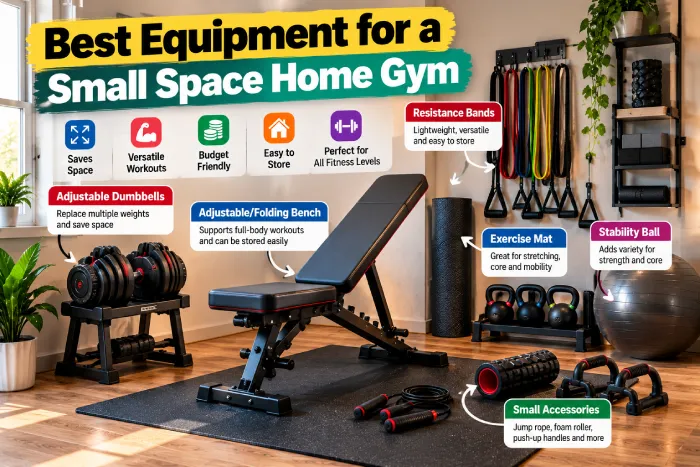
A health club would not get away with equipment only being used for one purpose. Sometimes space and finance means that equipment is limited so why not allow for multi-use..
Adjustable Dumbbells
The adjustable dumbbells fold away to some extent (but not entirely) to conveniently be stored, and have the capacity of replacing many pairs of dumbbells.
You can use them for:
- Goblet squats
- Shoulder presses
- Rows
- Lunges
- Romanian deadlifts
- Chest presses
- Biceps and triceps exercises
They are particularly useful for people who want progressive resistance without installing a large weight rack.
Resistance Bands
Resistance bands are low-cost, they can be carried around easily, they are easy to store, and are very versatile. The bands are suitable for strength building exercises, warm ups, mobility work and for use as an assistance exercises. When the exercise is complete the bands can be suspended from a wall hook or stored in a draw.
Adjustable or Folding Bench
A bench will broaden your exercise range, but a standard bench takes up the majority of a small room. Think about a fold able or adjustable bench that you can put against a wall when not in use.
Exercise Mat
Mat provides a specific space for stretching, mobile movements, core movement, yoga and body weight exercises. It can also be rolled away after training.
Use Vertical Storage to Save Floor Space
One of the easiest mistakes when creating a small gym is treating the floor as your only storage area. Look upward. Wall-mounted storage is ideal for storing bands, jump ropes, mats and other lightweight accessories. Racks that are designed to hold weights can prevent weights from being scattered around the room. Store frequently used equipment within easy reach.
A simple rule is:
Train on the floor. Store on the walls whenever practical.
This will leave the middle of the workout space free and give a feeling of more space.
How Should You Arrange a Small Home Gym?
Don‘t congest the room with the devices. Keep it simple by partitioning the room into basic areas.
| Zone | Purpose |
| Workout zone | Squats, lunges and standing exercises |
| Floor zone | Core, stretching and mobility |
| Equipment zone | Dumbbells, bench and resistance equipment |
| Storage zone | Bands, mats and accessories |
These zones can overlap. If a folding bench moves out of the way while you are doing other strength training exercises, then it may be easier to work around. Wheels, hinged frames or compact storage positions enable this.
Small Space Home Gym Example
Suppose you have one spare corner in a bedroom. Instead of building a bunch of machines, you could put together a very simple arrangement of:
1 adjustable dumbbell set + resistance bands + folding bench + exercise mat.
That combination can support a surprisingly complete full body workout. You may do so with a few pieces of equipment; try goblet squats, dumbbell Romanian deadlifts, bench presses, one-arm rows, reverse lunges, shoulder presses, and core strengthening movements may be utilized without devoting an entire room to a home gym. The aim is to not have the most equipment. It is to get more exercise options from fewer pieces.
Common Small Home Gym Mistakes
Buying Large Equipment First
A treadmill or multi-gym can consume most of your available room. Start with compact equipment and add larger pieces only when they solve a genuine training need.
Ignoring Exercise Clearance
An item‘s dimension may just fit but when you try to use it you find there‘s not enough space. Put the dimension of the equipment footprint beside the dimensions that will be needed surrounding it.
Buying Too Many Accessories
Small fitness equipment can pile up before you know it. Purchase only what you need to use during your workout, not necessarily for how it looks.
Forgetting Noise
This is especially important in apartments. Jumping and moving weights may disturb people living below or beside you. Choose your flooring and exercises accordingly.
Removing All Open Space
Open floor space is valuable. Allows space for warm-ups, mobility work, body holding lunges and exercises, and stretching.
Small Home Gym: Myth vs Fact
Myth : A big room is necessary in order to construct an effective home gym.
Fact: you can do a lot of strength and fitness exercises with almost no equipment.
Myth: If you have more equipment, your workouts will be better!
Fact– A good workout is more important than a room full of machines, so stick to manageable workload and choose exercises wisely.
Myth: Home gyms cannot be used once you are in good shape.
Fact: You don‘t have to have a separate room in order to do progressive work outs. When properly resourced and equipped, even a closet or small living room becomes a viable workout environment.
Final Thoughts
Constructing a more compact space house gymnasium is all about prioritization. Take measurements of your house high, shield your valuable house for shifting, select versatile gear and make use of s Mary Peg moment storage as appropriate. begin with the gear you need for the workouts you are presently doing rather than aiming to guess what you might need.
This basic equipment of adjustable dumbbells, resistance bands, a mat, and small bench, can offer enough variety for strength and mobility work and full-body training. The key to small home gyms is convenience. The best small home gym is not necessarily the one with the most equipment; it is the one that allows you to start the next workout easily.