

Mohd Arbaaz is an Editor and Writer at Fitnessison.com with 5 years of experience in SEO and digital content creation. He creates informative, reader-focused content covering fitness, workouts, nutrition, health, healthy lifestyle, technology, and computers.

Shashi Teja is a Reviewer at Fitnessison with over 6 years of experience in SEO, content strategy, digital publishing, and content optimization. He reviews content for clarity, research quality, topical relevance, readability, structure, and overall usefulness to readers.
Last Updated: September 28, 2026
Constructing a home gym on a budget doesn‘t involve purchasing substandard equipment or ineffective workout routines. You can establish an effective training environment without investing in costly machines, a full set of weights, or professional-quality gym flooring initially. The key is straightforward: purchase equipment based on the exercises you genuinely undertake.
Dumbbells, resistance bands, a mat, and some space to move are all that are needed to begin strength and full-body regimes at home for countless individuals. As your fitness levels increase, you can make incremental upgrades without a large upfront financial investment. Find out how to assemble a budget-friendly home gym without falling into the trap of wasting money.
What Is the Cost of a Budget Home Gym?
You can’t have a gym at home for $200 or less. Find out how much it will be based on how you work out, your current available space, and if you purchase new equipment or second-hand.
A simple planning framework might look like this:
| Budget | Possible Setup |
| Under $100 | Resistance bands, mat, jump rope |
| $100–$300 | Bands, dumbbells, mat, basic accessories |
| $300–$600 | Adjustable dumbbells, bench, bands, mat |
| $600–$1,000 | More resistance, better bench, storage and flooring |
| $1,000+ | Rack, barbell, plates or cardio equipment |
These are planning ranges rather than fixed prices because equipment prices vary considerably. The important point is that you do not need to complete your entire gym immediately. Start with what supports your current workouts. For a broader look at planning the entire room, visit our Home Gym Setup guide.
Start With Your Fitness Goals
The quickest route to overspending is acquiring equipment prior to having a clear idea of the training method. Anegalities bodybuildingorientated individual may require nothing more than adjustable dumbbells, bands and a mat.
A person interested in heavier strength training may eventually want:
- Barbell
- Weight plates
- Bench
- Squat rack
- Appropriate flooring
Someone primarily interested in cardio may put his money into a stationary bike or treadmill. Whatever your focus, that‘s where your money should be.
Ask yourself:
What types of activities would I still be able to do on a weekly basis?
Buy for those exercises first.
Best Equipment for a Home Gym on a Budget
Resistance Bands
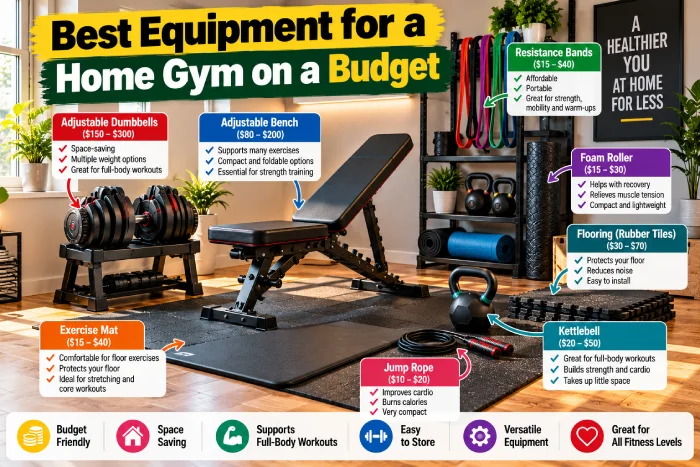
Bands Resistance bands are one of the easiest to add variety to a program without the price of buying other equipment. They can be incorporated into rows, presses, squats, mobility work, warm-ups and accessories. They also require almost no storage space.
Adjustable Dumbbells
A typical set of fixed dumbbells can be costly and take up a lot of floor space. Adjustable dumbbells enable a range of weights to be used in a relatively small space. They can be used for numerous exercises such as squats, lunges, rows, presses, deadlift variations among many others.
Exercise Mat
A simple mat is another option and provides comfort for stretching, core work, mobility, bodyweight exercises etc. if you‘re setting up a small space home gym as your only equipment.
Adjustable Bench
A bench is not always necessary when starting out. This can add variety to your training in the early stages, when money is tight. Once you‘ve got the money to splash, however, it‘s worth investing in a solid piece of equipment, programmed with the exercises you want to do.
Buy Versatile Equipment First
Where there is a limited fund, any items purchased should ideally serve more than one purpose. For example, think of spending five hundred dollars on a large piece of equipment with a limited range of actions, then contrast that with five hundred dollars spent on a set of adjustable dumbbells, a set of resistance bands, a bench, a mat and some storage. The second setup may offer far more workout combinations.
Before buying anything, ask:
- How many exercises can I do with it?
- These people are higher users of drugs and How long do I think I will use it for?
- Is there no other product out there to do the same thing?
- Can it support my fitness level as I progress?
- Where will I store it?
If you are unable to answer these questions, hold off on buying.
Consider Used Gym Equipment
Second hand equipment can be a real bargain, especially when you need simple items like weights plates and dumbbells. Do check the condition of the equipment thoroughly. Be wary if there is excessive rust, cracks, loose parts, torn upholstery or other signs of damage or neglect. Be very careful of anything with a cable, electronic, a motor or many moving parts. Anything that is a ” cheap buy ” could be very expensive if it needs replacing instantly.
Don’t Spend Your Entire Budget on Equipment
One common mistake is allocating every dollar to weights and machines.
Your home gym may also require:
- Flooring
- Storage
- Fans
- Lighting
- Cleaning supplies
- Equipment delivery
- Assembly
Not every gym needs all of these, but leaving part of your budget unspent gives you flexibility. For example, buying a rack and weights but having no suitable flooring may create another unexpected expense.
Build Your Home Gym in Phases
You do not need to know everything you will want six months from now.
Phase 1: Start
Buy the minimum equipment required for your current workout.
Phase 2: Train
Use your setup consistently for several weeks. Notice which exercises are difficult to perform because something is missing.
Phase 3: Upgrade
Purchase equipment that solves a real limitation. This approach is much better than buying equipment based on what looks useful online. Your training experience becomes your shopping list.
Common Budget Home Gym Mistakes
Choosing the Cheapest Option Every Time
The financial affordability and the low-cost are different in terms of costs and quality. The cheap and affordable equipment which is unstable or breaks down easily, can use more costs.
Buying Too Much Too Soon
You might find that your training style shifts after a couple of months. Begin with what you feel most comfortable with.
Ignoring Storage
Cluttered equipment. A cluttered room can make it hard to work out. Basic shelving, racks, or wall storage are helpful for keeping it tidy.
Buying Specialized Equipment First
A single-movement machine can be effective, but it generally best helps to rely upon flexible equipment to satisfy your fundamental training requirements.
Example $500 Home Gym
A hypothetical $500 budget could prioritize:
- Dumbbells with dial-a-weight: $150 ($30 each) These are a set of 5 platforms with 10 pairs of circular weights that can be placed onto each platform and secured with a screw. There can easily be changed from as low as 1kg to as high as 45kg in 2.5kg increments.
- Standard adjustable bench: $125
- Resistance bands: $40
- Also, a not so cliche gift of the exercise or yoga mat for $30.
- Storage/accessories: $60
Total: $500
The case study illustrates how a modest budget can go to providing several training needs instead of a single large machine, even though prices do fluctuate. With this equipment you could train some squats, lunges, presses, rows, Romanian deadlift, shoulder work, arm work and core work.
Final Thoughts
Building a home gym on a budget is not simply about picking the cheapest equipment. It is about spending your hard earned cash where it can do you the most training. Begin with your goals. Select flexible equipment. Keep some of your budget aside for flooring and storage. Go for good second-hand equipment if you can and add to your room in the long-term. And most certainly get started on your training before you become an expert on building the perfect gym. A basic facility used correctly will be far more beneficial than a costly room that you never use.