

Mohd Arbaaz is an Editor and Writer at Fitnessison.com with 5 years of experience in SEO and digital content creation. He creates informative, reader-focused content covering fitness, workouts, nutrition, health, healthy lifestyle, technology, and computers.

Shashi Teja is a Reviewer at Fitnessison with over 6 years of experience in SEO, content strategy, digital publishing, and content optimization. He reviews content for clarity, research quality, topical relevance, readability, structure, and overall usefulness to readers.
Last Updated: September 28, 2026
A good home gym is more than having lots of expensive gym equipment in a spare room.. It is about having a place that helps you to exercise more regularly, easier and safer.
For one person it could be a pair of adjustable dumbbells and a mat by the bed. For the next it could be a converted two-car garage a California strength training center including a rack, barbell and plates and cardio gear.
Both can work.
The important question is not, “What equipment should I buy?”
Start with:
“What do I want to accomplish here?”
Your goals determine the equipment your room determines the size. Your budget determines how quickly you build it. This guide helps you understand those choices, and links you to more in-depth guides when you‘ve reached the level at which you‘d like to get into more detail.
What Is a Home Gym Setup?
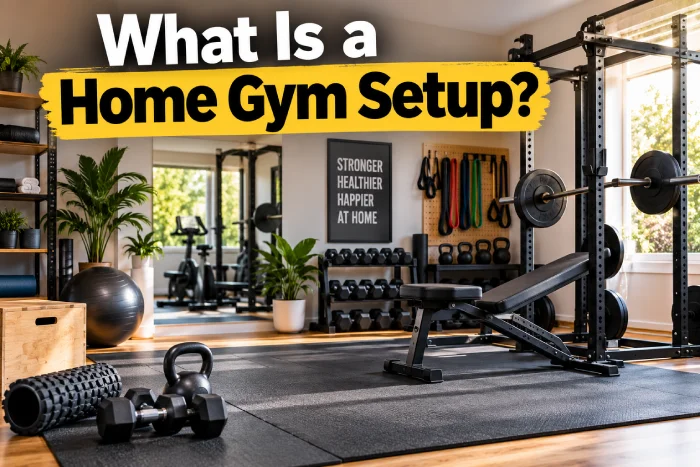
A home gym setup is a dedicated or shared exercise space designed around your training goals, available room, budget and preferred workouts.
It may include strength equipment, cardio machines, mobility tools, flooring, storage and open exercise space. A home gym does not have to reproduce a commercial gym. In fact, trying to do that is often where people go wrong. A more limited selection of gear to offer assistance to squat, hinge, press, pull, carry, core, and cardiovascular training still produces a wide range of options.
Current physical activity guidelines in the U.S. call for adults to accumulate between 150 and 300 minutes of moderate aerobic activity per week with muscle-strengthening activity three or more days per week. Depending on your home setup you can therefore plan your program around resistance training and movement and not the amount of machines you have.
Key Takeaway
The gym should be designed around the use of the workouts you will be doing, not based on the appearance of equipment.
How do you plan a home gym according to your goals?
Determine what your gyms need to do for you before you measure racks or compare dumbbells. An individual who is undertaking strength training is markedly different from one that is training for the 30-minute general fitness workout.
Match Equipment to Your Main Goal
| Goal | Equipment to Consider First | Lower Priority |
| General fitness | Dumbbells, bands, mat, bench | Large machines |
| Strength | Rack, barbell, plates, bench | Multiple cardio machines |
| Weight loss/fitness | Dumbbells, bands, cardio option, open space | Specialized lifting gear |
| Full-body workouts | Adjustable dumbbells, bench, bands | Single-muscle machines |
| Cardio | Bike, treadmill or rower + strength basics | Large rack system |
| Mobility/yoga | Mat, bands, blocks, open space | Heavy equipment |
The table is a starting point, and not a compulsory shopping list. You are no longer required to purchase a barbell once you have a dumbbell workouts you like. Similarly, it makes little sense to buy a treadmill with the investment in a desire to walk or run outside and use the shed or garage for resistance training.
Think in Movements, Not Machines
A useful way to evaluate equipment is to ask what movements it enables.
Ideally, your setup should help you train several major patterns:
- Squat
- Hinge
- Push
- Pull
- Lunge
- Carry
- Brace or rotate
- Cardiovascular movement
You can get away with a single set of patterns. In fact, an adjustable dumbbell can facilitate every exercise like goblet squats, Romanian deadlifts, presses, rows, lunges and loaded carries, etc. Hence multi-purpose equipment should often be the first choice in a small gym.
Plan Around Your Real Routine
Imagine the workouts you expect to perform three months from now.
- Where will you warm up?
- Can you extend your arms without touching anything?
- Where will you perform floor exercises?
- Can you move your bench easily?
- Will getting equipment out take longer than the workout itself?
These questions sound basic, but they separate a gym that gets used from one that slowly becomes storage.
Mini Summary
Your training goal should determine your equipment priorities. Begin with the movements and workout patterns, then select equipment that can accommodate them. Read our advice on how to develop a home gym based upon your goals for a more in-depth goal-to-equipment approach.
How Much Space Do You Need for a Home Gym?
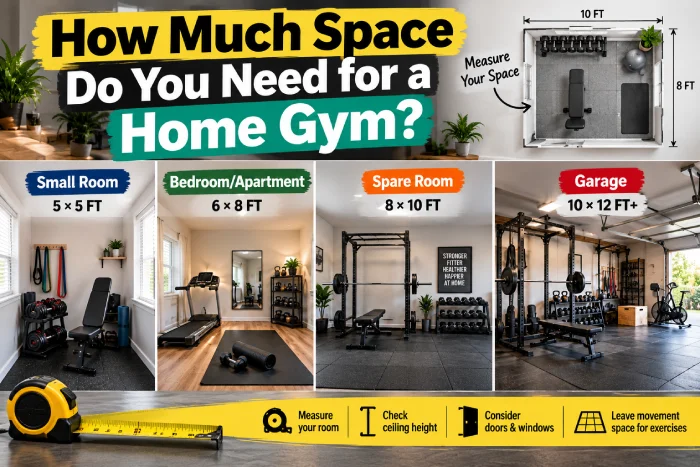
No minimum length provides universally. A reasonably sized workout area will suffice for an exercise corner using resistance bands, weights and bodyweight exercises, but a barbell gym needs much more room. Existing set up guides tend to differentiate between compact dumbbell areas and larger rack-based ones; Barbell & Bench, for instance, suggests that a compact dumbbell-and-bench set up will operate in approximately a 5 × 5 footspace whereas a barbell and rack space require significantly more area. Treat these numbers as planning estimates only, as dimensions of equipment vary.
Start With Measurements
Measure:
- Room length
- Room width
- Ceiling height
- Doorways
- Windows
- Outlets
- Built-in storage
- Garage-door tracks
- Permanent furniture
Then measure the actual equipment you are considering. Do not rely only on product footprint. You also need enough room to get on and off equipment, load weights and perform exercises.
Small Room Setup
A spare bedroom or small room works especially well with:
- Adjustable dumbbells
- Folding bench
- Resistance bands
- Exercise mat
- Kettlebell
- Compact cardio equipment
Use the walls for storage and preserve as much open floor as possible. A room that feels slightly empty is often more useful than one filled edge-to-edge with equipment.
Garage Setup
Garages offer several advantages. They commonly provide concrete floors, fewer concerns about disturbing rooms below and more space for racks and free weights. This Old House specifically notes garages and basements as practical locations for heavier gym equipment, although the exact suitability still depends on the property. Garages introduce other problems, however:
Heat. Cold. Humidity. Dust. Shared storage. Cars.
Include these factors before buying equipment.
Shared-Space Setup
Your home gym does not need a permanent room. A living room or bedroom can get a new dimension if equipment folds or stores vertically. Here adjustable dumbbells, resistance bands, suspension trainers and folding benches really shine.
Key Takeaway
What is more important though is “Usable space, which is affected…by styles, architecture, and the engineering of the rooms; we require space for living and nothing else”.
Sometimes, well-thought out, 70 foot-square training area is more effective than an unorganized 200 foot-square room.
Mini Summary
Measure the room first and equipment second. Protect open movement space instead of trying to fill every available foot.
Next: Explore our full guides to small home gym ideas and garage gym setup for tailored room-specific designs.
How Much Should You Budget for a Home Gym?
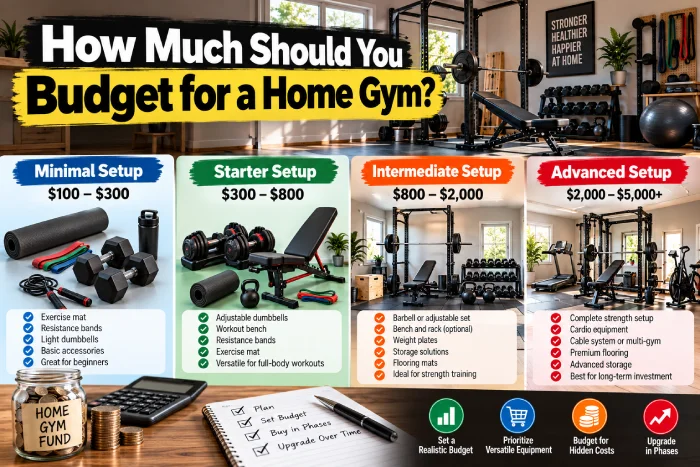
A home gym can range from very inexpensive to very expensive. There is no price at which it is suddenly “finished.” The more relevant question is:
For how much low do you have to spend in order to support your original training?
Example Budget Framework
| Setup | Typical Approach |
| Minimal | Mat + bands + basic dumbbells |
| Starter | Adjustable weights + bench + bands |
| Intermediate | Heavier resistance + bench + storage + flooring |
| Strength focused | Rack + bar + plates + bench + flooring |
| Advanced | Strength setup + cable/cardio equipment + upgraded storage |
Prices change constantly, so use budget tiers as planning categories rather than fixed promises.
Current 2026 guides show just how wide the range can be. Home Gym Foundry describes entry setups beginning in the low hundreds of dollars, while more complete strength configurations can reach several thousand dollars.
Spend More on What You Use Most
Think about you having $1,000. Purchasing six cheap items that you rarely use might be inferior to purchasing two heavy duty items that you use four times weekly.
Prioritize:
frequency of use → versatility → safety → durability → convenience
Appearance comes later.
Remember the Hidden Costs
People often budget for weights but forget:
- Flooring
- Storage
- Shipping
- Equipment assembly
- Wall mounting
- Lighting
- Fans
- Heating
- Mirrors
- Cleaning supplies
You may not need all of these. The point is to reserve some money instead of spending 100% of your budget on equipment.
Build in Phases
One of the safest ways to control spending is to create the gym gradually.
- Phase 1: Buy enough equipment to start.
- Phase 2: Train consistently and notice limitations.
- Phase 3: Add equipment that solves those limitations.
If you repeatedly wish you had heavier resistance, upgrade the weights. If you never use the cardio machine, buying a second one probably will not fix the problem.
Mini Summary
There is no perfect home-gym budget. Spend first on versatile equipment you expect to use frequently, and leave room for flooring, storage and later upgrades.
Next: Visit our home gym budget guide for detailed starter, mid-range and advanced setup examples.
How Do Flooring and Equipment Layout Affect Your Setup?
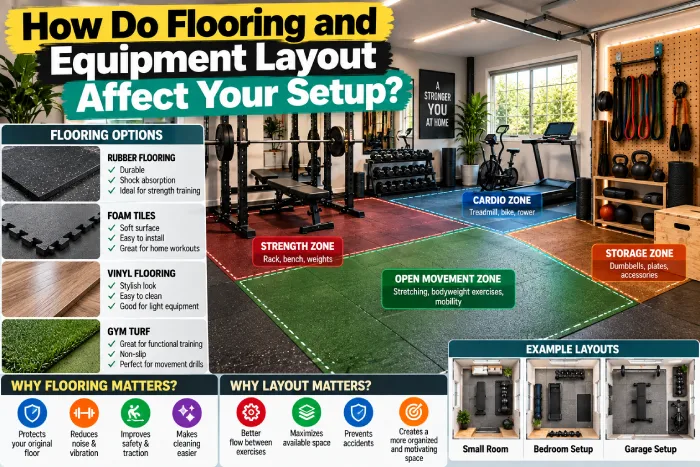
Flooring and layout are easy to overlook because neither feels as exciting as buying equipment. But both affect how the gym works every day.
Why Flooring Matters
Gym flooring can help:
- Protect the original floor
- Improve equipment stability
- Reduce some impact and vibration
- Make cleaning easier
- Define your training area
The appropriate material depends on your home and training style. A yoga and dumbbell room does not necessarily need the same floor system as a garage used for heavy barbell training.
Rubber Flooring
Rubber is popular for strength areas because it is durable and relatively easy to clean. Options include rolls, tiles and thick mats. Before installing anything permanently, consider the underlying floor, moisture and whether you rent or own the property.
Foam Flooring
Foam tiles can be useful for stretching, mobility and lower-impact exercise. However, soft flooring may compress or move under heavy equipment. Match the surface to the activity rather than choosing based only on appearance.
Design Training Zones
Instead of randomly positioning equipment, divide the room into zones.
For example:
- Strength zone: rack, bench and weights.
- Open zone: warm-ups, lunges, mobility and floor work.
- Cardio zone: bike, treadmill or rower.
- Storage zone: bands, plates, dumbbells and accessories.
Zones make a small room feel organized because every object has a purpose.
Keep Movement Paths Clear
Do not make yourself step over dumbbells to reach the bench. Try not to leave equipment where one can be caught on doors, bars or other moving parts. A well planned layout will have one comfortably moving from one exercise to another without having to change the room around all the time.
Draw the Gym Before Building It
Use graph paper or a simple room-planning app. Draw the room to scale. Add doors, windows and fixed objects. Then place rectangles representing equipment. Finally, add the space needed to use that equipment. As a ten-minute exercise, this is certainly a good investment for a buy that is technically all right for the room but, in reality, cannot be used comfortably.
Key Takeaway
Equipment footprint tells you whether something fits. Exercise clearance tells you whether it works.
Mini Summary
Install or plan your flooring before bringing in the heaviest equipment, and organize the room around training zones and clear movement paths.
Next: Browse our home gym flooring and home gym layout detailed guides.
What Equipment Does a Home Gym Actually Need?
No single list. Four categories for most beginners functions.
1. Resistance
Dumbbells and resistance bands are good versatile beginning tools due to the convenience of the storage. Barbells and plates and racks are justifiable should a higher level of strength training be desired.
2. Support Equipment
A quality bench expands your exercise options considerably. It can support pressing, rowing, split squats, step-ups and seated exercises.
3. Floor and Mobility Equipment
A mat is useful for mobility exercises, core work and warm-ups. Bands can also serve mobility and resistance-training roles.
4. Cardio
Cardio does not automatically require a machine. Walking, running, jump rope and outdoor cycling are options. If you are interested in indoor cardio, select the machine that you will use you sincerely like.
Equipment Should Earn Its Space
Before buying something, ask:
- How many exercises will I perform with this?
- How frequently will I use it?
- Do I already own something that performs the same job?
- Where will I store it?
- Can I upgrade it instead of replacing it?
That simple filter helps prevent equipment duplication. Small-space home-gym guides repeatedly emphasize multipurpose equipment for exactly this reason.
Mini Summary
You need enough equipment to train effectively, not enough equipment to recreate a fitness center. See our home gym equipment guide for detailed equipment categories and selection criteria.
How Do You Organize Storage and Maintain the Space?
Storage should be part of the original design. Do not wait until bands, collars and dumbbells are scattered around the floor.
Use Vertical Space
Walls can hold:
- Resistance bands
- Jump ropes
- Cable attachments
- Mats
- Light bars
- Small accessories
Wall storage is particularly useful in small rooms because it preserves training space.
Keep Heavy Items Low
Heavy plates and dumbbells should have stable storage that is appropriate for their weight. Avoid placing heavy equipment on lightweight shelves simply because the shelf fits.
Give Everything a Home
When every item has a storage location, cleaning up after training takes minutes. That makes the gym more inviting the next time you enter.
Simple Maintenance Routine
Clean high risk sweat prone areas, such as surfaces after training. Periodic inspection of equipment on a regular basis following I. E manufacturer specifications should be carried out especially on bolts, pulleys and cables, upholstery and moving parts. Floor should be maintained free of accumulated debris and regularly used gyms should be checked for deterioration on a regular basis. Additional care may be needed for garage gyms, as temperature, moisture and dust can have a longer term detrimental effect.
Mini Summary
Smart storage protects your training area from becoming cluttered and makes starting a workout easier.
Next: Read our complete guide to home gym storage ideas for wall, floor and compact storage solutions.
Home Gym Setup for Full-Body Workouts
If your main goal is a full body workout, you may need less equipment than you think.
A simple setup could include:
- Adjustable dumbbells
- Adjustable bench
- Resistance bands
- Exercise mat
- Pulling option where appropriate
Once you have those resources, a workout can consist of all different squat types, Romanian deadlifts, pressing, rowing, lunging, raising, and core work. This allows you to first design the workout, then choose the equipment needed rather than discover the equipment has not been chosen. For strength and health, guidelines from the U.S. state: ‘muscle-strengthening activities using all major muscle groups should be done on at least two days per week,’ and beginners shouldn‘t start with high-intensity training. Federal guidance specifically recommends gradual progression as activity increases.
Next: Follow our full body workout guide for exercise selection, programming and progression.
Common Home Gym Setup Mistakes
Buying Equipment Before Measuring
A machine fitting through the door does not mean it fits the workout area. Measure the room, ceiling and usable clearance first.
Buying for Your “Future Self”
It is easy to imagine using every machine five days per week. Buy primarily for the person you are today. You can upgrade when your training demands it.
Ignoring Storage
Small accessories create clutter surprisingly quickly. Plan storage from day one.
Covering Every Inch of Floor
Open space is equipment too. You need room to warm up, stretch, perform carries and move around safely.
Ignoring Noise
Jumping, running and dropping weights can transmit sound through a house. Consider who lives beside or below the training area before choosing exercises and equipment.
Forgetting the Environment
A garage that is intolerable in July or in January is not a comfy gym. Take into account: ventilation, temperature, lighting and moisture.
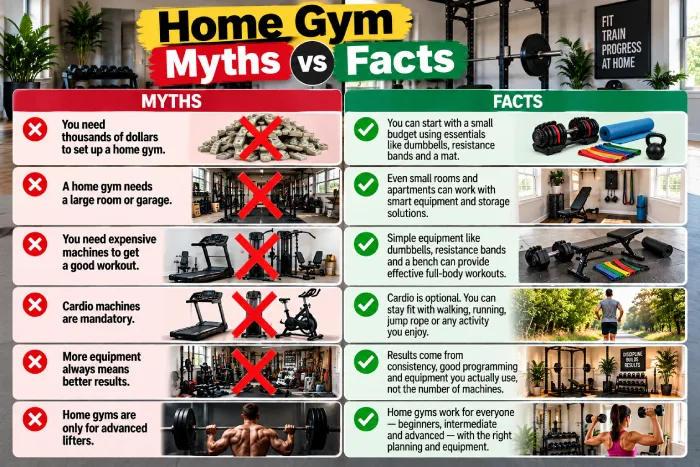
Home Gym Myths vs Facts
| Myth | Fact |
| You need thousands of dollars | Basic resistance equipment can create effective workouts |
| More equipment creates better workouts | Programming and consistent use matter more |
| A garage is required | Bedrooms and small spaces can work |
| You need cardio machines | Many forms of cardio require little or no equipment |
| Build everything immediately | Gradual upgrades often reduce wasted purchases |
| Small gyms cannot train the whole body | Multipurpose equipment can cover major movement patterns |
Troubleshooting Your Home Gym
“My Room Is Too Small”
Reduce equipment overlap. Consider adjustable weights, folding equipment and vertical storage.
“My Gym Feels Cluttered”
Remove anything you rarely use and create dedicated storage zones. Leave the center of the room as open as possible.
“I Bought Equipment but Don’t Use It”
The problem may not be equipment. Make workouts easier to start. Keep commonly used equipment accessible and create a realistic routine.
“My Garage Is Too Hot or Cold”
Address the environment before buying more equipment. Ventilation, fans, insulation and other climate solutions may make the existing gym considerably more usable.
“My Equipment Keeps Taking Over the Room”
Choose equipment that folds, stacks, adjusts or mounts vertically where appropriate. The goal is not maximum equipment density. It is maximum training usefulness.
Step-by-Step Home Gym Setup Checklist
Step 1: Define your main fitness goal.
Determine if increasing your strength, overall condition, managing your weight, your cardio, your mobility, or a different goal, is what matters most to you.
Step 2: Choose your training style.
Reflect on your preferred workout…
Step 3: Measure your space.
Note the size of the room, the height to the ceiling, the locations of the doors and windows, and any permanent objects.
Step 4: Set your budget.
Include equipment, flooring and storage rather than spending everything on machines.
Step 5: Protect the floor.
Choose flooring appropriate for the room and type of training.
Step 6: Design the layout.
Create strength, open movement, cardio and storage zones as needed.
Step 7: Buy essential equipment.
Start with versatile equipment that supports your main workouts.
Step 8: Add storage.
Give weights, bands and accessories permanent locations.
Step 9: Train before upgrading.
Use your initial gym for several weeks. It will inform you what is really lacking in your training.
What Will Home Gyms Look Like in the Future?
Home fitness equipment is now mainly tailored to small space in home. It‘s very clear. Adjustable weights, folding rack, wall-mount systems, small cable and so on connected fitness products enable us gain greater training even in a single room of house.
However, it does not alter the key principle. A successful gym still needs to make training convenient. For many people, the best future home gym will not be the one with the most technology. It will be the one with the least friction between deciding to exercise and actually starting.
Final Home Gym Setup Checklist
Before calling your gym finished, ask yourself:
- Does the setup match my primary training goal?
- Can I perform a balanced range of movements?
- Is there enough open exercise space?
- Can equipment be used without collisions?
- Is the flooring appropriate?
- Is frequently used equipment easy to reach?
- Does everything have a storage location?
- Is the room comfortable enough to use year-round?
- Can the gym grow without replacing everything?
- Do I actually enjoy training here?
The only way to know if you are better equipped to hit the home gym than most people.
Conclusion
A great home gym setup is not about having a big room, having lots of machines or having a set-up you look at and think ‘wow’. It is about what‘s right for you and your goals. Considering your training style, determine your available space for training, set a practical budget, safeguard the flooring, conserve your training space and purchase multi-function equipment before one-trick ponies.
Then move on to training. The third step in my training for building a well-sculpted body is to use the gym in a disciplined manner. After a period of time, with consistent use of the gym, the next upgrade typically becomes clear. This method would make your home gym more affordable and flexible for adjusting to your fitness pursuits.