


Mohd Arbaaz is an Editor and Writer at Fitnessison.com with 5 years of experience in SEO and digital content creation. He creates informative, reader-focused content covering fitness, workouts, nutrition, health, healthy lifestyle, technology, and computers.

Shashi Teja is a Reviewer at Fitnessison with over 6 years of experience in SEO, content strategy, digital publishing, and content optimization. He reviews content for clarity, research quality, topical relevance, readability, structure, and overall usefulness to readers.
Last Updated: September 8, 2026
Beginning a fitness journey can be daunting, especially if you haven‘t ever been active regularly, but one of the best, safest ways to build your strength, increase your stamina, and create great exercise habits, is to do a complete body workout for beginners.
Full-body workouts challenge every major muscle group (your legs, chest, back, shoulders, arms and abdominals) in a single session. Working out all your major muscle groups in one sitting can be a good way for a beginner to work on his general fitness and avoid muscle imbalance.
No matter what you‘re wanting to achieve, whether it‘s weight loss, toning your muscles, or just being healthier, this self-help advice will show you how to create an effective workout plan that is suitable for beginners.
What Is a Full Body Workout?
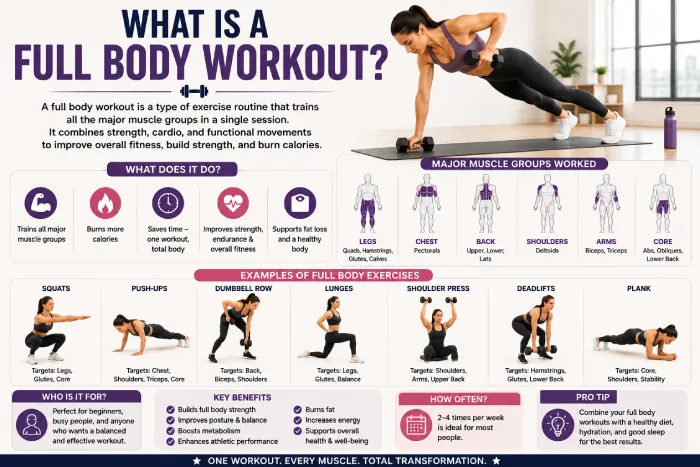
Workout that works all the muscles of your body is called a full body workout.
In contrast to split training, you are only training a couple of muscles groups each day in full body training.
A beginner workout typically includes:
- Lower-body exercises
- Upper-body exercises
- Core exercises
- Functional movements
- Light cardio
It also enhances overall fitness and has the benefit of saving time.
Benefits of Full Body Workouts for Beginners
Easy to Learn
The majority of introductory exercises implement basic movement patterns that are relatively easy to learn.
Improves Overall Strength
Full body workouts help develop all round muscle.
Burns More Calories
Using multiple muscle groups burns more calories.
Saves Time
It is usually possible to tone up your whole body in 30–45 minutes.
Builds Better Coordination
Functional movements are movements that translate an activity into a safe movement pattern including, improve balance, posture, and daily function.
Encourages Consistency
Since novices only require 2–3 training sessions a week, it‘s less challenging to remain consistent.
Why Learners Should Start with Full Body Training
A common question many learners ask is: Should I do full-body workout or split routines?
For most people, full-body exercise is the better choice because it:
- Teaches correct exercise form
- Builds strength evenly
- Avoid muscle imbalances
- Provides for better regeneration between sessions.
- Brings quicker progression for beginners
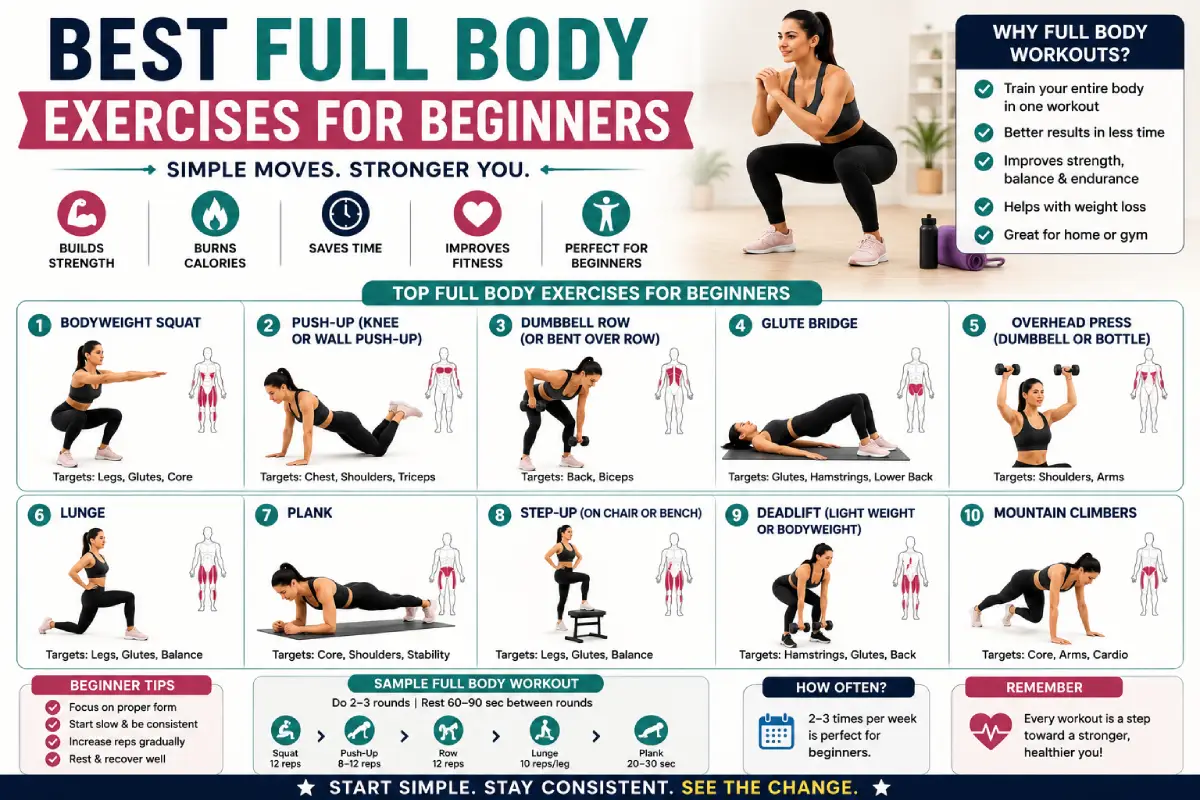
Best Full Body Exercises for Beginners
1. Bodyweight Squats
Very good exercise to introduce to beginners this is one of the better lower-body exercises, because it is simple, safe and effective.
Muscles Worked
- Quadriceps
- Hamstrings
- Glutes
- Core
Benefits
- Builds leg strength
- Improves mobility
- Enhances balance
2. Wall Push-Ups
A simplified, easy-to-perform form of the classic push-up.
Benefits
- Strengthens chest
- Develops stability in the shoulders
- Builds upper-body muscle mass
3. Glute Bridges
A good exercise for the hips and lower back.
Benefits
- Activates glutes
- Supports posture
- €222.39 Improvements in hip stability
4. Bird Dog
A fundamental movement that enhances the stability of the core.
Benefits
- Strengthens core
- Improves balance
- SO Foundation. So roller Sore back, neck pain, aches supports other parts of the…AV supports maintaining the health of the..HS supports the fitness of the..
5. Standing Dumbbell Press
If you have dumbbells that are light, this is a good upper-body workout.
Benefits
- Strengthens shoulders
- Improves posture
- Develops arm muscles
6. Step-Ups
Whole body exercise using stairs as if climbingup.
Benefits
- Strengthens legs
- Improves coordination
- Enhances balance
7. Bent-Over Dumbbell Row
Excellent for strengthening back and back posture.
Benefits
- – Improves upper back Strength
- Enhance the ability to pull26
- Helps maintain healthy shoulders
8. Plank
A great beginner core exercise.
Benefits
- Builds core stability
- Improves posture
- Provides support to lower back
9. Marching in Place
A simple cardio move.
Benefits
- Raises heart rate
- Improves endurance
- Burns calories
10. Superman Exercise
Emerges in the back muscles.
Benefits
- Improves posture
- You could strengthen the lower back
- Improves spinal stability
Beginner Full Body Workout Routine
Do this work out two to three times a week.
| Exercise | Reps |
| Bodyweight Squats | 12 |
| Wall Push-Ups | 10 |
| Glute Bridges | 15 |
| Bird Dog | 10 on each side |
| Step-Ups | Ten each leg |
| Plank | 20 seconds |
| Marching in Place | 30 seconds |
Workout Structure
- Finish 2–3 repetitions.
- Giving yourself one to one and a half minute recovery between rounds.
Full Body Dumbbell Workout for Beginners
If you‘ve got a pair of light dumbbells, try this.
| Exercise | Reps |
| Goblet Squat | 12 |
| Dumbbell Shoulder Press | 10 |
| Dumbbell Row | 12 |
| Romanian Deadlift | 12 |
| Reverse Lunges | 10 per leg. |
| Plank | 30 seconds |
30-Minute Full Body Workout for Beginners
Warm-Up (5 Minutes)
- Arm circles
- Leg swings
- Marching in position
- Bodyweight squats
- Shoulder rolls
Main Workout (20 Minutes)
- Squats
- Wall Push-Ups
- Step-Ups
- Dumbbell Rows
- Glute Bridges
- Plank
Perform 2–3 rounds.
Cool Down (5 Minutes)
- Hamstring stretch
- Quad stretch
- Child’s Pose
- Cat-Cow stretch
- Deep breathing
Weekly Workout Schedule for Beginners
Monday
Full Body Workout
Tuesday
Light Walking
Wednesday
Rest
Thursday
Full Body Workout
Friday
Yoga or Stretching
Saturday
Light Cardio
Sunday
Rest
Tips for Beginners
Focus on Proper Form
Poor technique is more harmful than heavy weights.
Start Slowly
Don’t overdo it while settling in your first couple weeks.
Stay Consistent
Try to do at least two to three training sessions a week.
Progress Gradually
Once exercises become easier, increase repetitions or resistance.
Prioritize Recovery
Sleep, hydration and nutrition are fundamental for the recovery and development of the muscle.
Common Beginner Mistakes
Skipping Warm-Ups
Prepare your body with adequate warm-up.
Doing Too Much Too Soon
Increase the intensity of your exercises very slowly.
Ignoring Rest Days
The fact is, recovery is key to muscle growth.
Using Poor Technique
Incorrect form! Single most important factor in performance. Incorrect form increases injury risk.
Comparing Yourself to Others
Everyone has their own pace of development.
Nutrition Tips for Beginners
Eat Enough Protein
Protein contributes to muscle repair and recovery.
Stay Hydrated
Drink water before, during and after workout sessions.
Eat Whole Foods
Pick fresh fruits, vegetables, protein, healthy fats, and grains.
Don‘t Skip Meals
. Proper nutrition will aid in your workout.
FAQs
How long would a beginner do full body workouts?
For most beginners, it is best to train 2-3 times per week with rest days in between.
Is a full body workout suitable for beginners?
Yes. Full body workout provides the most balanced system of developing musclestrength and fitness.
Is it possible for a novice to develop muscle using full body training?
Sure. Starting strength will allow beginners to gain lean body tissue while increasing general endurance.
Is gym equipment necessary?
No. Many effective workouts for beginners can be accomplished simply with bodyweight but light dumbells will add variety.
Length of a beginner‘s workout
Most beginner workouts are 30-45 mins long, including warm-up and cool-down.
Conclusion
A full body workout for beginners is one of the quickest ways to start building your strength and endurance, and develop a reliable exercise routine. Squats, wall push ups, glute bridges, rows, plank, and step ups hit all the major muscles in a safe and effective manner for a beginner. Consistently following a schedule of these exercises matched with the right diet, rest and movement progression will provide you with long-term health advantages.