


Mohd Arbaaz is an Editor and Writer at Fitnessison.com with 5 years of experience in SEO and digital content creation. He creates informative, reader-focused content covering fitness, workouts, nutrition, health, healthy lifestyle, technology, and computers.

Shashi Teja is a Reviewer at Fitnessison with over 6 years of experience in SEO, content strategy, digital publishing, and content optimization. He reviews content for clarity, research quality, topical relevance, readability, structure, and overall usefulness to readers.
Last Updated: September 9, 2026
If you’ve been trying to figure out how to organize your training — and feeling overwhelmed by terms like “push/pull/legs,” “bro split,” or “upper/lower” — you’re not alone. And quite likely, the answer you‘re searching for isn‘t all that complex.
A full body workout is any session that involves working all the body’s major muscle groups – chest, back, shoulders, arms, core, quads, hamstrings, glutes – in one session. It means no body parts are given their own day, ever, you work the lot. It sounds like more work. It’s actually smarter work.
Full body training is one of the most extensively researched and consistently recommended approaches in exercise science — particularly for people training 2–3 days per week, people prioritizing fat loss and muscle retention simultaneously, and anyone who wants a training system that’s hard to mess up even when life gets busy.
This guide is your hub for everything full body workout related. You’ll understand the framework here, then find complete deep-dive programs for every equipment type and training goal in the cluster guides below.
Full-Body Workout Resource Center
Explore our complete collection of full-body workout guides covering dumbbell and kettlebell training, routines for men and women, beginner-friendly workouts, and equipment-free bodyweight exercises.
Full Body Workout vs. Training Splits: Which Is Actually Better?
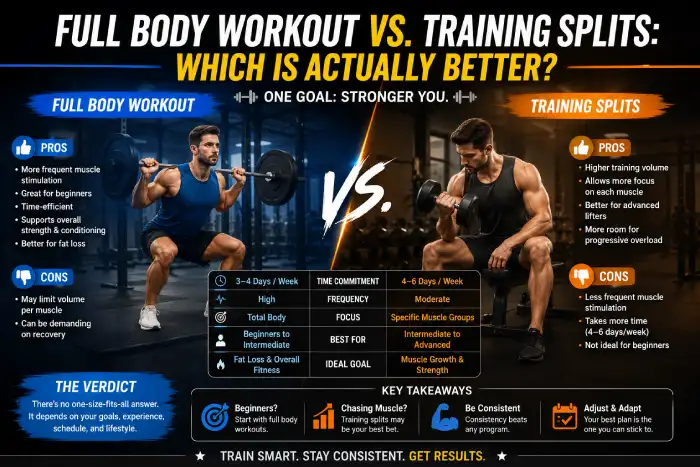
This is the question every gym-goer eventually asks — and most fitness content gives a frustratingly vague answer.
Here’s a clear one: neither is universally better. They’re better for different situations.
The Honest Comparison
| Factor | Full Body Workout | Training Split (PPL, Upper/Lower) |
| Training frequency per muscle group | High (2–3x/week) | Low–Moderate (1–2x/week) |
| Sessions needed per week | 2–3 | 4–6 |
| Best for muscle growth | Excellent for beginners and intermediate | Excellent for advanced (more volume needed) |
| Best for fat loss | Excellent (high calorie burn, full activation) | Good, but requires more sessions to maintain |
| Best for busy schedules | Excellent — maximizes 2–3 day windows | Requires consistent 4+ day commitment |
| Risk of missed sessions | Low — 1 missed session doesn’t skip a body part | High — missing leg day = 1 week without leg training |
| Complexity | Low | Moderate–High |
What the Research Says
It is well established that the signal for muscle growth (also called muscle protein synthesis) are elevated 24–48 hours post training and are back to resting levels 72 hours post training. Thus training a muscle 2–3 times a week maximises muscle growth.
Full body training naturally achieves this frequency with just 3 sessions per week. A traditional body-part split training each muscle once per week misses this window entirely for 5–6 days.
A 2016 meta-analysis in the Journal of Strength and Conditioning Research found that training each muscle group twice per week produced significantly greater muscle hypertrophy than once per week — directly supporting full body training frequency over single-day splits.
The verdict:
- Training 2–3 days/week? Full body is almost certainly your best option
- Training 4+ days/week consistently? Upper/lower or PPL splits can add volume efficiently
- Beginner or returning to training? Full body — no contest
The Benefits of Full Body Workouts
1. Higher Training Frequency Per Muscle Group
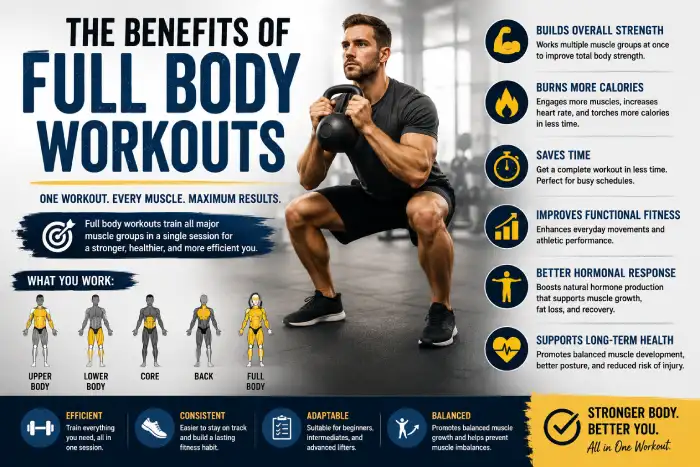
As covered above, each muscle gets trained 2–3 times per week with full body programming. More frequent training = more muscle protein synthesis signals = faster strength and muscle gains.
2. Maximum Efficiency for Limited Time
A well-designed 45–60 minute full body session accomplishes what would require 3–4 separate split sessions. For anyone with a busy life — full body is not a compromise, it’s the optimized solution.
3. Built-In Redundancy
Miss a session with a split program? You’ve lost an entire muscle group for that week. Miss a full body session? Your next session covers everything again. Full body training is resilient to the unpredictability of real life.
4. Superior Fat Loss Environment
Full body workouts hit the greatest amount of muscle groupings in one session than isolation or split workouts. The more muscle working the more calories you burn/session + also the big up regulation of growth hormone, testosterone + EPOC (post workout calorie burn).
5. Balanced Muscle Development
Traditional split training leads to overstressing “mirror muscles” (chest, biceps, quads) at the expense of the posterior chain (back, hamstrings, glutes)-the most common cause of postural unevenness and injury. Full body programming ensures balanced stress because each session includes both push and pull, and both quad-dominant and hip-hinge movements.
6. Ideal for Beginners
The neuromuscular system is trained like a movement pattern, so the more repetitions the faster skill is acquired. Training 3x a week instead of one as an example of training the squat, hinge, push, pull movement pattern will result in much faster skill acquisition. Beginners make faster progress on full body programs for exactly this reason.
Mini Summary: Full body workouts are more time-efficient, better for muscle frequency, more forgiving of missed sessions, and superior for balanced development — making them the optimal choice for 2–3 day training schedules.
How Often Should You Do Full Body Workouts?
Frequency is where most people either underdo or overdo full body training.
The Frequency Framework
| Schedule | Sessions/Week | Best For |
| Minimum effective dose | 2 | Maintenance, extremely busy schedules |
| Optimal for most people | 3 | Muscle building, fat loss, general fitness — the sweet spot |
| High frequency | 4 | Advanced, with alternating intensity (heavy/light) |
| Too much | 5–7 full body | Recovery impossible — leads to overtraining |
Why 3 Days Per Week Is the Sweet Spot
Full recovery of each muscle group takes 48–72 hours to allow the muscle to be trained again optimally. With 3 full body workouts per week on non consecutive days (Monday/Wednesday/Friday or Tuesday/Thursday/Saturday) your within this window:
- Day 1 (Monday): Train everything
- Day 2 (Tuesday): Recovery — muscle protein synthesis elevated
- Day 3 (Wednesday): Train again — muscles recovered, ready to adapt
- Day 4 (Thursday): Recovery
- Day 5 (Friday): Train again — full cycle complete
The fact is that the rule of non-consecutive days is enforceable. Training fullbody on consecutive days will deprive the important day-to-day finishing would be productive.
Can You Train Full Body 4 Days Per Week?
Yes — with a modification. Alternate heavy and light sessions. Old school heavy sessions Low repetitions (4-6 reps at 80-85% 1RepMax) with heavy weights. Light sessions Higher repetitions (12-15 reps at 60-70% 1RM), with lighter weights.
This creates enough variation in stimulus to allow consecutive-day training without compromising recovery.
How to Structure a Full Body Workout Session
What works and what doesn‘t? Having an idea of the exercises is very different from knowing the rep ranges, how to order it, how many sets, the duration of breaks etc.
The Ideal Full Body Session Structure
Warm-Up (Minutes 5–10) Body-warm-up exercises that increase temperature, stimulate nervous system and warm-up particular joints:,
- 5 minutes light cardio (jog in-place, jumping-jacks)
- Leg swings, Hip circles, Arm circles
- Two lights warm up sets for your 1 st exercise (~50–60% of working weight)
Main Work Block- Compound Priority (25 35min) Order: The following movements should be performed with strict proper technique (hardest work first).
| Order | Movement Pattern | Sets × Reps | Rest |
| 1st | Squat or Hip Hinge | 3–4 × 5–8 | 2–3 min |
| 2nd | Horizontal or Vertical Pull | 3–4 × 6–10 | 90 sec–2 min |
| 3rd | Horizontal or Vertical Push | 3–4 × 6–10 | 90 sec–2 min |
Secondary Work Block Accessory (10–15 minutes) Use smaller compound or isolation movements to target lagging areas or increase volume:
| Order | Exercise | Sets × Reps | Rest |
| 4th | Lunge or split squat variation | 2–3 × 10–12 | 60–90 sec |
| 5th | Core work (plank, ab wheel, RDL) | 2–3 × 10–15 | 60 sec |
| 6th | Optional isolation (bicep curl, tricep) | 2 × 12–15 | 45–60 sec |
Cool-Down (5 minutes) Static stretching — hip flexors, hamstrings, chest, lats. Reduces next-session soreness.
Total session time: 45–60 minutes. Anything beyond 75 minutes without a specific reason is likely too long for an effective full body session.
Sample Full Body Workout Plans
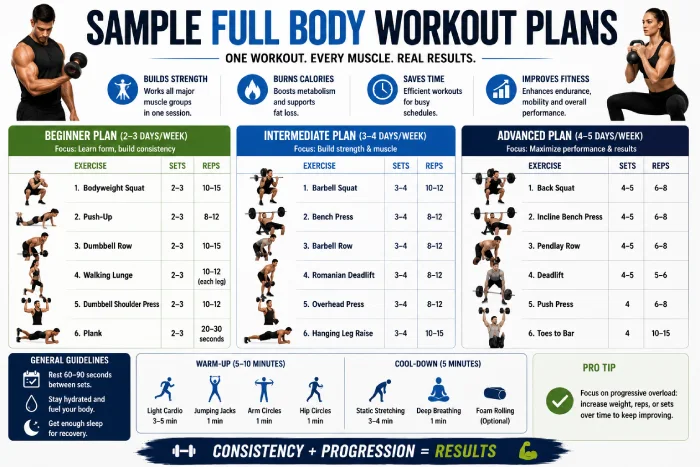
Plan A — Beginner Full Body (3 Days/Week, No Equipment)
Format: 3 sets × 10–12 reps, 60–90 sec rest between sets
| Exercise | Sets × Reps |
| Bodyweight squat | 3 × 15 |
| Push-up (knees if needed) | 3 × 10–12 |
| Hip hinge (good morning or glute bridge) | 3 × 12 |
| Inverted row (under table) or band pull-apart | 3 × 10 |
| Reverse lunge | 3 × 10 each leg |
| Plank | 3 × 30–45 sec |
Progression: Add 1 rep per set every week until you reach the high end of the rep range (then go heavier or find a harder variation).
Plan B — Intermediate Full Body (Dumbbells, 3 Days/Week)
Format: 3–4 sets × 8–10 reps, 90 sec rest
| Exercise | Sets × Reps |
| Goblet squat | 4 × 8 |
| Romanian deadlift | 4 × 10 |
| Dumbbell bench press | 3 × 10 |
| Single-arm dumbbell row | 3 × 10 each |
| Dumbbell overhead press | 3 × 10 |
| Dumbbell Bulgarian split squat | 3 × 8 each |
| Plank to push-up | 3 × 8 |
Plan C — Advanced Full Body (Barbell, 3 Days/Week)
Format: 4 sets × 5–6 reps on compounds, 3 sets × 8–10 on accessories
| Exercise | Sets × Reps |
| Barbell back squat | 4 × 5 |
| Conventional deadlift | 4 × 5 |
| Barbell bench press | 4 × 6 |
| Barbell row | 4 × 6 |
| Standing overhead press | 3 × 8 |
| Pull-up | 3 × max reps |
| Ab wheel rollout | 3 × 10 |
Mini Summary: Full Body session: As strict hierarchy: big compounds (more body) are followed by accessories and finally core. Duration: 45–60 minutes with planned rest periods.
Full Body Workouts With Dumbbells
Dumbbells are the single most versatile piece of home or gym equipment for full body training. This design also enables you to do single limb (unilateral) training of each pair of muscles, helping to correct imbalances of strength. They‘re also great because you don‘t need a spotter for hard pressing movements.
One pair of adjustable dumbbells (or a set that goes from light to heavy) makes all movement patterns possible:
- Squat pattern: Goblet squat, front squat with a dumbbell
- Hip hinge: Romanian deadlift, dumbbell deadlift
- Horizontal push: Dumbbell bench press, push-up hand-dumbbells.
- Horizontal pull: One arm dumbbell row, Renegade row
- Vertical push: Dumbbell overhead press, Arnold press
- Vertical pull: Dumbbell pullover, single-arm row (elbow above the shoulder)
The main dumbbell benefit: In a home gym, especially if you‘re working out alone, dumbbells are a whole lot safer than a barbell when pressing. You can drop them if a set fails — you can’t safely bail a barbell bench press alone.
Mini Summary: Dumbbells cover every movement pattern needed for a complete full body workout and add the unilateral training advantage that barbells alone can’t provide.
Read More: Complete dumbbell exercises, weight selection guidance, progressive programs, and home vs. gym dumbbell training — see our full body dumbbell workout guide.
Full Body Workouts With Kettlebells
Kettlebells provide a new element to the overall benefits of a full body workout which dumbbells and barbells cannot quite mimic: ballistic, explosive exercises that develop strength and power, cardiovascular health, and grip strength all at the same time.
The kettlebell swing-the most fundamental kettlebell exercise-is one of the most calorie-intense single exercises in the entire strength workout system, at about 20 calories per minute worked at high effort. It trains the entire posterior chain explosively in a movement pattern that no barbell exercise fully replicates.
Why Kettlebells Complement Full Body Training
- Swings and cleans create a cardiovascular demand that traditional weight training doesn’t
- Turkish Get-Up trains full-body integration, shoulder stability, and core through one movement
- Single kettlebell circuits create complete full body sessions with one piece of equipment
- Offset loading (single kettlebell) challenges core stability more than bilateral barbell work
The Core Kettlebell Full Body Exercises
| Exercise | Movement Pattern | What It Trains |
| Kettlebell swing | Hip hinge | Posterior chain, cardio, power |
| Goblet squat | Squat | Quads, glutes, core |
| Turkish Get-Up | Full body integration | Everything, stability |
| Clean and press | Hip hinge + vertical push | Full body power |
| Single-arm row | Horizontal pull | Back, biceps, core |
| Kettlebell deadlift | Hip hinge | Posterior chain |
| Overhead press | Vertical push | Shoulders, triceps, core |
Mini Summary: Kettlebells add explosive power and metablic conditioning to a full body workout that no other individual piece of equipment can. One kettlebell is genuinely enough for a complete, challenging full body workout.
Read More: Kettlebell swing technique, beginner to advanced programs, single-kettlebell full body circuits, and calorie burn data — see our complete full body kettlebell workout guide.
Full Body Bodyweight Workouts: Zero Equipment, Full Results
Here’s a misconception worth correcting immediately: bodyweight training is not a substitute for “real” training. It IS real training.
Progressive bodyweight training — systematically making exercises harder as you get stronger — builds genuine muscle, burns significant calories, and develops functional strength that translates to everyday life and athletic performance.
The progression is the key. Most people get stuck with bodyweight training because they never progress to harder versions of the exercise.
The Bodyweight Progression Ladder
| Movement | Beginner | Intermediate | Advanced |
| Push | Knee push-up | Full push-up | Archer push-up / plyo push-up |
| Squat | Bodyweight squat | Bulgarian split squat | Pistol squat |
| Hinge | Glute bridge | Single-leg glute bridge | Nordic hamstring curl |
| Pull | Band-assisted row | Inverted row | Pull-up → Weighted pull-up |
| Core | Plank | Ab wheel rollout | Dragon flag |
The rule: When an exercise can be “easily” performed (more than 15 repetitions) while maintaining impeccable form, proceed to the next level progression. This creates the progressive overload that drives muscle growth — with no equipment.
Mini Summary: Bodyweight full body training is limited only by your knowledge of progressions. Every major movement pattern has a bodyweight version that can be made progressively more challenging over months and years.
Read More: Complete bodyweight progression system, apartment-friendly routines, no-equipment full body circuits, and a 12-week bodyweight program — see our full full body bodyweight workout guide.
Full Body Workout for Beginners: The Right Starting Point
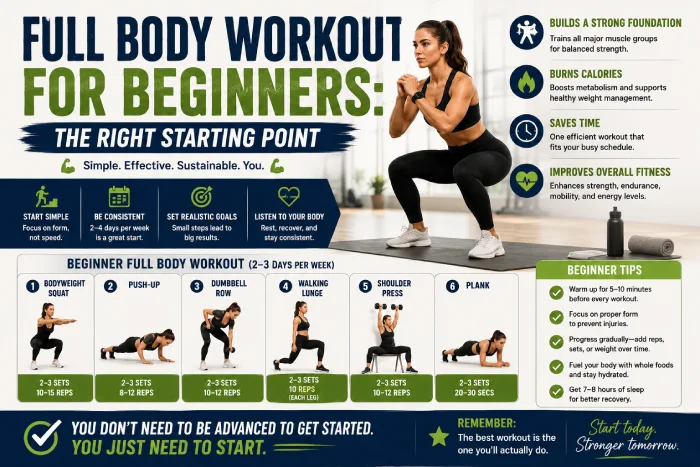
The biggest novice mistake when it comes to full body training isn‘t exercise selection it is the selection of the program itself. Going too heavy too early or selecting complex movements or copying a program meant for advanced bodybuilders will only lead to injury and frustration and quitting within a few weeks.
What Beginners Actually Need
1. Simple movement selection
Line up to six basic movement patterns, using the exercise that are ideal for a beginner (goblet squat, Romanian deadlift, push-up, dumbbell row, dumbbell press, lat pulldown). Nothing fancy. Nothing that requires significant technical skill before you’ve learned to brace your core.
2. Light-to-moderate weight to learn form
The first 4–6 weeks of full body training should be treated as a skill acquisition phase — not a maximum effort phase. Use weights you could do 15+ reps with, but only do 10. This builds movement quality without the injury risk of going heavy before your body is ready.
3. 3 sessions per week on non-consecutive days
Monday/Wednesday/Friday or Tuesday/Thursday/Saturday. Don‘t compromise on recovery and adaptation.
4. Simple progressive overload
Add one for each set each session until the top of the rep range is reached before jumping 5 lbs then start again. For the first 3–6 months this is all a beginner needs.
5. Priority: show up, not crush it
Consistency in the first 8–12 weeks is far more critical than intensity. The beginner who trains 3x/week at moderate levels for 12 straight weeks will beat the beginner who trains intensely for 3 weeks, gets sore, discouraged, then quits.
Mini Summary: What‘s the reason for beginner full body success? Easy exercises, moderate poundage, regular attendance, and a dead nuts progressive overload scheme. Complexity is the enemy of beginner progress.
Read More: 8-week beginner program, form coaching cues, common beginner mistakes, and first-session guidance — see our complete full body workout for beginners guide.
Full Body Workout for Women: What’s Different (and What’s Not)
The principles of full body training are identical for women and men. Progressive overload, compound movement priority, adequate recovery, protein intake — none of this changes.
What does change is the emphasis within those principles based on common goals and physiological differences.
Programming Differences That Matter for Women
Glute and posterior chain emphasis:
Most women have glute development as a primary training goal — and full body programming allows specific posterior chain emphasis without sacrificing overall balance. Here is one way that this could be achieved by placing the emphasis on the hip hinges (RDLs, hip thrusts, glute bridges) and the squat variations that load the glutes (sumo squats, Bulgarian split squats) in a full body workout.
Higher rep tolerance:
Research has demonstrated that women are more comfortable with higher repetitions (10-20 reps) than men, who tend to do better in the 6-10 repetition range. Full body programs for women may include a higher volume at Moderate levels without any decreasing returns.
Hormonal cycle awareness:
Energy, recovery capacity, and strength vary across the menstrual cycle. Many women find the follicular phase (days 1–14, rising estrogen) their strongest training window — ideal for heavier sessions. The luteal phase (days 15–28) often benefits from slightly reduced intensity or higher rep, lower weight sessions.
The bulk myth — still needs addressing:
Women will not build large, “bulky” muscles from full body strength training. The hormonal environment (significantly lower testosterone than men) makes this physiologically very difficult without specific pharmaceutical assistance. What full body training produces in women: a leaner, more defined physique with stronger glutes, firmer arms, and improved posture.
Mini Summary: Full body training for women follows the same principles as men — with emphasis adjustments for posterior chain development, higher rep ranges, and hormonal cycle awareness.
Read More: Women-specific full body programs, glute-emphasis routines, hormonal cycle training guidance, and the “toning” myth debunked — see our complete full body workout for women guide.
Full Body Workout for Men: Muscle, Strength, and Efficiency
Men typically enter full body training with one of two primary goals: building muscle while staying lean, or maximizing strength. Both are achievable — and full body training serves both goals better than most men expect.
Why Men Often Avoid Full Body Training (And Why That’s a Mistake)
The traditional gym culture for men gravitates toward “chest Monday,” arms-heavy splits, and body part isolation. This approach has one significant flaw: most men training this way train chest twice per week and back once, train biceps multiple times but neglect posterior chain, and end up with the classic muscle imbalance pattern — overdeveloped mirror muscles, underdeveloped back and hamstrings.
Full body programming forces balance. Every session includes both push and pull, both knee-dominant and hip-dominant movements. The result is more functional strength, better posture, and lower injury risk alongside excellent physique development.
Optimizing Full Body Training for Men’s Goals
For muscle mass:
3 days/week full body with compound-heavy programming (4 × 6–8 on big lifts) + 8–12 week progressive loading cycles. Caloric surplus of 200–400 calories. Protein at 0.8–1g per pound of bodyweight.
For fat loss with muscle retention:
3 days/week full body compound-first + 2 moderate cardio sessions. Caloric deficit of 300–500 calories. Protein at 1g per pound of bodyweight to preserve lean mass.
For strength:
3 days/week, emphasis on powerlifting movements (squat, bench, deadlift, overhead press) in 3–5 rep ranges. Longer rest periods (3–5 minutes). Accessories for volume support.
Mini Summary: Men get more from full body training than gym culture suggests. Balanced programming, compound priority, and appropriate loading produce muscle, strength, and physique results that body-part splits often fail to deliver consistently.
Read More: Strength-focused full body programs for men, muscle building protocols, fat loss with muscle retention plans — see our complete full body workout for men guide.
Common Full Body Workout Mistakes — And How to Fix Them
The 7 Most Damaging Full Body Training Mistakes
Mistake 1: Training to failure every session
Training to absolute failure on every set of every exercise creates excessive fatigue that impairs recovery. Stop 1–2 reps short of failure on compound movements — this produces nearly identical muscle growth with dramatically less systemic fatigue. Reserve true failure for the last set of isolation exercises.
Mistake 2: No progressive overload
Doing 3 × 10 with the same weight for 6 weeks is not a training program — it’s a maintenance routine. Your body adapts within 2–4 weeks. Keep the weights and repetitions consistent while steadily increasing the stress.
Error 3: Not following the pattern of a hip hinge.
Fear and lack of knowledge cause many to steer clear of deadlifts and RDLs. This leaves the hamstrings, glutes, and lower back undertrained — the muscle groups most responsible for injury prevention, athletic performance, and physique development.
Error 4: Prioritizing isolations over compounds
Loading the first 20 minutes with bicep and tricep work before squats and rows is an inverted priority. Compound movements should be done first when a person has the most energy. Isolation work is secondary.
Mistake 5: Not resting long enough between sets
For compound movements with significant loading (squat, deadlift, bench), 90 seconds of rest is the minimum — 2–3 minutes is optimal for strength and muscle development. Traveling between sets cuts the amount of weight you can lift and the quality of each individual set.
6. Avoid warm-up and cool-down.
Starting a squat session cold is asking for trouble. Five minutes warm-up and 2 lighter warm-up sets before working sets is the least. Post session 5 mins static stretching reduces soreness for next session and preserves flexibility.
Error 7. No nutritional support.
Training without real protein is like trying to build a house with no bricks or mortar. Protein is vital for muscle repair and growth a good aim is 0.7–1 g per lb bodyweight day, with 30–40 g within 2 hours of training.
Full Body Workout Myths — Busted
Myth vs. Fact
| Myth | Fact |
| “Full body workouts are only for beginners” | Full body training is used by elite powerlifters, Olympic athletes, and advanced bodybuilders — especially during cutting phases and competition prep |
| “You can’t build real muscle on full body” | Research shows full body 3x/week produces equal or superior muscle hypertrophy compared to splits when volume is equated |
| “Training the same muscles 3x/week leads to overtraining” | Overtraining comes from insufficient recovery — 48 hours between sessions prevents this. Professional athletes train movement patterns daily with periodized intensity |
| “You need to feel sore to know full body worked” | DOMS (soreness) is not a reliable indicator of training effectiveness or muscle growth |
| “Full body is inefficient — you can’t give enough attention to each muscle” | A 3-day full body program that trains each muscle 3x/week dramatically outperforms a 1x/week split for muscle frequency — the primary driver of hypertrophy |
| “Women should do lighter, higher rep full body work only” | Women benefit equally from heavy compound training — strength and physique development follow the same progressive overload principles regardless of gender |
Full Body Workout and Nutrition: The Missing Piece
Training is the stimulus. Nutrition is the raw material. Without the right nutritional support, full body training produces a fraction of its potential results.
The Three Nutritional Non-Negotiables
1. Protein — the foundation
- Target: 0.7 1.0g per pound of body weight per day
- Best sources: Chicken breast, lean beef, eggs, Greek yogurt, cottage cheese, salmon, lentils, tofu
- Post workout priority: 30–40g 2 hours after training
2. Carbohydrates training fuel
- Pre-workout (1–2 hours before): Complex carbs oats, sweet potato, brown rice
- After workout: Moderate fast carbs + protein banana + protein shake, rice + chicken
- Don’t eliminate carbs while training hard — it impairs performance and recovery
3. Total calories — goal dependent
| Goal | Caloric Approach |
| Build muscle | 200–400 calorie surplus above maintenance |
| Lose fat | 300–500 calorie deficit below maintenance |
| Body recomposition | Maintenance calories (works best for beginners) |
How Long Should a Full Body Workout Take?
| Session Type | Duration | What’s Included |
| Efficient minimum | 35–45 min | 4–5 compound exercises, abbreviated warm/cool down |
| Optimal standard | 45–60 min | 5–6 exercises, proper warm-up, cool-down |
| Extended (advanced) | 60–75 min | 6–8 exercises, more accessory work |
| Too long | 90+ min | Often indicates too much rest, inefficient pacing, or excessive volume |
The most common time waster: Rest periods between sets that balloon to 5–10 minutes due to phone use. Use a timer. 2 minutes for compounds. 90 seconds for accessories. This discipline alone transforms workout efficiency.
FAQs: Full Body Workout
Q1: What is fuller body workout?
Full Body Workout – What is a Full Body workout? A full body workout is a training routine that targets all the major muscle groups within your body (chest, back, shoulders, arms, core, quads, hamstrings and gluttues). Rather than dedicating different days to different body parts, you train everything in each session. A complete full body workout includes at least one exercise from six foundational movement patterns: squat, hip hinge, horizontal push, horizontal pull, vertical push, and vertical pull.
Q2: Is a full body workout better than a split?
For training 2–3 days per week, full body workouts are significantly more efficient — each muscle group gets trained 2–3 times per week rather than once. Research shows training each muscle twice per week produces greater hypertrophy than once per week. For training 4–6 days per week with sufficient recovery, upper/lower or push/pull/legs splits can add volume. For most people — especially beginners and intermediate trainees — full body programs produce equal or superior results with fewer sessions.
Q3: How many days a week should I do full body workouts?
Three days per week on non-consecutive days (e.g., Monday/Wednesday/Friday) is the optimal standard — enough frequency to stimulate each muscle 3 times per week while allowing 48 hours of recovery between sessions. Two days per week works for maintenance. Four days per week requires alternating heavy and light sessions to prevent overtraining.
Q4: Can you build muscle with full body workouts?
Yes — definitively. Although they are usually defined as training upper and lower body muscle groups on different days (split training), the research does not support this training method being superior at causing muscle hypertrophy to full body training when volume is equated. With full body training, there is a higher frequency of muscle stimulation per muscle group (3x/week vs 1x/week) and thus more chances for muscle protein synthesis
Q5: How long should a full body workout be?
For most people, 45–60 minutes is the optimal window — enough time for a proper warm-up, 5–6 exercises with appropriate rest, and a brief cool-down. Beyond 75 minutes without specific programming justification, the additional volume typically doesn’t produce proportional returns. The limiting factor isn’t time — it’s maintaining sufficient intensity and focus throughout.
Q6: A complete body workout should be what?
A good full body workout consists of: warm-up, 5 min; squat-patterndevelopment 1 exercise; hip hinge group 1 exercise, horizontal press 1 exercise, horizontal pull 1 exercise, vertical push/pull 1 exercise, core and accessory movements optional, 1 exercise; cool down, 5 min. The compound lifts should be done first, when neural input is at a maximum.
Q7: Will a full body workout help with weight loss?
In terms of fat reduction (weight loss) full body workouts are the most effective style of training. This is because there is more total muscle stimulated in each workout (bigger calorie burning effect) and there is a higher afterburn (EPOC). When incorporated into a reasonable calorie restricted diet with full body training along with moderate calorific restriction (300-500kcal below maintenance) and a sufficient protein intake will definitely lean out an individual without sacrificing muscle.