

Mohd Arbaaz is an Editor and Writer at Fitnessison.com with 5 years of experience in SEO and digital content creation. He creates informative, reader-focused content covering fitness, workouts, nutrition, health, healthy lifestyle, technology, and computers.

Shashi Teja is a Reviewer at Fitnessison with over 6 years of experience in SEO, content strategy, digital publishing, and content optimization. He reviews content for clarity, research quality, topical relevance, readability, structure, and overall usefulness to readers.
Last Updated: September 30, 2026
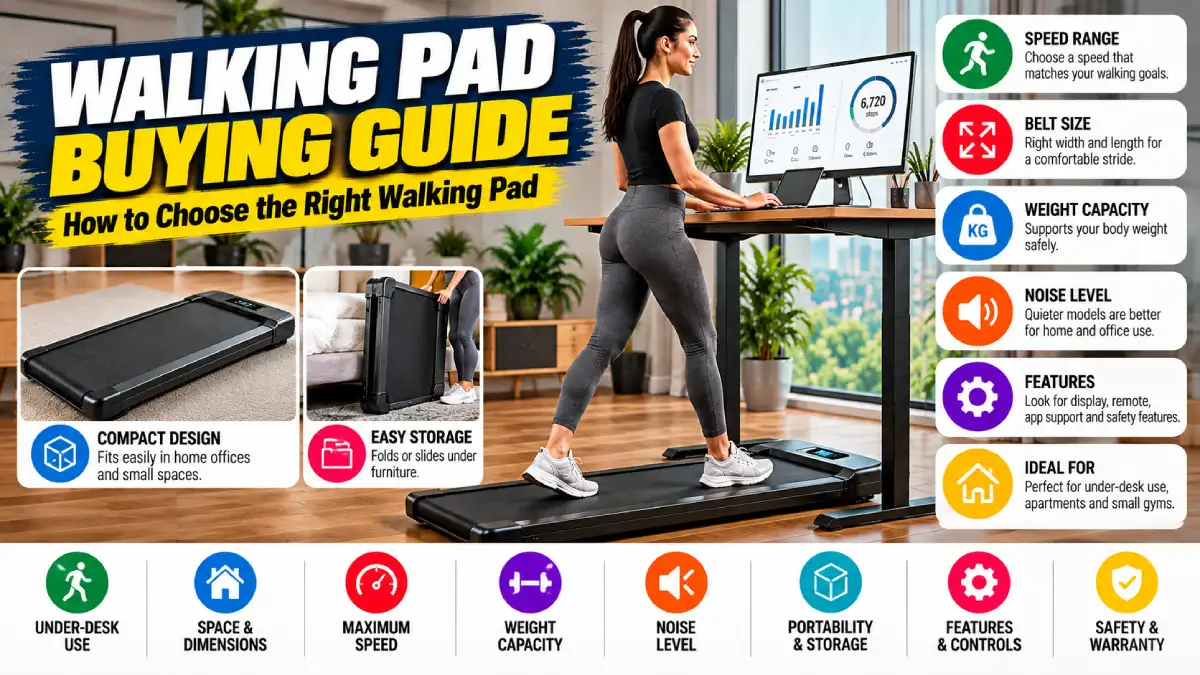
Walking pads can be a great way to increase your daily activity volume without taking up the space of a full-sized treadmill. These lightweight walking machines are commonly designed for use in home offices, small apartments, and other limited spaces. But walking pads can vary a lot in their belt width, maximum speed, maximum user weight, noise level, portability, and safety features. This walking pad buying guide will help you find the one that best suits your needs.
What Is a Walking Pad?
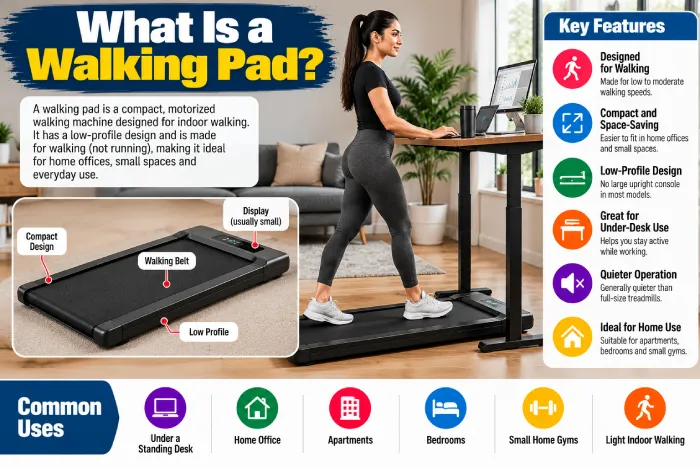
A walking pad is a small motorized walking device designed more for walking speeds over running speeds. Many models are fairly low to the ground and do not have the large upright console seen on traditional treadmills. Instead controls may be located on a remote, small display or app.
Walking pads are commonly used:
- Sip wooden cups state of the art in public drinking10,000 to 50,000 Moisten mouth with a sip from a wooden cup then briefly swish liquid in mouth to release aroma. (Modern cups are hooped like a barrel.)
- At home offices in the organization.
- In apartments
- In bedrooms
- For small home gyms.
- Relative intensities for light indoor walking 7km/hr.
While some models fold up for storage, others are thin enough to slip beneath certain beds, desks or pieces of furniture.Whereas a walking pad might look like a treadmill, it isn‘t always obvious that is designed for treadmill pace running.
Walking Pad vs. Treadmill: What’s the Difference?
The most obvious difference comes down to the intended use. An average treadmill might be made primarily for walking, jogging, or running with features such as handrails, a bigger console, a greater maximum speed, or a larger running surface.
The walking pad focuses of not only walkability but smallness.
| Feature | Walking Pad | Treadmill |
| Primary use | Walking | Walking, Jogging or Running: When at a reasonable walking speed, walking can be quite pleasant, and anyone who has run regularly will notice significant benefits. |
| Size | Usually compact | Generally larger |
| Maximum speed | Usually lower | Often higher |
| Handrails | Frequently inconsistent, missing, or inadequate. | Common |
| Storage | Often easier | Needs a larger space. |
| Under-desk use | Common | Usually impractical |
| Workout features | Usually basic | Usually more comprehensive |
Verify specs as sometimes GBL blurs distinction.
Check the Walking Belt Size
Don‘t concentrate solely on overall dimensions. The width of the walking surface is important to, as the longer the belt the more room the treadmill has to accommodate your natural stride length. Look at both belt width and belt length.
Consider your:
- Height
- Stride
- Walking speed
- Intended use
- Comfort preferences
If you‘re going to walk while working at a desk, you should be self-assured enough to get into a steadied position. If you have to continually look down at your feet, the walking may not be sustainable.
Consider Maximum Speed
Most walking pads have a lower maximum speed than standard treadmills. This is not just a general economic saving. It can be pretty pointless having a maximum speed you will never use if you simply want to walk slowly on your computer or on conference calls. It is wise to check the manufacturer‘s specification for the product before purchase. Do not buy a walking-only treadmill if you plan to use it for running, simply because your legs can propel you faster.
Check the Weight Capacity
All walking pads are rated for a maximum user weight by the manufacturer. Confirm the model supports your rider‘s weight. Do not use weight capacity solely as a quality indicator.
Also examine:
- Frame construction
- Machine dimensions
- Belt size
- Warranty
- Intended usage
- Customer support
If several individuals will be using the walking pad, think about the requirements of each frequent user.
How Much Space Do You Need?
Another big selling point of a walking pad for many shoppers is its very small footprint. Still, measure first.
Check:
- Operating dimensions: How much space it requires when being used.
- Storage dimensions: especially critical for foldings.
- Machine height: make sure it is not too high so you can slide it underneath your furniture.
- Desk clearance: Must be sufficiently high to be used comfortably under a desk.
Allow for enough space to get on and off the machine safely. If needs to be stored under a bed or sofa. measure the actual clearance rather than assuming it will fit.
How Important Is Noise?
In the case of an under-desk walking pad, noise may be crucial. Something that would be tolerable when exercising while lifting weights all alone in a fitness center could be annoying when trying to concentrate on a call.
Noise can come from several sources, including:
- Motor
- Belt
- Rollers
- Foot impact
- Flooring
- Loose components
A suitable equipment mat will be beneficial for floor protection and some vibration where feasible, also please read the setup instructions supplied by the manufacturers. Always keep in mind that no motorized walking machine is silent.
Look at Portability and Storage
The walking pad can be small, even if it is heavy. Review how much the machine weighs if you will be carrying it around each day. Transport wheels can be useful for moving. If the walking pad folds, investigate what folding mechanism it has, and whether the final folded size will be appropriate to your storage area or not, and review the manufacturer‘s storage instructions. Never stand or store a walking pad on end unless it is made to be kept there.
Which Features Are Worth Having?
Walking pads can include:
- Remote controls
- Digital displays
- App connectivity
- Speed controls
- Workout tracking
- Folding designs
- Transport wheels
- Automatic modes
Initially, concentrate on the practical features. Having a reliable speed display and easy-to-use controls may be far more useful than an app you never use. Ensure any app needed for essential operations is compatible with your phone before purchasing.
Common Walking Pad Buying Mistakes
Avoid these common mistakes:
- Purchasing without having measured the belt
- Blank machine height.
- Assumption that all models fit beneath a desk.
- Walking pad for unsupported running
- Many practitioners, however, seem to focus on the weight capacity side of the equation and overlook the fact that initiating and resistant muscles have to work through the entire range of motion.
- Forget noise considerations
- Purchasing a heavy model that has to be shifted daily
- Not Pursing warranty coverage
- Assuming all Models Fold
- Memories storage clearance7. What is the effect of forgetting? Here, the question is memory storage clearance. The mechanisms under which family changed the heart memory is one of the general understanding.
A little machine is actually feasible if you actually get on a common regimen.
Walking Pad Maintenance Basics
Observe the maintenance procedures as indicated by the manufacturer.
Regularly inspect:
- Walking belt
- Belt alignment
- Power cable
- Remote or controls
- Frame
- Rollers
- Folding mechanism, if available
Visit and touch up the mats that walk on the belt as soon as needed. There are several machines that need to be lubed with the belts at the time designated for that particular model, and others that do not.
FAQs
Can you use a walking pad under a desk?
A variety of models exist for under-desk walking; however be aware of the dimensions of the machine (height), desk clearance, range of speeds and manufacturer‘s guidelines.
Can you run on a walking pad?
Only in the situation where the model is designed and rated for running by the manufacturer. A good number of walking pads are solely for walking.
Are walking pads good for small apartments?
The compact design may also allow for use in tighter spaces, so check the operating dimensions, storage dimensions, noise and machine weight.
Is a walking pad the same as a treadmill?
More or less. Walkpads are, for the most part, meant for strolling, while classic treadmills are capable of handling a wider variety of speeds and exercises.
Conclusion
When shopping for a walking pad, an effective buying guide must be centered on the walking pad fitting into your routine. Before buying, compare the walking surface, maximum speed, weight capacity, dimensions, noise levels, portability, storage, controls, warranty and maintenance requirements of each walking pad. But, most importantly, buy a walking pad that is built for the activity at hand and not just the cheapest, or the smallest. For a more general comparison of walking pads, tread mills, exercise bikes, rowers, ellipticals, and other cardio equipment, see our main Cardio Equipment guide.