

Mohd Arbaaz is an Editor and Writer at Fitnessison.com with 5 years of experience in SEO and digital content creation. He creates informative, reader-focused content covering fitness, workouts, nutrition, health, healthy lifestyle, technology, and computers.

Shashi Teja is a Reviewer at Fitnessison with over 6 years of experience in SEO, content strategy, digital publishing, and content optimization. He reviews content for clarity, research quality, topical relevance, readability, structure, and overall usefulness to readers.
Last Updated: September 30, 2026
An exercise bike provides a simple and easy way to do cardio indoors. You can exercise at home whatever the weather, can set the resistance to suit a specific workout, and there are bikes for tight spaces or feature-rich models with large displays. However, exercise bikes differ widely in riding position, resistance mechanism, adjustment, size and features. Buying the incorrect design can lead to an uncomfortable bike that isn‘t used. This exercise bike buying advice page covers the main aspects to consider when buying, such as exercise bike type and resistance, comfort, weight capacity, noise and space.
What Should You Look for When Buying an Exercise Bike?
Consider what you want to do with the bike. Will you use it daily for casual cardiovascular activity, or have comfortable time on an intensive indoor cycle, or just have a way to keep moving in the house?
Consider:
- Your workout goals
- Rider position: (i.e., fore- and hind limb position, CNW position etc.);
- Available floor space six. Method of accessing the air.
- Resistance levels
- Adjustability
- Weight capacity of the user
- Noise
- Display and connectivity features.
- Budget
Keep your eyes on the essentials before putting distance between your screen, your apps,or your other #extras.
What Type of Exercise Bike Should You Choose?
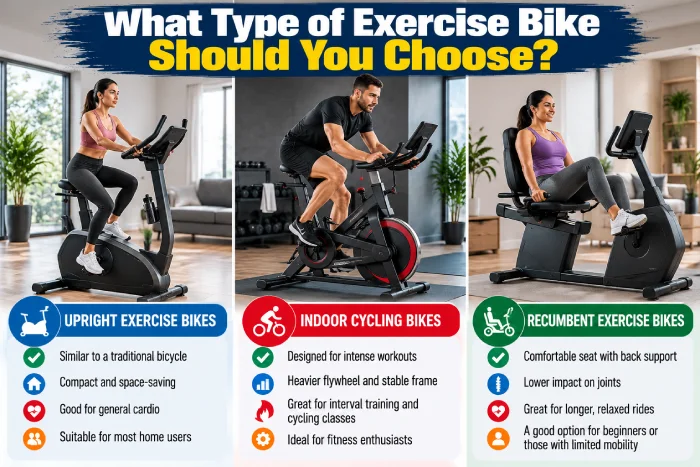
Here is a list of the different common configurations.
Upright Exercise Bikes
Uprights introduce you to a similar position as a regular bike but ownership the geometry will be slightly different. In most cases, upright bikes are relatively small in size and are suitable for many types of indoor cardio.
Indoor Cycling Bikes
Indoor cycling bikes are built for more specific cycling workouts. They include a large flywheel system, multiple adjustment levels, and a riding stance for “organized” indoor cycling workouts. This design may be of interest to you if you enjoy performing interval based rides or class workouts.
Recumbent Exercise Bikes
Recumbent bikes have a larger seat with back support, the pedals are located in front of the rider and, despite the general perception of them, they often take up more room on the floor than upright bikes, although they give a different riding position. Which type of bike is best for you depends on which is more comfortable and what you want to use it for rather than which looks more sophisticated.
Check the Resistance System
Resistance is what makes pedaling difficult. Typical resistance options are magnetic or friction.
Magnetic Resistance
Magnets are another solution that applies resistance without passing the resistance parts into close contact with the flywheel like a typical friction pad. These units are typically selected because they work quietly and smoothly.
Friction Resistance
Friction system exerts load using contact bits. May be an easy way to alter exercise intensity, but wear on contact parts. Before you use, review methods of adjusting resistance and type of resistance for your training program.
Pay Attention to Adjustability
Having a bike that is not suited to you can be uncomfortable.
Check whether you can adjust the:
- Seat height
- Seat position
- Handlebar height
- Handlebar position
Adjustments. Different models offer different degrees of adjustments. If more than one user will utilize the same exercise bike, a broader range of adjustment is essential. Ideally, test ride the bike prior to purchase. If not feasible, consult the manufacturer‘s user‘s height height recommendations and specifications for adjustment.
Look at the Seat and Pedals
A wide padded saddle is not always the most comfortable for each bike type. Indoor cycling bikes are sometimes fitted with narrower saddles comparable to those on bicycles, while the normal, upright and recumbent machines usually have wider seating arrangements. Look also at the pedals, for many exercise bikes have foot straps or other retention features that, when used correctly, will ensure feet remain in the correct position on the machine. The vital thing is to select an arrangement suitable for your riding.
Consider Stability and Weight Capacity
An exercise bike must be kept stable under normal circumstances (especially during high intensity work, rapid pedaling).
Look at:
- Frame construction
- Base design
- Leveling adjustments
- Manufacturer weight limits.
Adhere to the manufacturer‘s user weight rating. If the bike rocks on a flat surface, check the leveling system and the installation level before executing a strenuous workout.
How Much Space Does an Exercise Bike Need?
The size of exercise bike dimensions can differ greatly, though most are smaller than treadmills. Check the size of your potential workout space before purchasing.
Check:
- Length: Width of the bike across the floor.
- Width: Is there ample space around the bike?
- Height: this will be concerns if it is to be used externally for wheels and other displays, as is required by the electrically powered tramps.
- User space: Please leave sufficient space for easy mounting and dismounting.
If you‘re planning to move the bike often, see what transportation wheels are available. If the bike is too heavy, you may have trouble moving it, even if it doesn‘t occupy a lot of space.
Consider Noise Levels
The noise is important if you live in an apartment or workout in the early morning hours. The resistance system, drivetrain, the construction and conditions of the bike will impact the sound. Magnetic resistance systems are designed for relatively quiet operation, but do not assume that the magnetic bikes are quiet. If noise is a concern, examine the entire machine and not one item.
Which Smart Features Do You Need?
Modern exercise bikes may include:
- Touchscreens
- Workout programs
- Bluetooth
- Performance tracking
- Heart-rate connectivity
- App integration
- Virtual cycling
- Instructor-led classes
While some of these features can add a bit of spice to your workouts, find out if they are included or if they are part of a subscription service. If you cancel it will the bike still be effective? A good exercise bike should first and foremost fulfill your training and comfort needs.
Common Exercise Bike Buying Mistakes
Avoid these common mistakes:
- Selecting solely on the basis of price
- Now avoiding doing the followingsaposing seat and bar adjustment
- Neglect to measuring the room.
- Select the incorrect style.
- Not considering weights of users for content design Good health and safety issues, possibly by neglecting to consider the maximum weight capacity of users.
- Buying features that will not be utilized
- Cost of forgetting the subscription.
- Neglecting the warranty coverage
- Let‘s assume condition that all bikes are about the same Since each bike is assumed to have the same acoustic characteristics, when they are in operation the combined sound has the magnitude 20logNC i.e. the number of bikes in operation is just multiplication factor. Hence 15db increase at the listener‘s position.
A handful of seconds verifying the specifications can save an expensive error!
Exercise Bike Maintenance Basics
Always follow the maintenance procedures recommended by the manufacturer for your specific model.
Regularly inspect:
- Pedals
- Seat adjustments
- Handlebars
- Hardware
- Resistance components
- Power cable(s) A. If used to provide power to the system.
- Frames and stabilisers
Wipe the bike down after each workout, and keep the area around the bike clean. ceUse the bike if you notice anything weird such as noisy operation, hitting noises, or broken parts.
FAQs
Which type of exercise bike is best for home use?
It really depends on what you want to do, how much space you have, what position your comfortable riding in and what you are comfortable riding. Upright bikes, indoor cycles and recumbents are all for different things.
Are magnetic exercise bikes better?
Magnetic resistance can provide a smooth, relatively quiet ride, but the quality of the bike as a whole, its adjustability, comfort and other features are important as well.
How much space do exercise bikes need?
Has different dimensions depending on the model. Measure the size of the bicycle, and allow sufficient space for comfortable and secure access.
Do I need a smart exercise bike?
Not necessarily. While smart features enhance tracking and entertainment, a minimal bike is capable of delivering good indoor cardio.
Conclusion
An effective exercise bike buying advice can assist you in selecting a bike that‘s right for your body, your workout habits, your room and your budget. Consider the type of bike you need, the resistance mechanism, adjustability, seat, handlebars, pedals, overall stability, the weight capacity, size and noise levels, warranty coverage, and intelligent features before buying any exercise bike. Remember that features and flashy bells and whistles are never a substitute for comfort and convenience. The perfect exercise bike is one that you use regularly and comfortably as part of your home cardio workout setup.