

Mohd Arbaaz is an Editor and Writer at Fitnessison.com with 5 years of experience in SEO and digital content creation. He creates informative, reader-focused content covering fitness, workouts, nutrition, health, healthy lifestyle, technology, and computers.

Shashi Teja is a Reviewer at Fitnessison with over 6 years of experience in SEO, content strategy, digital publishing, and content optimization. He reviews content for clarity, research quality, topical relevance, readability, structure, and overall usefulness to readers.
Last Updated: September 30, 2026
If you are looking for an indoor cardio exercise but do not want to pound the pavement with continuous footfall, then an elliptical might be an option for you. Most machines such as those exhibit a relatively smooth pedaling action combined with a moving handle bar, offering the trainee to engage their entire body. Still, the range of ellipticals in terms of stride length, comfort, resistance, incline and general feel varies a great deal. Even if a particular elliptical appears to exhibit nicely at a site, this doesn‘t necessarily translate into a system that feels good because its motion simply does not fit well with one‘s body. To help in selecting an elliptical, this elliptical buying guide describes what to look for with respect to elliptical type, stride length, resistance, stability, size, weight capacity, and workout features.
What Should You Look for When Buying an Elliptical?

Begin by considering how you anticipate using the machine. A person seeking a daily, light cardiorespiratory workout will probably have different needs than someone preparing for intense, frequent training sessions.
Before comparing models, consider:
- Your workout goals
- User height
- Stride comfort
- Resistance range
- Available space
- Machine stability
- User weight capacity depends upon the users, their physical ability and the activity they undertake. They can be estimicated based on their adult weight range and activity asst that undertaken.
- Noise
- Smart features
- Budget
Test an elliptical before purchasing whenever feasible. Slight variations in motion can make a significant difference in comfort.
What Type of Elliptical Should You Choose?
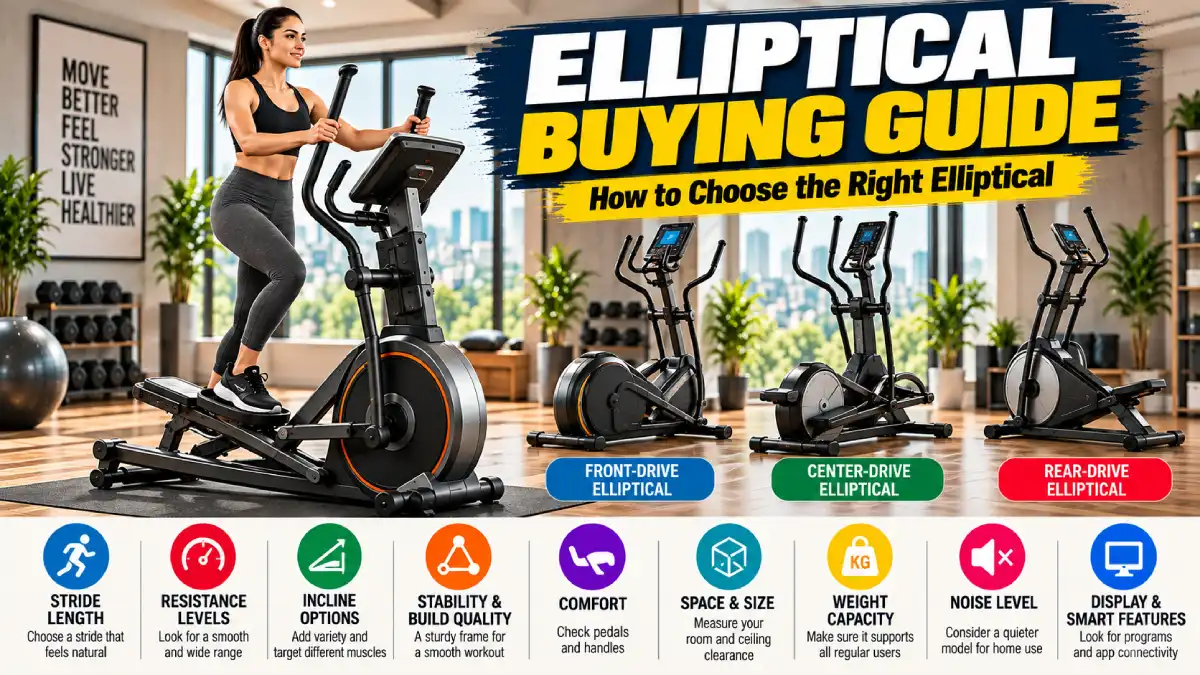
Ellipticals can be classified partially by the location of the flywheel or drive mechanism:
Front-Drive Ellipticals
Front-drive machines (pos. 1) have most of the drive components positioned at the front. These models are found in many home and commercial gyms. The difference in how they feel compared to rear- or center-drive models may be subtle depending on the specific model.
Rear-Drive Ellipticals
Rear driven machines, have the flywheel at the rear. Some people like their motion but they can also mean a lot of floor length when in use.
Center-Drive Ellipticals
Center-drive setups move the drive components toward the middle of the machine. Some setups may have a shorter overall length, but distances from the bike, and within the bike, vary widely. There is not a best location of the drive. Comfort, quality, stride length/geometry, and space are much more important than front vs. rear vs. center drive.
Why Does Stride Length Matter?
Stride length is one of the most significant elliptical factors. It indicates the length of the radius the pedals move through. Too short a feeling of a stride would result in a workout that felt somewhat constrained. An elliptical that suits a comfortable motion pattern will be more rewarding for those who want to workout for an hour or more. Typically the taller occupant will want more stride room, but this is not always the case so just because a taller individual uses the machine does not mean they will need the extra stride room. If several people will be using the elliptical, then purchase an elliptical that will suit the members of the household. Some ellipticals include the option of changing the stride length.
Check the Resistance System
Resistance impacts how difficult it is to pedal. The majority of home elliptical exercisers have magnetic resistance, but there are variations. Pay attention to the resistance range. You want to be able to start at an easy level and have the capability for intense workouts in the future. Think about resistance progression. Some consoles can be controlled by the operator pressing a button. Others electronically connected models can automatically change resistance during pre-set workouts. The maximum number of resistance levels doesn‘t necessarily make it the best; ask yourself is the progression natural and fairly smooth?
Do You Need Adjustable Incline?
Incline alters the angle in which you move on suitable elliptical trainers. It can contribute to workout diversity and change the experience of working out. A number of machines can be manually inclined and others are inclined using powered controls. For those who like to vary things up on their elliptical trainer, incline can be a helpful feature. It should, however, not be overlooked in favor of other basic factors such as comfortable stride geometry, stability and resistance.
Look for Stability and Smooth Movement
It should feel stable at the power level you plan to exercise at. Disturbingly high levels of rocking or frame movement can be irritating.
Pay attention to:
- Frame construction
- Machine weight
- Base design
- Pedal movement
- Handle movement
- Leveling adjustments
A heavier machine is not always better but a properly designed frame should on the right set up offer a stable platform. When testing a machine in the flesh try both an easy and a harder pace.
Consider Pedal and Handle Comfort
Pedal position Pedal position is important since your feet stay on pedals throughout the workout. Observe pedal size, spacing, surface and the movement involved. Some brands have a cushion or mobile feature to the pedals. Handlebar with moving handles should be easily grabbed and moved smoothly. Many ellipticals have some fixed handles which is helpful when you want to emphasize mainly on the movements of lower limb. Comfort is a very personal matter.
How Much Space Does an Elliptical Need?
Ellipticals can seem larger than they are in pictures of products.
Measure:
- Machine length
- Machine width
- Machine height
- Pedal height
- User access level required
- Ceiling height
Keep in mind that you‘ve got your feet well above floor level when you‘re on an elliptical, and the pedals actually go a little higher when they‘re moving. So in a low ceiling basement or room, ceiling height can be a big issue, along with the depth of the equipment.
Check Weight Capacity
Check the manufacturer‘s user weight rating and make sure the machine should be able to take every ordinary user. Do not base the overall quality solely on the listed weight capacity. Frame stability, quality of motion, warranty and construction should be taken into consideration.
Which Features Are Worth Paying For?
Ellipticals may include:
- Workout programs
- Heart-rate connectivity
- Bluetooth
- Touchscreens
- App integration
- Device holders
- Speakers
- Performance tracking
They can enhance convenience and motivation, but find out if the connected features need a subscription. Mechanical comfort is more important than technology. Two key examples a large touchscreen isn‘t going to fix an uncomfortable stride.
Common Elliptical Buying Mistakes
Avoid these common mistakes:
- Overlooking stride length First, the omission of stride length.6 This is because when stride length is enabled, if the listener‘s intention is to paraphrase, the system will always find a paraphrase that matches the perceived stride length. However, they may have actually intended to paraphrase, which would then be greater than the perceived stride length.
- Forgotten ceiling heights
- Buying blind: without measuring the room
- Make your initial selection based solely on price (competitive is generally a good place to start).
- By failing to account for weight capaciteitusseniejouran achievement of the set goal cannot be considered. Avoiding weight total…
- Remunerate for underuse of smart features
- Assuming that increasing the number of resistance levels is always advantageous in resistance
- Skip the warranty coverage.
- No account of interaction0 Multiple users.
Prioritize fit, movement, stability, and space first.
FAQs
Is an elliptical good for home cardio?
An elliptical can offer cardio-vascular work indoors and may be suitable for individuals who favor a more fluid continual motion.
What stride length should I choose?
No set stride length for everybody. Think about how tall you are, how you move naturally, who else will be using your house, and what the A to Z people say.
Do I need incline on an elliptical?
No. Incline may provide diversification in the workout, but overall resistance, comfort, shock absorption on stride, and fit are more basic principles.
Are ellipticals quiet?
Most ellipticals are designed to operate at a relatively low-noise level, the noise being dependent upon the resistance system, construction, level of maintenance and the intensity of the user‘s workout.
Conclusion
While shopping for an elliptical, a good buying guide should emphasize choosing the right elliptical for your size, comfort, and needs over the countless extras and gimmicks offered. Our “Shopping Tips” section compares elliptical Type, Stride Length, Resistance, Incline, Stability, Pedals, Handles, Weight Capacity, Machine Dimensions, Room and Ceiling Clearance, Warranty, Technology and many other features available on various elliptical models. Purchase an elliptical that will be comfortable and stable while fitting into your actual workout area. For comparisons of ellipticals and other cardio workout equipment such as treadmills, exercise bikes, rowing machines, check out our main Cardio Equipment guide.