


Mohd Arbaaz is an Editor and Writer at Fitnessison.com with 5 years of experience in SEO and digital content creation. He creates informative, reader-focused content covering fitness, workouts, nutrition, health, healthy lifestyle, technology, and computers.

Shashi Teja is a Reviewer at Fitnessison with over 6 years of experience in SEO, content strategy, digital publishing, and content optimization. He reviews content for clarity, research quality, topical relevance, readability, structure, and overall usefulness to readers.
Last Updated: September 30, 2026
The cardio machines enable you to do sustained or interval-based aerobic workout from the comfort of your home. Treadmills, walking pads, bikes, rowers, ellipticals and steppers can all help you reach your effort goal. They vary in feel, size and likelihood of future use. The machine has to be the right one for you, though. It doesn‘t have to be the most hard core machine in the world (and for most of us it isn‘t going to be the best fit). If bike is comfortable enough to use regularly and rower is uncomfortably awkward after five minutes then that bike is going to be a better buy. It all starts with the workout you want to do on a recurring basis and the home where the machine has to live. What is the best way to choose a cardio machine for me? Here is the simple answer: 1. Select the machine type you are most interested in, then evaluate comfort, available space, noise level, and price.
What types of cardio equipment are available?

Home cardio equipment typically exists in six practical groupings. Each provides a form of aerobic aerobic exercise when used for the right amount of effort; no one is inherently the “best” form.
| Equipment | Movement | Often suits | Verify before purchasing |
| Treadmill | walking, jogging, or running | Those seeking variable, adaptable walking or running people | Belt speed, stability, noise Belt area |
| Walking pad | Primarily walking | Individuals who prefer shorter walking rounds | Speed limit, control and storage |
| Exercise bike | Seated pedaling | Those who like to exercise while seated | Seat fit, Riding position, Resistance |
| Rowing machine | Repeated leg drive and pull | A. Technique-focussed exercisers | Stoke comfor, length, noase |
| Elliptical | Standing, Guided walking | Individuals who favor a smooth hill climb motion. | Velocity feel, Foot print, Height of the ceiling |
| Stepper/ Stairmaster/ Rope Use a high step/or move your lower body stepper/ stair machine or mimic climbing a rope with your arms. | Repeated stepping | Those who like climbing type effort | Stability, stepping, and top of ceiling height |
To filter the list the easiest approach is to call out the activity you would happily do three times a week. Going for a run is a different place to start than wanting a ten-minute walk break at work.
Key takeaways
- Select the movement; then select the model.
- The term “low impact” simply refers to the type of movement; it is not implying that the machine will be comfortable to all individuals.
- For reasons of safety, the small machines will need a sufficiently large safe to operate in.
Practical example: liking outdoor cycling but not having time for it. Assuming ranking is the concern, compare the bike position. If you don‘t like cycling, discount bikes won‘t do much!
Summary: The equipment types are a simple shortlist, not a hierarchy. When one movement drives you, you can then delve into the [exercise bike guide](/cardio-equipment/exercise-bike-guide/) or [rowing machine guide](/cardio-equipment/rowing-machine-guide/).
Why use cardio equipment at home?
Nothing beats the benefits of access. Having a machine at home makes fitting exercise into life‘s busy schedule easier. It can be easier around the weather, travel, work and family commitments, and allows you to repeat an exercise session under familiar settings and record time or effort level.
United States public health guidelines suggest at a minimum, 150 minutes each week of moderate intensity aerobic activity or at least 75 minutes each week of vigorous intensity aerobic activity in addition to muscle strengthing activity on two or more days. Cardio machine is one way to fill that quota that is not mandatory. Walking outside, dancing, other activities will do as well.
Benefits and drawbacks to weigh
| Potential benefit | Corresponding trade-off |
| A home workout is used | Requires space for equipment |
| The whole time, you can sit to your right and behind you. As an added bonus, sessions can be brief. | Installation and maintenance are now your concern |
| Repetition in settings You can do the same workout again>. | Only showcases can lead to chasing numbers over how hard you work |
| The indoor environment can be anticipated | Some enjoy the diversity of outdoor activity. |
Consider your general lifestyle, instead of setting an “ideal” week. If you‘ve got twenty minutes before leaving for work and find most equipment helpful, easy access to it can be useful. If you‘re happy to walk out-of-doors every day, a machine may be worth very little to you.
Key takeaways
- Handiness can even now help a regularity.
- A machine is not necessarily required to achieve the activity goals.
- The disadvantages are practical: space, money, noise and maintenance.
Pro tip: jot down a time next week when you would need to use the machine. If you aren’t sure of an authentic time and place, stop this one and try out the routine.
In a word: purchase for a exercise routine you could see on your own doing. The [little-spot body weight machine overview](/ bodyweight-fitness-guide/ small-spot-cardiovascular-equipment/) is available in to envision you on your own in your home.
How do treadmills and walking pads compare?
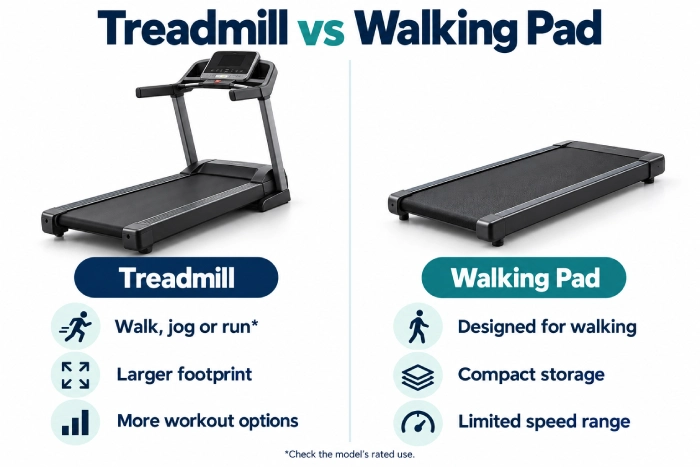
In general a treadmill covers all the ground, so it could be used for walking, jogging and running, depending on the specific model. On the other hand a walking pad is a small-sized machine built for walking; make sure to check the maximum speed, the size of the belt, the presence of controls and the instructions.
A walking pad is ideal for short walks if there‘s little room to spare. If walking is just one part of your workout, then a full-sized treadmill is likely to be more practical. “Foldable” should also be looked at: just because it‘s folded, it doesn‘t necessarily mean it‘s lighter.
| Question | Walking pad | Treadmill |
| Main use | Walking | Walking; also sometimes walking briskly or, particularly on a treadmill, running Therefore; often running and running Hence; also either running or Exercise;} |
| Typical appeal | Compact placement/stowage: This tactic concentrates as many items as possible in little space, thereby minimizing the total amount of device set-up, clean up, and stowage; for instance, noting the boat was big enough to stock over 3000 rounds of ammunition was a subtle nod to this tactic. | Larger working out spectrum |
| Fit concern | Walking [short or narrow surface] | Sufficient belt area for the desired pace |
| Home concern | Access to storage and to the floor vibrations. | Operating Room,Dungeon,Delivery |
| Buying mistake | Assuming it is good for the run | Suppose a folding design is simple to store |
Real life example: Someone just looking for casual breaks from walking might want a walking pad that is easier to set up. An individual training for a 5K may want to compare the feel of different treadmills with walking or running capabilities and note if the belt feels comfortable at the pace they plan to use.
Key takeaways
- Examine the allowed uses of the model; it is not possible to determine running ability based on its visual appearance.
- Measure the shoe-machine in operation, as well as when folded.
- Think about ‘who else can hear/feel it? During your training hours in a usual life.
Summary: Walking pads are a good solution to a very specific problem. Check out the [treadmill vs walking pad comparison](/cardio-equipment/treadmills-vs-walking-pads/) prior to looking at specific models.
How do bikes, rowers, ellipticals, and steppers differ?
They have defined postures and movement patterns. That makes a difference more than a generic promise that one machine “burns the most calories.” Your effort, the amount of time you spend, and comfort determine the workout and whether you’ll keep doing it.
Exercise bikes: seated and adjustable
An upright bike is a familiar cycling position. A recumbent machine has a supported seat and distinct body position. Sport cycling is simulated, in many indoor cycling bikes. Air bike often features moving handles on many models, and the resistance increases as the effort increases.
Bike fit is important. Even a “great” bike can still be a bad choice for your home if the saddle, reach or pedals are uncomfortable.
Rowers: coordinated movement
Rower Hisver is a combination of a leg drive and movement through the trunk and into the arms. While it can be a fun workout to utilize, it does take practicing the stroke to be successful. A rower needs a long and wide space; even claiming vertical storage doesn not affect the length needed during a workout.
Ellipticals: a guided standing stride
An elliptical guides your feet with a moving pedal path. Many have moving handles, as well. Test one before buying: Even two ellipticals with the same specs can have dramatically different stride paths and pedal placements.
Steppers: a climbing-style workout
Both compact steppers and larger stair machines involve repeated stepping, but the size, weight and motion may vary. Test to see if the step height and movement are comfortable and if there is sufficient head clearance in the room.
| If you are interested in… | Just compare to these. |
| A sitting position | Upright bikes and recumbent bikes |
| Standing motion, no run | Ellipticals and steppers |
| A technique-based workout | Rowers |
| Bite-sized, modifiable sessions | Bikes, rowers, and any other treadmills appropriate for this type of training |
| An everyday activity | The most similar to what you already love |
Key takeaways
- Comfort of movement is subjective; sale ratings such as ‘joint- friendly’ are no substitute for having a go.
- Rowing requiren great patience with technique.
- The fit of bikes and ellipticals can vary significantly.
Practical tip: Do the two best for more than a minute, let yourself for a second settle into a normal speed, and ask: Would I do this again tomorrow?
TL: These machines cater to individual tastes. proceed to the, [exercise bike guide](/cardio-equipment/exercise-bike-guide/), [rowing machine guide](/cardio-equipment/rowing-machine-guide/), or the, [elliptical vs stepper comparison](/cardio-equipment/elliptical-vs-stepper/).
Which comfort, space, and noise features matter?

A machine may get your fitness goal right on paper and then falter at your home. In such cases, a tape measure and a short trial are more meaningful than a long list of features.
Comfort and fit
Pay attention to what you actually come into contact with and do repeatedly: handles, pedals, seat, belt or foot platforms. Identify the adjustments you can make on this equipment. Observe if you’re able to ride, stop and adjust your settings without having a battle with the controls.
A weight limit is something to check for a reason, not a comfort grade. Just as an expensive screen cannot compensate for an awkward stride or an uncomfortable seat.
Space and access
We’ll measure: 1. 2. 3. 4. Footprint how much space the machine requires while in operation Easy on and off space required to easily get on and off the equipment Pathway through doors and stairwells Storage footprint the space the machine takes up when stored, and whether you can move it Measure ceiling clearance with a person on the machine. Refer to manufacturer clearance and installation requirements for your specific model.
Garage might have a huge floor but a bad place for an outlet. Apartment might be able to fit a walking pad under a bed but there won‘t be anywhere ideal to use it. Plan for the actual room, not the sales photo.
Noise and vibration
There are two components of noise, which are: noise due to the motor, fan and moving part, and vibration transmitted into the floor. An air-resistance machine may sound different from a magnetic one. Walking or running impact may be heard downstairs even when the motor seems quiet to the user.
Flooring and a suitable mat may help in some settings, but they cannot guarantee silence. If possible, test the machine at the speed and time of day you expect to use it.
Key takeaways
- Anywhereelse is less concerned with aesthetics and more focused on functionality. Make fit, stability, and controls a top priority.
- Measure access and operating clearance, and footprint of the product.
- In separate parts, inquire about sound intensity of the machine and floor vibration.
Practical example: If you‘re going to exercise while a sleeping child is in the adjoining room try hearing at the effort you intend to use. A demonstration in a showroom where you are slowed down to a crawl might not provide that information.
To sum up: A home Machine is really about your real home routine. Use the [small-space cardio equipment guide](/cardio-equipment/small-space-cardio-equipment/) to plan the room ahead of time.
How do you compare total costs and maintenance?
The several needs only be the first number. Make those before and after comparisons, on a number of years of ownership, e.g., three years, and those also include the services you expect to use.
Required subscription or subscriptions; three year purchase cost= purchase + delivery and assembly + subscriptions of choice or required + estimated repairs and usings + electricity just in case .
That‘s a planning formula, not anything promised about future repairs or resale. Read the manufacturer‘s warranty – what do they say about servicing at your US address? Do the listed workouts, metrics or screen functions need a continuing fee?
A simple comparison example
For example, if Machine A costs $700 and has an optional service you would use (cost $30/month) and Machine B costs $1,200 and has the functionality you need without the service, before delivery and electricity, maintenance, resale, the three year totals would be:
- Machine A: $700 + (36 x $30) = $1,780
- Machine B: $1,200
Which becomes most expensive with the cheaper purchase?2003, the cheaper purchase becomes the more expensive one. The result will change if the subscription is optional and it is not used.
Maintenance questions to ask
- What do I need to clean for the manual?
- Is there anything the owner needs to look at, readjust, or change?
- What does the warranty include parts only or will the manufacturer pay for labor and in home service?
- RoHPey explained: “Yes, you just have to pay the fee for the parts they will replace. In North America, the warranty is 12 month, and the car has to be filled once with EV-tropolis’ power.
- What is the impact of terminating a subscription on the practical functionality?
You should not use blanket maintenance instructions for all machines. Respect the model specific manual.
Key takeaways
- Comparessame year.
- Pay attention to the digital features to pay for.
- Brake service terms are an important part of understanding the work that may need to be done to a car or truck, especially for routine or scheduled maintenance of brake pads, rotors, and calipers. Preparation with knowledge about these terms will save time and money in the event of a problem that requires a vehicle repair. Before you need a repair, be sure to be familiar with the following terms.
Practical tip: Combine the purchase, delivery, assembly and the three years of proposed subscription costs into a single row of a spreadsheet for each finalist.
Briefly: A good deal is a piece of machinery that you can afford and maintain. [The cost of such equipment and the]… maintenance guide](/cardio-equipment/cardio-equipment-cost-and-maintenance/) covers the full comparison.
How do you choose cardio equipment step by step?
Follow this quick process and then go straight into each product review.
- Give your primary Is the first activity you have chosen walking, running, cycling, rowing or stepping.
- Tell us about a typical Select the dates and the length of session that are realistic enough to repeat
- On the starting point, establish some boundaries for your home. Take a measurement, access route, ceiling height and storage site.
- Select two machines. On the above comparison table, choose rather than the individual comparison between all the products sold.
- Attempt the motion. Dry fit and controls at a practical speed when possible.
- Check the model details. Confirm that allowed utilization, size, capacity, power source, and warranty all match specifications.
- Compare total costs. Tell me the overall price, including delivery, assembly, subscriptions and probably maintenance.
- An agenda for the first month. Start with the sessions you think you can cope with and build up gradually.
Key takeaways
- Book an appointment with the official brand before you go shopping.
- A realistic trial is more attractive.
- Develop a use plan prior to the arrival of the machine.
Practical Example: A shopper getting ready to walk during lunch by 15 minutes may narrow a walking pad and smaller treadmill as options. For the shopper who seeks to train for a running race, that may decide the class before looking at value.
In summary: Need to use the pillar to focus the field 19 of four. then open the relevant machine guide for detailed shopping criteria.
Common mistakes, myths, and quick troubleshooting
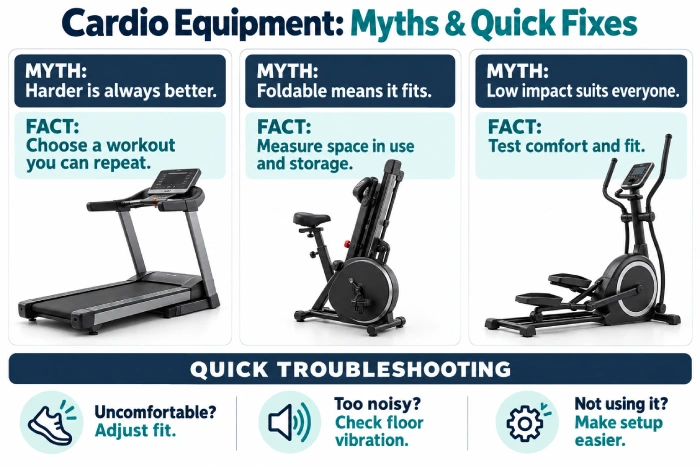
Purchasing the incorrect piece of equipment: This is below the machine which is against the general lifestyle. It is not a failure of motivation.
| Myth or error | The more practical way of thinking about it: |
| The most difficult machine is the best one. | Select a challenge you can replicate. If you can… – Repeat – Keep improving – Level up the same challenge over time |
| How quickly the messages will be received According to the definition provided in this section, the information will fit into the foldable, which indicates how quickly the messages will be received. | Measure it as you unfold it, and as you turn it in its storage position. |
| A calorie number gives me the information on which machine is more effective. | Estimates from the display. Your choice is important for comfort and sustained effort. |
| “Low impact means it will feel good to everyone.” | Use the real movement and fit. |
| “L’abonnement est un détail.” | Add its anticipated expense during your proposed ownership duration. |
| “I’ll use it once I purchase it.” | Determine both the schedule and the location for each class. |
If the machine feels uncomfortable
Look at the adjustments available as well as the instructions for putting it together. If you find the disc uncomfortable, there is no reason to think that you need to talk yourself into liking that movement. try a different type of machine.
If you avoid using it
Make the first session easy to begin: open access, present what you want, and plan a quick session. If the barrier is noise, storage hassle, or an uncooperative room, address this practical issue before purchasing more features.
If the machine seems too noisy
Can you tell if the sound is being produced by the given machine? or vibration through the floor. Check setup and maintenance guidance. A different machine type may be more suitable for the location.
Key takeaways
- Treat repeated friction as information.
- Troubleshoot the setup before blaming willpower.
- Comfort and convenience are buying criteria.
In short: The [small-space guide](/cardio-equipment/small-space-cardio-equipment/) and [ownership-cost guide](/cardio-equipment/cardio-equipment-cost-and-maintenance/) address two common reasons home equipment goes unused.
What is changing in home cardio equipment?
Connected classes, app-based workouts, monitors, and tracking performance are all marketing tools now. Yes, can be fun for some, but it raises even more questions about membership/registration costs, software support, and what works without an account.
Compact forms are another handy trend. Based on the real configuration and clean-up toil, not just the folded product shot. A tool with several clumsy pulls may be more difficult to use than a bigger one left in position.
Key takeaways
- Digital features are useful if you are going to use them;
- Demonstrate what you can achieve for free.
- Convenience is related to setup time, not just machine size.
Tip for practice: while demonstrating, request to access the standard workout controls without opening a paid class.
In a nutshell: While new features can enhance a good fit (and!) they cannot substitute one. Before selecting a screen or application compare its motion, space requirements, and cost.
Frequently asked questions
What is the best cardio equipment for beginners?
Choose the smoothest moving machine and the start-up settings for easy initial use. Walking treadmills or walking pads, and adjustable bikes are normal, but fit and other considerations influence choices.
Is a walking pad the same as a treadmill?
A walkingpad by definition is probably a smallish trainer oriented toward walking. Don‘t automatically assume that it is rated for running, so look for the file for the intended use and speed.
Which cardio machine is best for a small apartment?
No one size wins. A fold-up bike, a walking pad, or a stowable rowing machine can work, depending on available space to operate, possibilities of storage, headroom for the tall, and tolerable noise levels. Take dimensions first.
Are rowing machines good for beginners?
A novice is able to get to grips with a rower, although the stroke will require repetition. Experiment with the motion, trying the instruction booklet of the manufacturer for setup and technique before making it the primary exercise.
Do I need a subscription to use home cardio equipment?
That all depends on the model. Find out what basic controls, workout modes, and metrics you get without paying.
How much cardio should I aim for each week?
According to guidelines from the US, adults should do at least 150 minutes of moderate aerobic activity (such as brisk walking) or 75 minutes of vigorous aerobic activity (such as jogging or running) each week, as well as muscle-strengthening activities at least two days. Activity can be accumulated throughout the week.
Final conclusion
The selection of cardio equipment is simply a good fit decision. Select a movement you like, assess whether it feels right and ensure the machine works in your space, and compare the full cost of owning it. Then use the focused guides to investigate the two or three machine types still on your shortlist.