

Mohd Arbaaz is an Editor and Writer at Fitnessison.com with 5 years of experience in SEO and digital content creation. He creates informative, reader-focused content covering fitness, workouts, nutrition, health, healthy lifestyle, technology, and computers.

Shashi Teja is a Reviewer at Fitnessison with over 6 years of experience in SEO, content strategy, digital publishing, and content optimization. He reviews content for clarity, research quality, topical relevance, readability, structure, and overall usefulness to readers.
Last Updated: September 30, 2026
A rowing machine can give a whole body cardio workout without a dedicated space for a room full of cardio equipment. A rower involves repeated leg drive, upper-body pulling and cardio effort all combined into one movement. No wonder they are a common addition to a home gym. But to make a good purchase decision you need to understand how different types of rowers can feel very different depending on their resistance system, rail length, seat, handle, build quality and technology. This rowing machine buying guide explains what you should think about before you buy a rower, including resistance types, size, comfort, noise, weight capacity, storage and workout features.
What Should You Look for When Buying a Rowing Machine?
Before getting into particular models, consider how and where you‘re intending to use your rower.
Ask yourself:
- How much will I be rowing?
- What is the scope of flexibility?
- Will this machine be used by several people?
- Just how significant is noise?
- There I need to store it after each workouts?
- Would I prefer basic performance stats, or connected workouts?
- How much are my financial finances?
Once those are understood it, it is simple to compare models.
What Type of Rowing Machine Should You Choose?

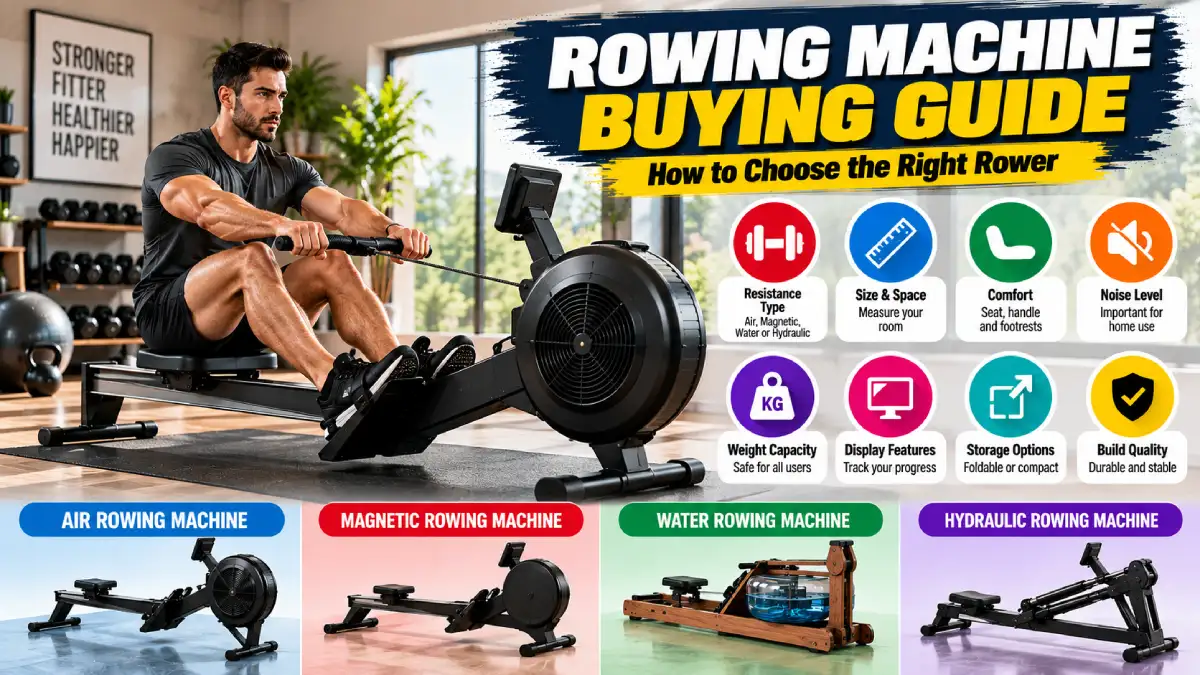
There are many types of rowing machines, but one of the first things to compare is the type of resistance they use.
Air Rowing Machines
For air rowers, the flywheel and a fan are used. Moving air acts as the resistance, therefore in a rowing machine, the more air you move, the harder you pull on the handle. This sort of rowing machine is very versatile and will react to the amount of power you put into it, not to mention that is widely used for anything from steady cardio, to maximum effort workouts. The only problem to be aware of with this type of rower is the noise. The fan makes a great deal of noise when used with a high intensity.
Magnetic Rowing Machines
Magnetic Rower:uses magnets to provide the resistance, this type is popular in the home as it tends to be quieter. Varies around the level of resistance that can be preset.
Water Rowing Machines
Water rowing machines provide resistance by using paddles in a water tank. The sound of the water on water rowing machines has a unique rowing sound that some people prefer. The tank also increases the weight and may need to be cleaned during use.
Hydraulic Rowers
Hydraulic rowing machines use pistons or cylinders to create the resistance. They tend to be smaller and to attract people with space restrictions. The range of movement and the feel of rowing can be quite different from a full length air, magnetic or water machine.
Check the Rail Length
Rail. The distance the seat can travel during each stroke is set by the rail, this can be significant for high users. Too short and the user can not move comfortably and will find it difficult to complete the desired stroke. Photograph images can be deceiving when judging length, check the sort listed in the manufacturers recommended user-height range and physical dimensions before buying. If the rower is for several household users ensure it is suitable for your tallest normal user.
Consider the Seat and Footrests
Comfort issues. These only appear with longer sessions. The saddle needs to sit comfortably on the rail (the seat needs to slide smoothly and offer a comfortable sitting platform). Check the footrests too.
Look for:
- Secure foot straps
- Appropriate placement of the foot
- The ring is available in fixed sizes ranging from 41/2 to 9 (in 1/2 size increments) or in a half si. This although convenient also means that two different sizes have been kept in stock.
- Stable construction
Remember about your feet as well. Follow all the instructions related to the position of your feet by the machine. But the grip is an important issue as well. What is OK for a span of 2 minutes may just be not the same for a longer period of usage.
Look at Stability and Weight Capacity
A rower needs to feel stable throughout its stroke. Pay attention to the construction of the frame, stabilizers, the design of the rail and the manufacturer‘s user weight rating. Do not assume that a more “robust” or higher capacity advertised rower is necessarily “better”. While the design may be more or less suitable for the user, the machine should be designed with its main users in mind. Lastly, take care of the floor. An exercise equipment mat may serve to both protect the floor and mark the workout area, depending on the user‘s flooring and the manufacturer‘s recommendations.
How Much Space Does a Rowing Machine Need?
This is where the buyer can be caught napping. Lengthy rowers. You can scale the quality of a rowing machine by its length. Take the length of machine and the workout area you have before you buy.
Check:
- Length: Ample space to accommodate the entire machine.
- Width: Area that allows for easy access.
- User clearance: space around the rower so they can get on and off.
- Storage measurements: If the machine folds or separates then this is useful.
A few rowing machines are capable of being stored sideways but many fold or break down into sections. Never time a rowing machine on its end unless specified by the manufacturer to be so.
Which Rowing Machine Is Quietest?
Noise may be a consideration if you live in an apartment or do your workout when others are sleeping. Most magnetic rowers are designed to operate fairly quietly. Air rowers will be noticeable by the sound of the fan, water rowers will sound like rushing water. Remember the noise level will also be a factor of the machine construction, its maintenance, and of course the type of flooring you are using and the amount of exertion.
What Display Features Do You Need?
A basic rowing monitor may track:
- Time
- Distance
- Stroke rate
- Calories
- Workout intervals
More advanced machines may add:
- Touchscreens
- Bluetooth
- Heart-rate connectivity
- Training apps
- Virtual rowing
- Instructor-led workouts
These features can even provide more interesting training, but ensure subscription conditions are acceptable. If you only want a simple cardio workout, a clear basic performance monitor may be sufficient.
Common Rowing Machine Buying Mistakes
The most common mistake that is made is not measuring the room before selecting a particular rower.
Other mistakes include:
- Suppose we ignore the length of trains and that the velocity of the train is magnified by the factor that the train length is 10cm rather than the real value. Since we are primarily concerned with the relative effect, relative mean transit time would be of prime interest. This results in a mean time of 0.04. ’.
- Based only on a price For the individual consumer who considers cost to be his or her primary purchasing concern, low price is becoming a major issue.
- Silent Forgetting: How we forget about noise
- Passengers may progress beyond the places to which they are entitled. For instance, some airlines allow a passenger to pay an excess baggage charge upon arrival instead of at check-in, but will not permit excess passengers.
- Let‘s assume that all of the rowers join.
- Covering the cost of redundant technology
- Forgetting charges
- Disregarding warranty coverage
- Failure to consider the maintenance done
Your perfect equipment should complement your home just like it does your workout.
Rowing Machine Maintenance Basics
Different resistance systems have different maintenance needs.
Follow the manufacturer‘s instructions and regularly check:
- Use handle and strap or chain7
- Seat rollers
- Rail
- Foot straps
- Hardware
- Display
- Power connections
- Resistance components
Maintain the rail clean so the seat can move freely. If using water rowers check whether there are special conditions for water tank maintenance. Resistance types other than water may have their own maintenance conditions.
FAQs
Which type of rowing machine is best for home use?
We don‘t have an all-around favorite. Air, magnetic, water and hydraulic rowers each bring different qualities of rowing sensation, noise levels, size, cost and maintenance to the table.
Are magnetic rowing machines quiet?
They are all, rather surprisingly, made to run fairly quietly. Since each Lurking Machine varies considerably in overall ma chine noise, with age, maintenance, weight etc, comparisons are difficult.
Do rowing machines take up a lot of space?
Most full-length rowers demand ample floor length. Always check the operating and storage dimensions before buying.
Is a rowing machine good for full-body workouts?
In rowing you use the power of your legs, trunk and upper body in smooth coordination, whilst putting considerable strain on your cardiovascular system.
Conclusion
A practical rowing machine buying advice should aid you to go past the looks and select a machine suitable for your home workout room. Take into account the resistance type, rail length, comfort of seat and footrest, stability, maximum user weight, operating noise, space dimensions and storage, monitor functionalities, warranty and necessary maintenance. And don‘t forget to measure your home space in advance. The proper rowing machine can become such a multifunctional cardio device together with your treadmill, exercise bike and other cardio equipment!