

Mohd Arbaaz is an Editor and Writer at Fitnessison.com with 5 years of experience in SEO and digital content creation. He creates informative, reader-focused content covering fitness, workouts, nutrition, health, healthy lifestyle, technology, and computers.

Shashi Teja is a Reviewer at Fitnessison with over 6 years of experience in SEO, content strategy, digital publishing, and content optimization. He reviews content for clarity, research quality, topical relevance, readability, structure, and overall usefulness to readers.
Last Updated: September 29, 2026
Selecting strength training equipment can be overwhelming very quickly. One acquaintance indicates that you require a barbell. Another suggests that adjustable dumbbells are preferable. A further advises that resistance bands are effective for possibly almost anything. Then there are racks, benches, kettlebells, cable machines, weight plates and dozens of other accessories battling to attract your focus.
The down and dirty truth is there is no single equipment list that works for everyone. Whatever equipment you buy depends on what you want to do with it, how you like to train, how much space you have and of course, how much strength and resistance you will need in the future
This is important because strength training, as well, does not necessarily require a certain piece of equipment. The 2026 American College of Sports Medicine resistance training update, evaluated evidence from research involving more than 30,000 participants, and determined that equipment choice (machines versus free weights) did not always influence outcomes in healthy adults. This, as well as what ACSM says, is about training consistency and appropriateness.
So instead of racing out to buy gear, ask a smarter question: What gear can I use to help me do the exercises on my program efficiently, safely and consistently? This guide will help you.
What Is Strength Training Equipment?
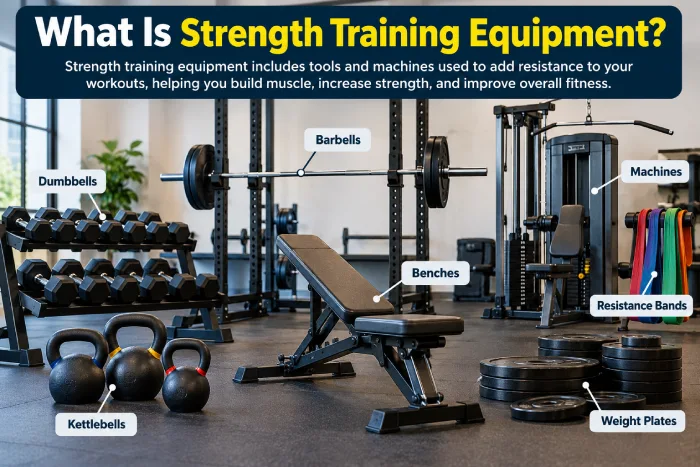
Strength training equipment is any type of equipment that is utilized in a way that creates, maintains or supports resistance in a work out designed to enhance muscular strength, size, power or endurance.
Common examples include:
- Dumbbells
- Barbells
- Weight plates
- Kettlebells
- Resistance bands
- Weight benches
- Squat and power racks
- Cable systems
- Selectorized machines
- Pull-up stations
- Weighted accessories
There are also some strength exercises that have no equipment at all, such as push-ups, lunges and other exercises. These body weight exercises are a reminder that in a home gym your own body weight can be the equipment. The equipment should provide additional options, not a reason not to exercise. The U. S. Physical Activity Guidelines recommend at least 2 days a week of muscle-strengthening activities.
Key takeaway
Strength equipment (for resistance and progression) More costly or complex does not mean it is also the more useful
Practical example
For example, a person training in an apartment may turn to a set of adjustable dumbbells and bands. Conversely, a person preparing to perform highly on the barbell might make it a priority to get a rack, barbell, plates and bench. Various fitness goals demand different equipment investments.
Mini summary
Begin with your training instead of your shopping list.
Which Strength Training Equipment Fits Your Goals?
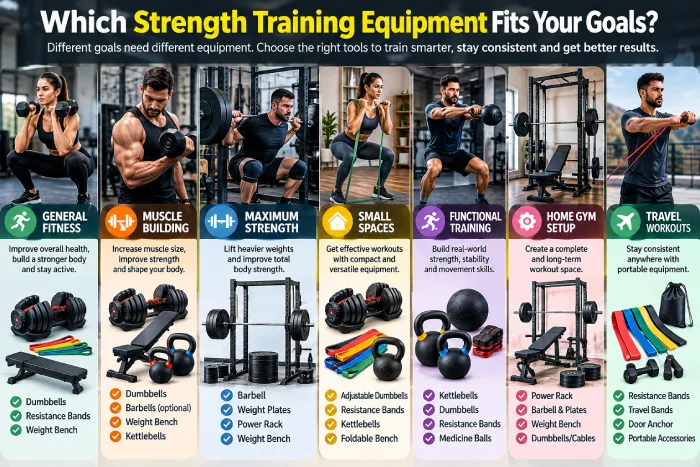
Rewrite that this example should be the first question you answer. If you do not have a goal in mind, purchasing equipment can fill your room with things you almost never use.
For general fitness
Even just a pair of dumbbells, a set of resistance bands, or pair of TRX suspension trainers offers a wide range of options.
You can train movements such as:
- Squats
- Lunges
- Rows
- Presses
- Romanian deadlifts
- Curls
- Triceps exercises
- Loaded carries
Add a bench later on and your exercise possibilities grow more.
For building muscle
Muscle-strengthening routines can include programmes with equipment that can progressively increase the challenge. Equipment such as dumbbells, barbells, machines and cable systems may be appropriate. As long as you can progressively increase the opposition and progress to different exercises, it is suitable.
For maximum strength
If you are aiming at gradually increasing the weight of squat, bench press, or other barbell group movements, then a barbell-friendly setup is more beneficial.
A typical setup may eventually include:
- Barbell
- Weight plates
- Powerrack/ Squatrack
- Safety arms, or straps
- Bench
The key word is eventually. You are not required to buy all of this before your first session.
For small spaces
Use multi-functional equipment banks of equipment that will do a number of different jobs without taking up valuable space on your floor.
Good candidates include:
- Adjustable dumbbells
- Resistance bands
- One or two kettlebellsss
- Foldable/compact benches
- Mounted on the door or wall mounted if installation can be justified
For functional or athletic workouts
Support for carrying, swinging, pressing, lunging, rotational and other multi-directional patterns may be provided by kettlebells, dumbbells, medicine balls and resistance bands.
Quick decision table
| Your Priority | Start With | Consider Later |
| General fitness | Dumbbell and resistance band combinations | Bench |
| Muscle building | Dumbbells + bench | Cables/barbell |
| Heavy strength | Barbell + rack | More plates |
| Small apartment | Adjustable dumbbells | Compact bench |
| Travel | Bands | Portable accessories |
| Exercise variety | Dumbells + bench. | Cable system |
| Kettlebell training | 1–2 kettlebells | Increased weight range |
Key takeaway
Select facilities of meeting the extension needs not by their trendiness.
Practical tip
Jot the five to eight exercises you are likely to do the most, and the minimum equipment you need to do them.
Mini summary
The right setup is purpose specific. A minimal approach setup might outperform a full setup packed with tools that you seldom use.
Dumbbells vs. Barbells vs. Kettlebells
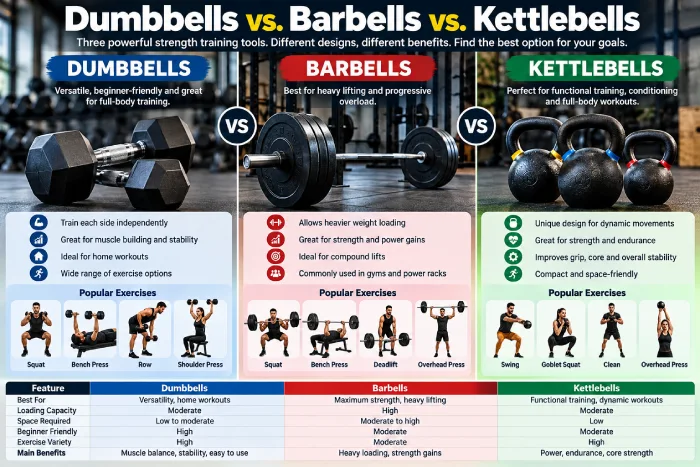
All three of these machines tend to look very similar, because they all have external weights. However, each machine has a very different feeling during a workout.
Dumbbells
With dumbbells, each hand can exercise on its own.
They are useful for exercises such as:
- Dumbbell bench press. When performing this exercise, a 36 lb. (16 kg.) weight is used. The lifter should use all the weight without overlapping or crossing their arms.
- Rows
- Lunges
- Goblet squats
- Shoulder presses
- Curls
- Romanian deadlifts
One reason adjustable dumbbells are popular in home gyms is that a number of different resistances can all be housed in a relatively compact space. The only obstacle seems to be when your strength exceeds the range of weighting, or when the heavy dumbbells become unwieldy to position.
Barbells
The weight plates are put onto the end of the long bar via a barbell.
This makes barbells particularly suitable for progressively loading exercises such as:
- Squats
- Deadlifts
- Bench presses
- Overhead presses
- Rows
A barbell, however, requires more preparation and planning. You may require plates, collars, proper flooring and (depending on the movement) a rack and safety system.
Kettlebells
A kettlebell has a handle on the top for handling above the mass of the bell.
That design works especially well for exercises such as:
- Swings
- Goblet squats
- Carries
- Presses
- Cleans
Kettlebells may be used to systematically combine resistance training with movement; however the smaller system of kettlebell weights offers less incremental loading options for a given movement than a large plate or dumbbell system.
Quick comparison
| Feature | Dumbbells | Barbells | Kettlebells |
| Beginner friendly | High | Moderate | Moderate |
| Small-space use | High | Lower | High |
| Heavy loading | Moderate | High | Moderate |
| Unilateral training | Excellent | Limited | Excellent |
| Dynamic exercises | Good | Moderate | Excellent |
| Equipment required | Low | Higher | Low |
| Home storage | Easy–Moderate | Moderate | Easy |
Don‘t feel that you have “pick one”. areas incorporate as address differing issues.
Key takeaway
Dumbbells focus on versatility, barbells facilitate heavy incremental loading, and kettlebells are great for more compact and dynamic training.
Mini summary
Choose what is right for the exercises you are going to do; don‘t try to find a single free weight that is “the best”.
When Are Resistance Bands Useful?
A resistance band is one of those training products that people can easily overlook, because it’s cheap and doesn’t take up much space. But it can actually be very effective. According to the ACSM’s 2026 guidelines, there is evidence that elastic-band, bodyweight and home training are viable options.
Bands can be used for:
- Rows
- Presses
- Pull-aparts
- Lateral raises
- Curls
- Triceps work
- Squats
- Hip exercises
- Warm-ups
- A selected workout providing assistance or added resistance
Many of these exercises also work using resistance bands or cable machines for instance, ACE‘s exercise library features dozens of exercises that utilize resistance bands or cables in many parts of the body.
Where bands shine
They are particularly convenient for:
- Travel: A small set fits well into a piece of luggage.
- Small homes: Storage space is almost unnecessary.
- Accessory exercises: Bands are another way of adding resistance without having to use another large piece of equipment.
- Different resistance angles: it is possible to attach the bands at different angles using one suitable secure anchor.
What bands cannot solve perfectly
Resistance usually increases as a band is stretched. That is a different sensation to lifting a dumbbell or barbell. Bands can also deteriorate. Regularly inspect the band, handles and anchor points for deterioration before every use. There was a 2026 CPSC recall on some of these bands for potential separation from the handles when being used.
Key takeaway
Resistant bands are not just for warm-up anymore. They can be a real strength training tool, especially when portability, budget and storage is important.
Mini summary
Utilize bands when their portability and variable resistance are beneficial to your program. However, check them periodically.
How Do You Choose a Weight Bench?
A simple looking bench can greatly expand the options for your home gym.
It can support:
- Dumbbell presses
- Barbell benches This is the chief technique for developing the pectoral muscles.
- Seated presses (shoulder)
- Chest-supported rows
- Split squats
- Step-ups and other exercises when they are suitable.
The two primary types are flat benches and adjustable benches.
Flat bench
A flat bench has less moving parts and can be a little less complex to operate. It makes sense if the user primarily trains flat pressing movements or needs a fairly minimal, stable platform.
Adjustable bench
A flexible model can make flat and inclined positons and, depending on it design, extra angles. That having said that versatility can be useful in a small home exercise room. Before you purchase anywhere it is, look beyond the upholstery.
Check:
- Manufacturer load rating
- Bench dimensions
- Stability
- Adjustment mechanism
- Footprint
- Storage requirements
- – Compatibility with your rack
- Manufacturer instructions
Key takeaway
Choosing a good bench is partly a question of matching your exercises with certain dimensions of the body, and the nature of the loading and available space.
Common mistake
Sometimes, we seem to get too hung up on exactly how many adjustment positions a bench can give us. First and foremost, simple and stable, and enough capacity for what you want to do is better than going for aesthetics with angles you rarely or never use.
Mini summary
Select a work surface for your bench, not a piece of furniture. Construction, stability and fit are important.
How Do You Choose a Squat Rack or Power Rack?
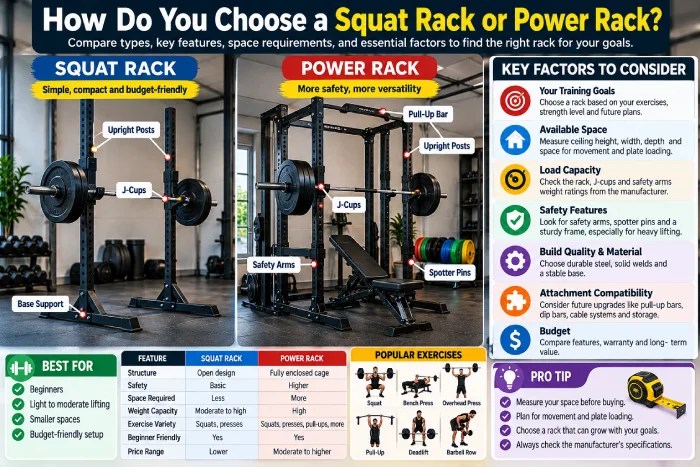
The rack is a key piece of equipment when training with a lot of barbells. The rack enables a barbell to be unracked and re-racked in a practical manner.
Common options include:
- Squat stands
- Half racks
- Power racks
- Folding racks
Most power racks enclose the lifting area with uprights and offer points for J-cups and safety bars.
Keep safety in mind16. Consider safety before.
If you plan to train alone always know how the rack‘s safety arms, pins or straps are meant to operate. Never assume that a rack or attachment can carry a specific weight. Always verify the recommended limits specified by the manufacturer.
Measure before buying
Measure:
- Ceiling height
- Rack height
- Rack width
- Rack depth
- Able to get at the back and to the sides of the rack
- Bench position
- Barbell clearance
- Plate-loading space
The printed sizes shown on a product page are not necessarily the entire workspace you will require. A seven-foot bar, for instance, may have to have one or two feet of space around it to enable plates to be loaded on and moved away safely.
Think about future compatibility
If you expect to add attachments later, check:
- Upright dimensions
- Hole spacing
- Hardware size
- Attachment compatibility
- Manufacturer recommendations
Not all fittings, which seem to be compatible, should be realized as compatible.
Key takeaway
Select a rack based on your available space, anticipated load, trainess and safety considerations.
Mini summary
The rack sits within the overall lifting area. Think about the whole footprint of the lifting area, not just doing the measurements for the rack frame.
What Load Ratings Matter?
No guessing needed here. Most equipment manufacturers specify rated capacities for benches, racks, storage systems, and the like. Use them.
Bench capacity
Read the wording on the bench carefully when measuring the seating capacity.
You need to know whether the rating refers to:
- Total supported load The magnitude of this force depends on the distance from the load to the support point and the gravity on the load.
- User weight
- External weight
- An alternative manufactured measurement
If you have a different idea yourself, do not put it forward.
Rack capacity
Step 3: Check specifications for rack and individual components where applicable. Each J-cup, safety arm, storage pin and attachment may have specifications.
Storage capacity
Weight requirements on storage stands, wall-mounted storage units, and shelves. Mounting method: be sure the means of mounting your piece of equipment adhere to the manufacturer’s installation specifics.
Adjustable dumbbells
Ensureweights are locked into position before lifting. This is especially critical since the 2026 CPSC recall included adjustable dumbbells that could may their plates fall off during use.
Key takeaway
The rated capacity is the capacity listed by the manufacturer for the specific product and configuration being used.
Mini summary
Never judge load capacity by the look of it, the thickness of the frame or comments from others online.
How Much Space Does Strength Training Equipment Need?
Your available room may influence your equipment selection more than your budget does. Initially, unbundled the space needed for storage from the space needed for training. A dumbbell takes up very little space when stored but needs much more room when you do lunges or floor presses.
Create a training footprint
Before purchasing large equipment:
- Quantify the room.
- Marks doors and windows.
- Please shall take note of the level of ceiling height.
- Locate vents and outlets.
- Mark the layout of the proposed equipment footprint.
- Create negative space that can be accessed for exercise movement.
- Add clearance for weights to load and unload.
- Plan storage.
A few pieces of painter‘s tape for sticking on a rack or bench footprint to the floor while still shopping. Wandering through the taped area, loading an imaginary bar, trousering a bench five minutes’ worth of such experimentation can reveal all sorts of problems that numbers alone may not.
Key takeaway
The product footprint is different from the usable workout footprint.
Mini summary
Design for ease of movement, loading, storage and access – not simply if the machine will physically fit.
Strength Training Equipment Maintenance and Safety Checks
Home gym equipment isn’t decor to be accessorised with.
Developers Create an Inspection Routine.
Before workouts
Inspect commonly used equipment for evident defects.
Look for:
- Loose components
- Damaged cables
- Frayed bands
- Unusual movement
- Damaged handles
- Loose collars
- Issues involving the locking mechanism of adjustable-weights
- Unstable benches
- Misaligned attachments
Follow the manufacturer‘s inspection and maintenance procedures for the equipment.
Periodically
Depending on the equipment and manufacturer‘s guidance:
- Check hardware
- Clean handles and pads
- Examine cables and pulleys
- Welds and frames (visual) assessment
- The band that is… examine.
- Verify the gear shift devices
- Inspect the weighing storage
- Equipment recalls at review
If anything looks like it‘s been structurally damaged, discontinue its use until it can be checked or treated in the method specified by the manufacture.
Why this matters
Fitness equipment is often moved, lifted and repeatedly loaded. Minor problems can become significant ones when used with heavy resistances. Failures can be related to hinges, attachment points, adjustable weight systems and other components as shown in CPSC’s recalls of fitness equipment.
Key takeaway
Maintenance must be assumed as a part of the ownership of strength-equipment.
Mini summary
To Specifications: inspection, cleaning and maintenance of equipment based on manufacturer rather than for obvious Failures.
Common Strength Equipment Buying Mistakes
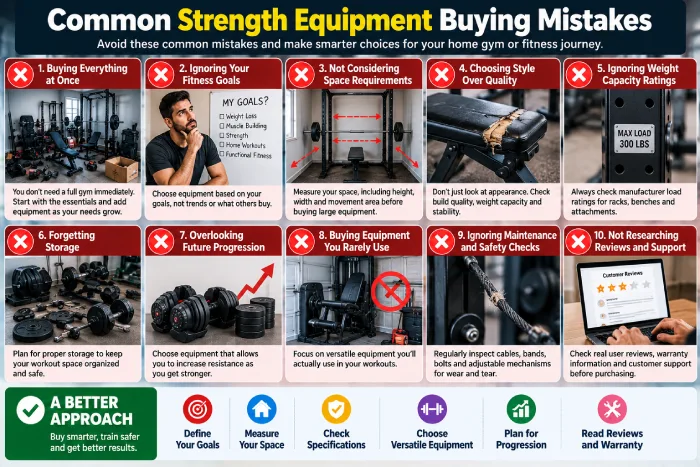
Key to buying equipment is knowing what not to do after that it is a lot easier:
Buying everything immediately
You are not required to set up a home ‘commercial’ gym. Begin with the equipment that would support the program you are presently using. Progress as you come to a real limitation.
Ignoring progression
What is tough now may be easier later. Can resistance be piled on piece by piece?
Ignoring space
Take the measurements of the equipment dimensions and working clearance.
Choosing variety over usefulness
Ten specialist instruments are not, all in all, better than two multi-utility instruments.
Forgetting storage
Loose plates, dumbbells, attachments, and bands rapidly clutter an area. Design it with a storage option in the initial plan.
Ignoring maintenance
Inspection of mechanical parts, bandings, paddings and regulable equipment.
Buying based only on maximum capacity
Capacity is just one factor to consider. Stability, size, adjustability, biomechanics, manufacturer guidelines and exercise items all come into play.
Strength Training Equipment: Myth vs. Fact
| Myth | Fact |
| You have to have expensive equipment just to develop strength. | A number of different types of resistance will still result in the desired training. |
| Everyone needs barbells. | The equipment should be appropriate for the program and the goal. |
| Resistance bands are for new people. | Why Use Bands? Bands are versatile and can be incorporated into numerous exercises and resistance training scenarios. |
| The more equipment (e.g. free weights, machines, cardio equipment) we have, the more diverse the workouts. | Important. Requires good products and regular practice/training. |
| A power rack is essential for any home gym. | The number of racks required will depend on the training exercises. |
| Gym equipment require no further care once installed. | Regular inspection and following the maintenance schedule suggested by the manufacturer are important. |
The more sweeping evidence demonstrates that a flexible approach is the recommended route. The 2026 ACSM position stand advances the idea that sticking to consistency and goal-specific programming has significance, and specific equipment selections should be less decisive than we often think.
A Step-by-Step Way to Build Your Strength Setup
At no point do you need to construct your ultimate gym.
Step 1: Define your goal
Choose your main priority:
- General strength
- Muscle growth
- Maximum strength
- Functional fitness
- Home fitness
- Athletic training
Step 2: List your core exercises
Which exercises will you do each week?
Step 3: Find the minimum equipment
Find the least amount of gear you’re going to need for the exercises. For the newbie, that might just be a pair of adjustable dumbbells and a few pieces of equipment.
Step 4: Check progression
– Will your equipment still be challenging as your strength increases?
Step 5: Measure the space
Design storage and active training areas.
Step 6: Check specifications
Read manufacturer‘s details on capacity, assembly, installation, use and maintenance.
Step 7: Train before expanding
Stick to the setup. You‘ll quickly find out what is really lacking.
Step 8: Upgrade around limitations
Maybe your dumbbells have gotten a little easy. Maybe you need a bench. Maybe barbell squats have to be a part of your program. Buy the next piece of equipment because your training demands it not because your gym feels like it is missing something.
Troubleshooting Your Equipment Setup
“My dumbbells are becoming too light.”
Instead go ahead and decide if heavier dumbbells are the answer or if your program is steering you to more barbell exercises.
“I don’t have room for a rack.”
Also a lot of strength exercises can be done with only uhands, kettlebells, bands and bodyweight exercises.
“My equipment takes too long to adjust.”
Ask yourself if quicker transition times on equipment would significantly enhance your workouts. This is relevant when performing circuits or exercises with rapid weight changes.
“My home gym feels cluttered.”
Look vertically.
Wall storage, weight trees and compact storage systems can free up usable floor space if they are properly fitted and loaded.
“I keep buying equipment but don’t use it.”
Reverse it. Select your program and then purchase equipment only when your workout demands it on a repetitive basis.
Future Trends in Strength Training Equipment
Strength equipment is also remaining more compact and modular. Even your typical home gym enthusiast now has access to weight stacks, temporary racks, cable towers, and multi-gym stations that previously would have necessitated multiple stations.
Connected apparatus Another emerging area is resistance devices that incorporate digital coaching and performance monitoring. However, when it comes to purchase, the principle remains unchanged:
Equipment should solve a training problem.
A new feature is almost worthless if it makes the equipment more complex without actually helping your workouts. For most of us simple equipment will always do just fine.
How Much Strength Training Equipment Do You Actually Need?
Probably less than you think. For the complete novice you could use bodyweight movements, resistance bands, or dumbbells to get started. For someone who is looking for more variety with their exercise you could add an adjustable bench. For a lifter working their way up to heavier barbell exercises, a rack and barbell with a set of plates would be the next addition.
That approach has several advantages:
- Starting cost is less.
- Less clutter
- A clearer comprehension of your true requirements,
- Next were (1) easier on the equipment decision, where the equipment was quite simple; (2) easier with used equipment decision, where the used status of the equipment was dominant in the decision; and (3) easier with equipment availability decision, where the equipment condition was dominant in the decision.
- More potential for better quality items to purchase down the road
It also keeps the focus exactly where it belongs on training.
FAQs
What equipment is used for strength training?
Typical strength training equipment includes dumbbells, barbells, kettlebells, weight plates, resistance bands, benches, squat racks, cable machines and strength machines. Body weight exercises can also be used to provide resistance without the use of traditional weight.
What strength training equipment should a beginner buy?
A beginner can commonly begin exercising with free weights like adjustable dumbbells or even with resistance bands. A bench can always be obtained later to increase the training flexibility. The equipment should be selected according to the training program exercises, not from a universal shopping list.
Are dumbbells enough for strength training?
Dumbbells are capable of hold a significant number of strength training exercises, such as presses, rows, squats, lunges, and Romanian dead-lifts. Ultimately, some people may need heavier weights, depending upon their strength and goal.
Are resistance bands effective for strength training?
Yes. Resistance bands can be a viable source of resistance for many exercise types. ACSM‘s 2026 guidelines include elastic-band and home-based resistance training as effective modalities.
Which is better: dumbbells or barbells?
Neither is better, in general. Dumbbells are more versatile because you can load each side independently and they are more flexible because you can do a lot more with them, but barbells are more commonly used to load heavier weights more easily in many of the traditional strength exercises.
Do I need a bench for strength training?
No, there are many movements that do not require a bench. But a bench greatly increases the pressing, rowing and seated/supported exercise movements available.
Do I need a squat rack?
Usually, an adequate rack is required for training types where a loaded barbell has to be supported at a specific, safe starting position (e.g., in many variations of the barbell squat and bench-press).
How often should strength equipment be checked?
Inspect all frequently used equipment regularly and adhere to the manufacturer‘s recommended service schedule. Look out for damage that can be seen before training such as instability, damage, loose parts, worn bands, broken wires and broken adjustment system.
Final Conclusion
The most effective strength training equipment is not always the most expensive, the heaviest, or the one with the most bells and whistles. It is equipment that is appropriate for your aims, fits the space you have available, offers the right degree of challenge and allows you to adapt it to your needs. Adaptable dumbbells and resistance bands may be adequate for many people. You may ultimately find that a workout bench, barbell, weight plates and power rack are more suited to your goals.
Kettlebells, cable systems and machines are fine if you have a specific reason for using them. Just make sure you create a plan first. Purchase only the equipment necessary to follow it. Then only add to it when you find that your current equipment is a real obstacle to your progress. This way you will keep your gym setup simple, your money will be spent wisely and your mind will be focused on the one thing that leads to positive development: long term consistency in strength training.