

Mohd Arbaaz is an Editor and Writer at Fitnessison.com with 5 years of experience in SEO and digital content creation. He creates informative, reader-focused content covering fitness, workouts, nutrition, health, healthy lifestyle, technology, and computers.

Shashi Teja is a Reviewer at Fitnessison with over 6 years of experience in SEO, content strategy, digital publishing, and content optimization. He reviews content for clarity, research quality, topical relevance, readability, structure, and overall usefulness to readers.
Last Updated: September 28, 2026
A good home gym layout is essential to making a small workout space feel comfortable, neat and functional. This is not just a matter of having enough space for the rack, treadmill or dumb bells. You also need room to move between stations. The ideal layout is based on your exercising needs. Strength training, aerobics, yoga and total body workouts all require different equipment and space allowances. Draw up an outline before you drag the heavy equipment into the room. A few measurements today can save you a costly misjudgment tomorrow.
How Do You Plan a Home Gym Layout?
Start by measuring the entire room.
Record the:
- Length and width
- Ceiling height
- Door locations
- Window locations
- Electrical outlets
- Permanent furniture
- Built-in storage
- Columns or other obstacles
If you are using a garage, also consider the garage door, tracks, water heaters, vehicles, and storage areas. Next, list the equipment you already own and anything you plan to purchase. Check the manufacturer’s dimensions for larger equipment. Remember that the dimensions of a machine only show its physical footprint. You may need considerably more room to use it comfortably. For complete planning beyond room arrangement, visit our Home Gym Setup guide.
Divide Your Home Gym Into Workout Zones
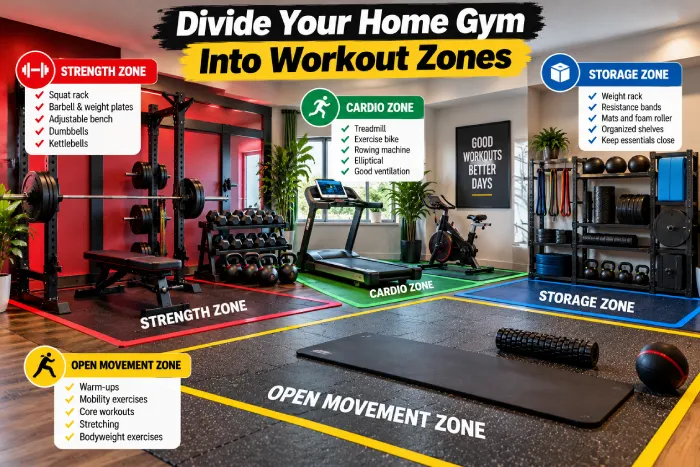
Making zones is one of the easiest measures to organize a home gym. It doesn‘t required rooms necessarily. Several zones can be happening in the same floor area at different times.
Strength Zone
Your strength area may contain:
- Squat rack
- Barbell
- Weight plates
- Adjustable bench
- Dumbbells
- Kettlebells
Keep regularly used weights within a comfortable distance without having to carry them across the room. If using a barbell leave enough space around both ends.
Cardio Zone
Treadmills, stationary bikes, rowing machines and ellipses are best suited for placement along the perimeter of the room – maximizes available floor space in the center of the room. Think about electrical access for electricity powered machines extension cords crossing the walkways should be avoided.
Open Movement Zone
Open floor area will be an element of your gym.
Use it for:
- Warm-ups
- Lunges
- Mobility exercises
- Core workouts
- Stretching
- Bodyweight exercises
Don’t try to put something in all those empty corners.
Storage Zone
Provide a fixed storage area for dumbbells, resistance bands, weight plates, mats, and other accessories. Having an organized storage area will make training sessions more efficient because you won‘t spend as much time finding what you need.
How Much Clearance Does Gym Equipment Need?
There is no one clearance measurement, as equipment designs are all different. Always check the manufacturer‘s specifications. Remember to consider exercise clearance and equipment clearance.
Storage for instance, storing a bench against a wall. If you are storing it between uses, then surface area is less important, but if you are using it for support in dumbbell presses, then the rack needs space for the plates, the barbell and the client. For a treadmill, there should be space behind it so that the client can use it safely.
Instead of asking:
Is this machine suitable?
Ask:
“Can I comfortably use this here?”
That difference can solve a lot of home gym layout frustrations.
Home Gym Layout Ideas by Room Type
Small Room
Have open space in the middle. Use wall storage and adjustable dumbbells. Add a foldable or portable bench. Use vertical storage for bands and light accessories.
Spare Bedroom
A guest room can also be ideal for dumbbell weights, yoga, mobility, and a little cardio. Ensure not to clog the doors and windows and think about whether the flooring can support heavy apparatus.
Garage Gym
In the garage, there’s room for racks, barbells, benches, and storage. An uncluttered garage floor plan may have the rack off to one side, storage lining a wall, and leaves the middle open for mobility. Be sure to take into account ventilation, temperature, moisture, and compound-footprint shared with a vehicle.
Think About Flooring Before Equipment Placement
Arrange your home gym flooring prior to bringing in the heaviest equipment. The floor may help to preserve the underneath surface, enhance grip and keep the workout space clean. Rubber flooring is often found surrounding strength equipment; mats might be enough for the lighter workout areas. The one you should choose is the one that depends on your training and the floor under the relation. Moving a rack with all the equipment inside because you forgot about the flooring is a pain compared to making the floor first.
Make Frequently Used Equipment Easy to Reach
Your gym should support the way you train. If you use dumbbells in all your sessions, don’t tuck them away behind a treadmill. If you use resistance bands throughout every warm up, keep them handy.
A useful rule is:
High-use equipment = easiest access.
Equipment which is not used very often may be stored in less accessible areas. This simple solution minimises any extra handling and helps keep the workout flowing.
Common Home Gym Layout Mistakes
Putting Too Much Equipment in the Room
Having more equipment does not mean the gym is better. Too many people means there is less room to move around.
Blocking Doors or Windows
It won‘t be worth sacrificing valuable access, light or ventilation just to squeeze in an additional machine.
Ignoring Ceiling Height
Some exercises, such as overhead presses, pull-ups and certain cardio equipment, may need more space vertically than you might think:
Forgetting Storage
Storage should be incorporated into the design from the outset rather than as an afterthought, that is, when equipment has begun to be stocked up.
Creating Trip Hazards
Maintain walkways free of loose plates, dumbbells, resistance bands, and electrical cables.
Example Home Gym Layout
Suppose you have a rectangular spare room.
You could arrange it like this:
| Area | Equipment |
| Back wall | Dumbbell/storage rack |
| Side wall | Adjustable bench |
| Opposite side | Why is it so hard to be more physically active? Fit for boat, for example, makes simple yet difficult to use equipment designed to incorporate physical activity into everyday life. But in order to make it accessible everyone needs to be able to integrate activity easily into their busy lives. Equipment that is used for short periods then sits unused beckons to be used more often. |
| Center | Indoor open workout space4 |
| Wall hooks | Bands, ropes and accessories |
The bench could be moved into the center for strength work and then moved back to the wall afterwards. This will make the gym flexible rather than having every last bit allocated to equipment.
Final Thoughts
Design a Functional Home Gym Before purchasing or installing any equipment or accessories, you should, by taking: Measure your room, list of your basic exercises, design training areas, plan flooring and storage areas, and make sure equipment can move about freely. Make sure your overall design is focused more on mobility rather than weight room aesthetics. Home gym should allow you to go smoothly from one workout to the next, without a hassle, climbing over equipment or repositioning heavy machine every time. When all your equipment has their proper place and when there is enough space to execute the workouts easily, even a modest home gym will be a great place to workout.