

Mohd Arbaaz is an Editor and Writer at Fitnessison.com with 5 years of experience in SEO and digital content creation. He creates informative, reader-focused content covering fitness, workouts, nutrition, health, healthy lifestyle, technology, and computers.

Shashi Teja is a Reviewer at Fitnessison with over 6 years of experience in SEO, content strategy, digital publishing, and content optimization. He reviews content for clarity, research quality, topical relevance, readability, structure, and overall usefulness to readers.
Last Updated: September 27, 2026
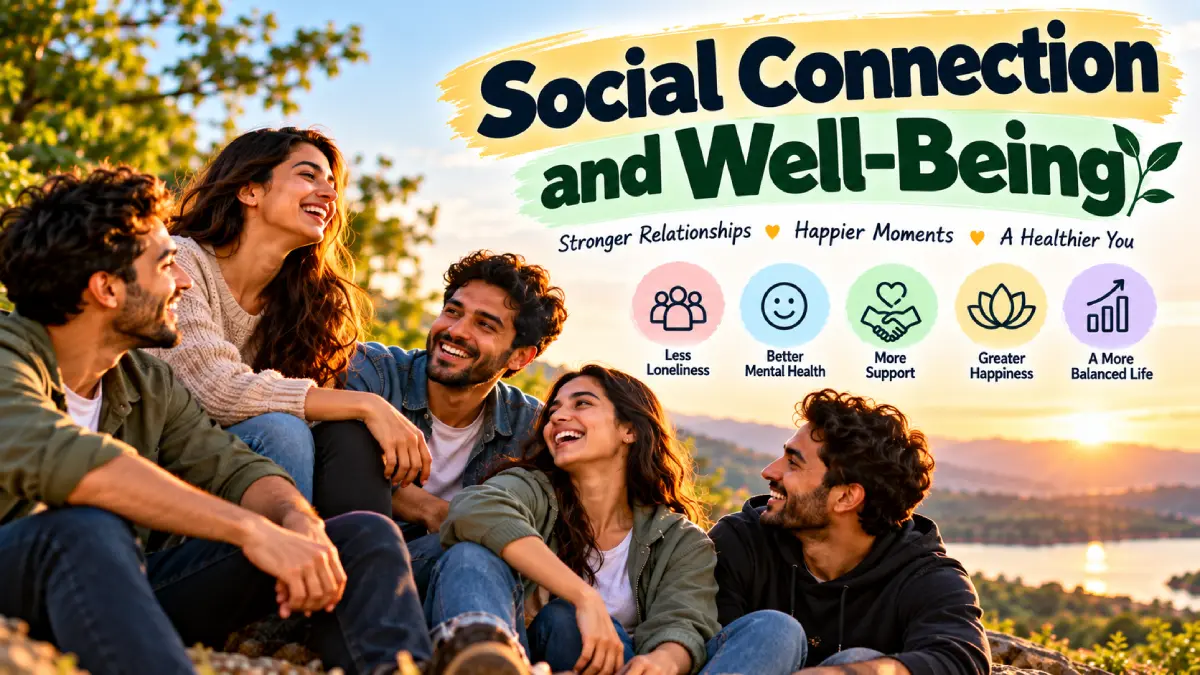
Connecting with Others Is Good for Your Well-being Our social environment can affect the support, understanding and connection we feel in our lives. But connecting with others doesn’t necessarily imply having countless friends or going to a bunch of social events. It’s possible that a handful of meaningful relationships matter more than a lot of acquaintances.
A family chat, a good friend, an exercise buddy, a local club or just a casual ‘chat to the person you like to work with’ are all factors in the pursuit of connection. Just like exercise, healthy diet, sleep and dealing with stress and others, healthy relationships contribute to your mental health.
What Is Social Connection?
Feeling connected with others. Social connection is the feeling that you belong, have meaningful relationships and are able to interact with the people around you who can give support, care, companionship or understanding.
Connection can come from many places:
- Family
- Friends
- Partners
- Coworkers
- Neighbors
- Sports teams
- Fitness groups
- Community organizations
- Hobby groups
- Faith communities
- Volunteering
A good social connection is more than just having a large social network. You can be in a room full of people and still feel alone. Conversely, a person with a limited social network may experience a stronger social connection.
Why Social Connection Matters for Well-Being
Humans are inherently social beings. The people we care about can serve as a source of validation and encouragement when we are going through hard times, a little bit of companionship on otherwise boring days, and a celebration of achievement. Reflecting the importance of social connection, the human connection advisory published by the U. S. Surgeon General has identified social connection as a determinant of health. Healthy relationships may afford us various kinds of support.
Emotional Support
At times you do not require someone to give you the answer. There are times you just need someone to listen to you. Having the opportunity to talk frank to a trust person can bring you relief during the taxing times.
Practical Support
And friends can also offer support in concrete ways. They might pick you up when your car stops running. They might watch your children when you have to work late. They might drive to the gym with you when you lose your zest. Small gestures like these help with little problems.
A Sense of Belonging
Having the “sense of belonging” to a group what we do in life family, friends, sport team, neighborhood, place of work, community, where we look around and feel at home can be psychologically helpful.
7 Ways to Build Stronger Social Connections
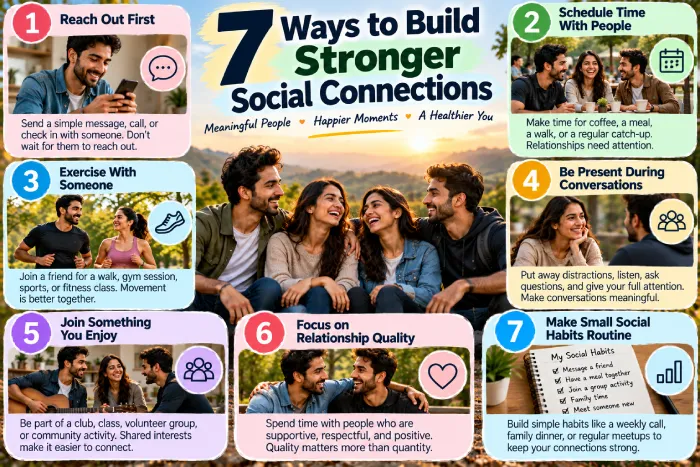
You do not have to have to reconstruct your social lifetime. Small your very first step.
1. Reach Out First
It is quite effortless to make people contact you, but try the other way around. If you want this make a move. Send him a message that says:
How are you?
You don’t need a specific reason to reconnect.
2. Schedule Time With People
Relationships can become incidental when we‘re busy. Several weeks pass without seeing someone you love or care about. Take time intentionally schedule a coffee, or an evening meal, or a walk on the weekend or a quick phone call. Relationships require attention just like any other significant aspect of life.
3. Exercise With Someone
Whatever type of exercise, it can be one of the easiest ways to fit in exercise while socialising.
Try:
- Enjoying a walk with your friend
- Running Group membership
- Options for losing weight beyond the gym Here are some things you could do that aren‘t strictly in the gym : 1. Going to a fitness class
- Participated in recreational sporting activities
- Training with a workout partner
- Walking with family
You need not sacrifice one for the other: if you can manage to spend time with others who also exercise, then you are getting social time and exercise at the same time.
4. Be Present During Conversations
Being physically close doesn’t always mean you are engaged. Consider the scenario of catching up with a close friend while looking down at your smartphone every time your phone makes a sound. You are together in the same place but not really. Try taking your phone out of reach while you talk. Pay attention. Ask questions. Pause and allow space for response. These slight shifts in your attentiveness can help make your interaction more satisfying.
5. Join Something You Genuinely Enjoy
The fact that forming new links is hard is probably a res onwhy it is so pleasant when two strangers recognize they have something in common. Doing something together can greatly facilitate the development of the link:
Consider:
- Finess classes
- Sports clubs: I will reflect on the current functioning of the sportsclubs and propose prospective developments that are desirable.
- Book clubs.
- Cookery sessions
- Volunteering
- Walking groups.
- Community events
Hobbies on the account of the artist ॥• Participatory role of the gallery for sure or participated: artistic activity can be entered into the body, but expresses: in this forum.
Find something you find interesting by yourself rather than as a reason you are not sensitive to d..
6. Focus on Relationship Quality
More connections do not always equal better. A good, healthy connection/relationship usually involves respect, trust, talking and just the right boundaries.
Ask yourself:
- Am I valued when I’m with this individual?
- Is it possible for us to speak forthright?
- Existence of boundaries:enter-if both individuals are working (or willing) to respect each other‘s boundaries?
Relationships do not have to be ideal, however, they should not be constantly leaving you feeling manipulated, degraded, or threatened.
7. Make Small Social Habits Routine
Connection, in fact, is not necessarily validated by a big occasion.
Try simple habits:
- Monday: communicating with a friend.
- Wednesday: Have dinner with theFamilyTurn off your phone while having family dinner.
- Friday : go exercise with one of your friends.
- Weekend: stop by a relative house or go to a community action.
A small step towards feeling more connected.
Social Connection vs Social Media
Social media allows us to keep connected – albeit from a distance. But these mediums are not a perfect substitute for authentic connection. Think about your social media behaviors. Are you actively engaging in conversations with loved ones? Or are you just mindlessly scrolling through other people’s update for an hour? Use technology liberally to stay connected instead of substituting it as a replacement for all forms of human interaction. A text can be a phone call. A group chat can be a weekend walk.
What If You Feel Lonely?
You can find yourself feeling lonely even when you are in the company of others.
Start gently.
Connect with one trusted individual, participate in an organized activity, volunteer at a community place where people interact with each other on a regular basis, or belong to a community where interaction occurs spontaneously. If ongoing loneliness induces overwhelming pain or adds to existing anxiety, depression or mental-health problems, consult a health-care or mental-health expert.
Conclusion
Connecting with others and your own well-being isn‘t about trying to be the most social person in the room: if you are feeling good, a little regular connection including a small network of them, socializing a few times a week, doing things with people, community engagement, and being a little more physically present with the loved ones in your life can help. Small steps: call someone up, go for a walk with a friend, eat without your phone, do something you find fun. Good relationships will not cure every problem, but they will offer something most other wellness practices can‘t the reassurance that you don‘t have to face all this alone.