

Mohd Arbaaz is an Editor and Writer at Fitnessison.com with 5 years of experience in SEO and digital content creation. He creates informative, reader-focused content covering fitness, workouts, nutrition, health, healthy lifestyle, technology, and computers.

Shashi Teja is a Reviewer at Fitnessison with over 6 years of experience in SEO, content strategy, digital publishing, and content optimization. He reviews content for clarity, research quality, topical relevance, readability, structure, and overall usefulness to readers.
Last Updated: September 26, 2026
Breathing Techniques for Stress Relief can be When life gets a little overwhelming, breathing exercises can be unexpectedly helpful. You don“t need special equipment, a quiet studio, or 30 minutes of free time. In most situations, you merely need to find a comfortable spot and spare a couple of minutes. Almost no one pays much attention to breathing.
Recall those times when you were rushing to complete a project, waiting in traffic, or expecting an important phone call. You might have felt your shoulders tightening, your mind racing, or your breath accelerating. That‘s where intentional breathing comes in handy.
It doesn‘t remove the problem. Deadline still exists. The traffic still parked. But reduce the traffic for a couple of minutes could make you feel a little less overwhelmed, so you can take your decisions patiently. These are five methods of breathing I would recommend to try.
5 Breathing Exercises for Stress
1. Start With Simple Slow Breathing
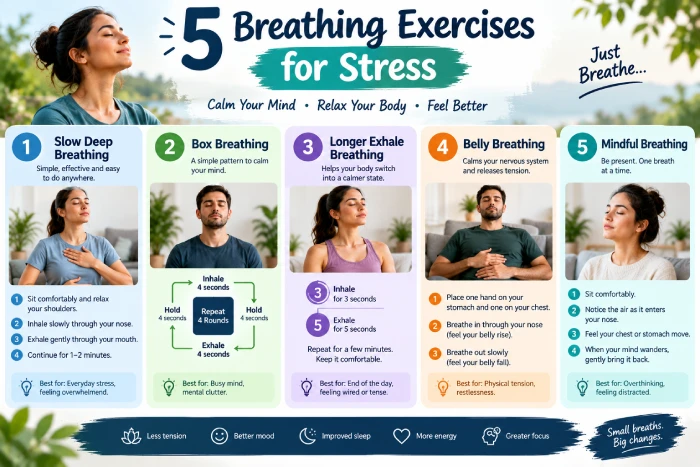
No need to start with a difficult method. Sit in a comfortable position and relax your shoulders. Take a slow breath through your nose and then a gentle exhale. Don‘t attempt to achieve deep breaths. Simply reduce your daily breathing more gradually. Keep doing this for a one or two. I find this method A are almost nothing to remember. You aren’t counting seconds or worrying about whether you’re doing it perfectly. You’re simply slowing things down. Try it before a meeting, after finishing work, or whenever you catch yourself feeling tense.
2. Try Box Breathing When Your Mind Is Busy
If merely “slow breathing” seems to generalize too much, box breathing offers additional order and precision:
The basic pattern looks like this:
- Breathe in for four counts.
- Hold four is used in an instance of a break.
- Exhale for four seconds:
- Hold for 4
Then do it again. The numbers don‘t matter. If four counts are awkward, go shorter. What makes box breathing a useful tool is that it demands your attention. When your mind is running around between emails, bills, deadlines, and planning tomorrow, counting your breaths gives your mind a break even if just for a moment. It might take only a few.
3. Make Your Exhale a Little Longer
This is one of the simplest ways to add to your evenings. Breathe in easily for about three seconds. Breathe out easily for about five seconds. Repeat without straining. No need to time yourself with a stopwatch. It’s just a way to extend your exhalation by a few more seconds than your inhalation while remaining completely relaxed. Use it when you’ve finished work but your mind hasn’t shut down yet. It’s easy to combine with other stress-reduction behaviors, like stretching, walking or stepping away from your computer or phone.
4. Practice Belly Breathing
Put one hand around your stomach and place the other on your upper chest. Breathe normally now. Feel your stomach rising as you breathe in. Take your time breathing out and let your stomach fall back down. That‘s all there is to it when it comes to belly, or diaphragmatic, breathing. Don‘t get so caught up in thinking about whether or not your stomach is moving enough or your chest too much that you lose sight of what the exercise is about. Just use your hands as a means for simple awareness of your breathing. Do this for a few minutes sitting comfortably or lying down.
5. Forget Counting and Just Notice Your Breath
Some people think it is relaxing to count, while some think it is a pain. If you are in the second group mindfulness of breathing may be better. Sit comfortably. Pay attention to your normal breathing. Notice the cool feeling of air coming in through your nose. Notice your chest or stomach rising and falling. Notice your exhale. Soon you will begin to think about something else. Dinner, work, that email you meant to reply too. That‘s perfectly fine and natural. When you notice your mind wandering, return it to your breathing. Don‘t get angry at yourself.
Which Breathing Technique is the Right One For You?
That‘s not necessary.
| Feeling…. | Try… |
| Generally tense | Slow breathing |
| Mentally scattered | Box breathing |
| Evening wired | Longer exhales |
| Physically tense | Belly breathing |
| Distracted or Badly overwhelmed | Mindful breathing |
Give a new tip a shot for a few days before you determine whether you prefer it. You can‘t use all five to the fullest.
A Five-Minute Reset for Busy Days
Here‘s something you can do right now, in a typical workday. Set your phone aside. Find a comfortable position. For the first minute, simply observe what you are experiencing at the moment. Then breath slowly for two or three minutes. Loosen your jaw. Unload your shoulders. Relax your hands. For that last minute, ask yourself:
What actually needs my attention next?
- Perhaps you require to complete a task.
- perhaps this his time for lunch.
- Perhaps you have to go for a walk around the block.
- The problem, perhaps, can be put off until tomorrow.
An often overlooked aspect of stress management. As much as calming yourself down can help, you will still need to address the problem sometime.
Don‘t Turn Breathing Into Another Task to Perfect
One mistake that is easy to fall into is overcomplication of relaxation. Relaxation is simple. It doesn‘t require the best breathing app. It doesn‘t have to be 10 minutes every day. Skipping a day doesn‘t mean your practice is over. Two minutes of quiet between meetings still counts. Another mistake is breathing deeply and rapidly because you think more air will equal more relaxation. It doesn‘t.
Maintain comfortable breathing. If you get symptoms such as dizziness or dizziness when under specific breathing channels stop and normalise your breathing, people with respiratory, cardiovascular or other relevant medical conditions are advised to seek medical advice before experimenting with the extended breath hold breathing methods.
Make It Part of Something You Already Do
The new habits are easier to remember when the attach to our good old habits. You could try breathing: After you switch off your work PC. Before you jump into your bed. After a workout. Sitting in the car is ready parked before you walk into the office. After brushing your teeth. No need to add another reminder on your phone. Put it use something you already do every day as your cue.
Final Thoughts
You don‘t need to make breathing exercises for stress too complex in order for them to work. Slow breathing, box breathing, lengthening the exhale, belly breathing, and breathing mindfully simply give you a straightforward way to take a break in a stressful day. Choose the technique that feels right and easy rather than what sounds best. Do it for a couple of minutes. Notice how you feel. And remember that breathing exercises are only one piece of the puzzle. Exercise, sleep, time away from screens, supportive relationships and addressing the essentials of life are all important too. For now, you can‘t change everything that is going on around you. But taking a couple of quiet minutes before trying to figure out what to do next can be a start.