

Mohd Arbaaz is an Editor and Writer at Fitnessison.com with 5 years of experience in SEO and digital content creation. He creates informative, reader-focused content covering fitness, workouts, nutrition, health, healthy lifestyle, technology, and computers.

Shashi Teja is a Reviewer at Fitnessison with over 6 years of experience in SEO, content strategy, digital publishing, and content optimization. He reviews content for clarity, research quality, topical relevance, readability, structure, and overall usefulness to readers.
Last Updated: September 26, 2026
Relaxation methods are easy things that you can do to simply help you to relax, ease your muscles and regain from daily stress. What can they be? Relaxation methods can be different, they can be breathing, exercising, meditation, stretching, out side, sound sleep or just having a walk away. Stress is part of everyday life. A busy, busy day at the office, a hectic family timetable, financial difficulty, a night of interrupted sleep or an unexpected problem may all make you feel totally stretched. It is not always possible to remove the stress, but you can alter your response to it. The following are some of the ways you can combat daily pressure.
8 Stress Relief Techniques
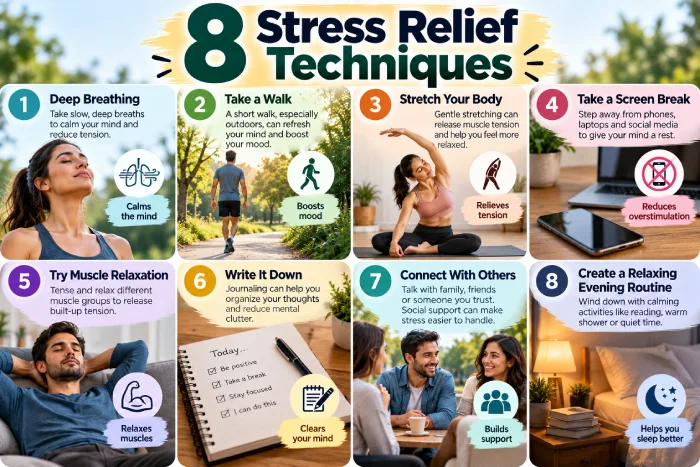
1. Practice Slow, Deep Breathing
The best stress buster in the world. This is something free and which nobody needs to know about so you can do it any where any time. When you are stressed you tend to sit a little less relaxed and breathe faster or more shallow. Concentrate on slowing down your breath then.
Try this simple exercise:
- Sit comfortably.
- Loosen your shoulders.
- Take a deep, diaphragmatic breath in through your nose very slowly.
- Exhale gently.
- Write above for a few minutes.
Try not to get too caught up in memorizing some difficult breathing rule. Slow, natural, comfortable breathing is all you need.
Here‘s a tip: Do this before a nervous presentation, after work, or when you find yourself tense.
2. Go for a Short Walk
There is no requirement of vigorous activity to make movement a tool for stress management. A quick walk is still a change of scenery and a great way to transition your brain to your legs if the weather is agreeable. Get outside if you can. Carry your phone in your pocket and be aware of your environment.
Can you feel the temperature, trees, buildings, sounds, and your breathing? A few minutes of just moving can be more feasible in a 24 hour day than an entire hour workout. If you would like more information about incorporating physical activity into your daily routine, check out our stress management tips.
3. Stretch Tight Muscles
Most stress is accompanied by physical tension as well. Are you pulling your shoulders up to your ears, or biting the top of your head off? Allow yourself a moment to stretch gently for five minutes.
Focus on areas such as your:
- Neck
- Shoulders
- Upper back
- Hips
- Legs
Some of you may experience pain rather than comfort while stretching (especially as time goes on and you might be more flexible). Don‘t worry- stretching (in the simple sense) is not supposed to be a hard workout. It is just a form of loosening up.
4. Take a Break From Screens
Sometimes your brain just receives way too much information. Our inboxes, social media, news updates, TV, work notifications, and more all require our focus.
Try switching off from your devices for a little while. Put your phone out of sight. Close excess browser windows. Deactivate any non-urgent pop-up messages. And then spend 10-15 minutes away from the wired world. Brew a cup of tea, step outdoors, stretch, tidy up your space, or just sit.
The goal is not to rid ourselves of technology. In fact, the goal is for technology not to have moments when it is seducing your attention away.
5. Try Progressive Muscle Relaxation
Progressive muscle relaxation involves tensing and relaxing various muscle groups intentionally. An example would be to gently tense your hands for a few seconds then release. Then proceed to a different muscle group. This aids in creating awareness of the contrast between tension and relaxation. It can be effective in the evening when you are physically tired but still feel “switched on”.
6. Write Down What‘s Stressing You
Feeling overwhelmed can be heightened when multiple issues are vying for your attention. Putting them in writing might help you sort them out.
Make two columns:
| I Can Control | I Can‘t Control |
| Today’s priorities | Others’ opinions |
| My bedtime | Unexpected delays |
| Requesting assistance | The weather |
| Pausing (or Taking a Time out) | Past events |
Pick one small thing from the first column. Sometimes, stress relief is not relaxing. It is thinking through on small, manageable problem.
7. Spend Time With Supportive People
There’s no reason to bear all the stress alone. Vent to a confidant. Friend, girlfriend/boyfriend/partner, family member, co-worker, therapist or just, someone who cares. You may not even need advice. Simply speaking your troubles out loud can help you to clarify your thinking and ease feelings of loneliness. Use your social supports should be one tool in your wide stress-management toolbox rather than reserved for overcoming stress at the extreme end of the spectrum.
8. Create a Relaxing Evening Routine
Stress can also come along to bed with you. Prepare an easy transition from the busy day you have had to settling down to sleep.
Your routine might include:
- Availability to complete work at a specified time
- Having a hot shower
- Stretching gently
- Reading
- Reducing bright lighting in the room; the lights are quite bright and therefore this will be quite conspicuous.
- The food you need for tomorrow‘s stops.
- Practice slow breathing (according to p. 13 by inhaling through the nose, slowly breathing in and out, while co2 level in the blood reaches about 1/3). After breathing in through breath 10, 20, even 30 in a row and holding it for air for about 2 minutes, then breath out.
Remember to stay realistic. You do not have to be doing a two-hour whole wellness regime. A 20-minute wind-down you can do each time is much better than a shot-in-the-dark, ideal albeit inconsistent wellness practice.
Which Stress Relief Method Is Best for You?
No one approach is appropriate in all cases. A technique is only effective when suited to and appropriate to the circumstances.
- If your body is tight, try walking or stretching.
- Remember if your mind is racing: Do slow breathing or writing your thoughts down.
- Too much information? Take a break from anything electronic.
- Get in touch with a person you can rely on If feeling lonely.
- If stress frequently comes home with you in the evening, practice your bedtime routine.
When Stress Relief Isn‘t Enough
Stress management may help cope with daily pressures, but cannot resolve everything. Chronic stress may require long-term treatment for the underlying cause. You may wish to seek the advice of a trained health-care or mental-health professional if stress becomes unmanageable, persistent or begins to affect your sleep, work, relationships or daily life.
Final Thoughts
Some of the best ways to de-stress are surprisingly easy. Going for a stroll, napping, slowing breathing, stretching, turning down the level of stimulation in the environment, being with loved ones, and creating a more relaxed pre-sleep rhythm are simply a matter of incorporating into your life. Firstly, pick only one technique to work with and stick to it. Use it as often as you can and note the response. the best way of reducing stress is through adopting a full healthy lifestyle with exercise, sleep, recovery, eating, building relationships and setting boundaries in a way that allows them to be realistic and achievable.