
Mohd Arbaaz is an Editor and Writer at Fitnessison.com with 5 years of experience in SEO and digital content creation. He creates informative, reader-focused content covering fitness, workouts, nutrition, health, healthy lifestyle, technology, and computers.

Shashi Teja is a Reviewer at Fitnessison with over 6 years of experience in SEO, content strategy, digital publishing, and content optimization. He reviews content for clarity, research quality, topical relevance, readability, structure, and overall usefulness to readers.
Last Updated: September 26, 2026
The ability to cope with stress is not about leading a stress free life, it is about learning to recognize the stresses that occur to you, cope with them better, recover from stressful times and develop a routine that will enable you to cope better with the stresses of everyday life. You will experience stress. Your career, your bank account, your marriage or singlehood, your family life, concerns over your health, poor sleep, or even a full schedule can blow you off course.
Not all stress is bad. A little can help you stay focused during a crucial deadline, or respond more quickly to a crisis. However, if the stress never seems to go away your body and mind may not get the chance to rest. According to the CDC: “While occasional stress is a normal part of life, chronic stress can make health problems worse.”
This is why worry or stress management actually becomes part of living healthily along with training, eating, sleeping and recovery. This is why this guide presents the overview. From here, you can explore the individual strategies that fit your life in greater depth.
What Is Stress Management?
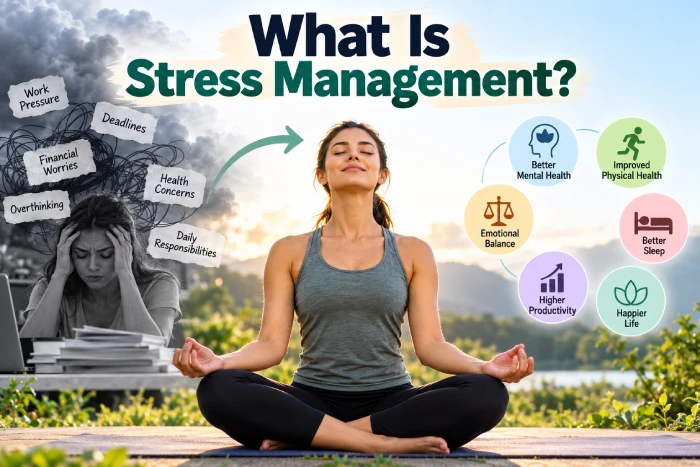
Managing stress involves recognizing your stressors and utilizing good mental, physical, behavioral, and lifestyle methods to cope and recover from said stressors. Stress is the body‘s response to a demand or challenge. The response can be mental or physical, and if the challenge is recognized by the brain, the body will activate the stress response, which leads to certain physical manifestations such as Q: Identification of stressors (sources of stress): A: -or, mental factors: Q: Responding to stress: A: -heat rate -blood pressure -states of attention and perception That reaction can be useful temporarily. The problem is when your system seems to stay switched on.
Stress Management Doesn’t Mean Eliminating Stress
Suppose you have an important presentation tomorrow. You might get a little worried which might motivate to it to do some preparation. You review your notes, practice your presentation and arrive prepared. Now imagine feeling that same level of pressure every evening for months. Your recovery time disappears. That‘s the value of stress management. It‘s not about living a lifestyle where stress doesn‘t exist; it‘s about having a better response to life.
A Simple Stress-Management Outline
Think of it as four steps:
- Recognize → Respond → Recover → Repeat
- Recognize: What is creating pressure?
- Respond: Is there anything you can change?
- Recover: What helps your mind and body return toward a calmer state?
Key Takeaways
Stress managementis aboutnot adding stressthat can be avoided andabouthow you deal with stress that need not be avoided. There is no simple solution it is usually not one thing to the rescue. For many movement, sleep, relaxation, social contact, action and practical problem solving works far better than one “stress hack”.
Mini Summary
You cannot control every deadline, traffic jam, bill or difficult conversation. You can work on your response. Want the deeper explanation? Read our guide to what stress management is.
How Stress Affects the Mind and Body
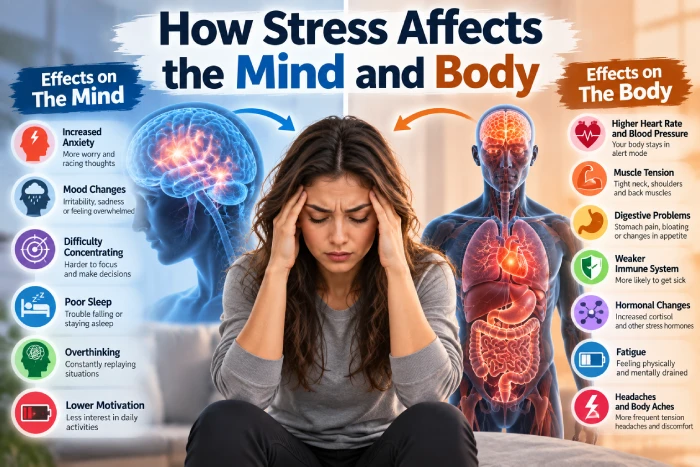
Stress isn’t simply a thought. Your brain and body communicate constantly during stressful situations. A short stress response can help you react quickly. But chronic stress means the body’s stress systems are activated repeatedly or for extended periods. Long-term activation of the stress response is also linked, according to the Mayo Clinic, to such issues as headaches, difficulty sleeping, and other health concerns.
Common Signs of Stress
Stress manifests differently in different people.
You might notice physical signs such as:
- Headaches
- Muscle tension
- Fatigue
- Digestive discomfort
- Difficulty sleeping
Or you might notice changes in mood and behavior, including:
- Irritability
- Worry
- Trouble concentrating
- Feeling overwhelmed
- Changes in appetite
- Pulling away from normal activities
Stress can also influence the behaviors that normally help you stay healthy. After an exhausting day, cooking dinner may feel harder. You may skip your workout. You may stay awake scrolling because you want some time to yourself. Then you sleep poorly. The following day begins with less energy—and another stressful day can feel even harder.
The Stress-Recovery Balance
One useful way to think about stress is:
Demand → Stress Response → Recovery
The demand is not always the problem. Insufficient recovery can be. This principle is familiar in fitness. Training creates physical stress. Recovery allows adaptation. Daily life works differently, but the same basic idea helps illustrate why periods of rest matter. You need opportunities to shift away from constant demand.
When Stress Becomes Chronic
Occasional stressful days happen. Chronic stress is different. Instead of recovering after a challenge passes, the pressure continues. This may occur when a person has a continuous period of financial strain, caring for others, work stress, difficulties in personal relationships or ongoing stress and uncertainty. It is important to note that you will not be able to reduce all of these chronic stressors with a five minute relaxation practice. Sometimes the stressor itself needs attention. That might mean changing your schedule, setting boundaries, asking for help or talking with a qualified professional.
Key Takeaway
Do not measure stress only by how “busy” you are. Notice how you are sleeping, thinking, eating, moving and recovering.
Mini Summary
Stress involves a real mind-body response. Just short term stress may be either absorbing, or even helpful, although long term stress needs to be given more recognition. Learn more in our guide how stress affects the mind and body.
Healthy Ways to Reduce Everyday Stress
Different methods of stress reduction may be effective for different people (including individuals at different times).
That‘s a gift. It leaves you opportunity to develop your own personalized stress management toolkit. CDC, Mayo Clinic, MedlinePlus and the American Heart Association all recommend combinations of positive behaviors, like moving, sleeping well, relaxing and being with caregiving people.
1. Identify What Is Actually Stressing You
“I’m stressed” describes the feeling. It doesn’t identify the problem. Try making the stressor specific.
Instead of:
“Work is stressing me out.”
Try:
“I have three deadlines this week and don’t know which one should come first.”
That gives you something to work with.
Ask:
Can I control it?
If yes, choose an action. If not, focus more heavily on your response and recovery.
2. Reduce Unnecessary Demands
Sometimes stress management means doing less. Look at your schedule.
- What actually needs to happen today?
- What can wait?
- What can someone else handle?
- What did you agree to simply because saying no felt uncomfortable?
Prioritization and setting reasonable limits are practical stress-management tools, not signs of laziness.
3. Protect Your Sleep
Stress and sleep can become a frustrating cycle. Stress makes switching off difficult. Poor sleep can leave tomorrow feeling harder. Create a predictable wind-down period where possible. Dim the stimulation. Finish demanding tasks earlier. Put work away. Reduce unnecessary screen use near bedtime. Do something that tells your brain the active part of the day is ending.
4. Stay Connected
Stress often encourages isolation.
You may think:
“I’ll talk to everyone once I get everything sorted.” Sometimes talking is part of sorting things out. Call someone. Take a walk with a friend. Eat dinner with family. Ask for practical help when you need it. Social support is a recurring recommendation across major stress-management resources.
5. Use Short Recovery Breaks
Not every stress-management activity needs 60 minutes.
Try:
- 2 minutes: slow breathing.
- 5 minutes: step outside.
- 10 minutes: walk without checking your phone.
- 15 minutes: stretch, journal or sit quietly.
- 30 minutes: exercise, take a longer walk or practice a relaxing activity.
Taking small breaks won‘t fix serious life issues, but it can help you regain some composure during the course of a tough day.
Unhealthy Coping Patterns
Some habits may temporarily, but not effectively, provide distraction from stress. Alcohol consumption, drug use, and emotional overeating or procrastination can serve as examples. General sources such as MedlinePlus or Mayo Clinic specifically warn against using these counterproductive behaviors as a coping response. Perfection is not necessary. When you become aware of the pattern, substitute it with a more appropriate response.
Key Takeaways
Start with your stressors. Separate controllable problems from uncontrollable ones. Then build recovery around the things you cannot immediately change.
Mini Summary
Often, good everyday stress management is a result of several minor daily actions rather than a major, high-impact change in lifestyle. Discover other simple ways to reduce everyday stress.
How Exercise and Relaxation Support Recovery
Exercise is one of the most useful tools in a broader stress-management plan.
You do not need an extreme workout.
- Walking counts.
- Cycling counts.
- Strength training counts.
- Yoga counts.
- Playing a sport counts.
Even household activities can get you moving. Mayo Clinic recommends physical activity as one option for stress relief, while a 2024 systematic review of 31 studies involving 1,386 adults found that acute exercise produced reliable reductions in blood-pressure and cortisol reactivity to laboratory stressors, although effects differed across other measures.
Exercise Gives Your Attention Somewhere Else to Go
Stress can trap your attention in loops.
- You replay a conversation.
- You imagine tomorrows problems.
- You check your inbox again.
- Movement gives your attention another target.
- Your breathing.
- Your steps.
- Your repetitions.
- Your surroundings.
That temporary shift can be valuable.
But More Exercise Isn’t Always Better
This matters on a fitness website. Exercise itself is abusive. In theory, if you‘re training intensively every day, sleeping poorly and just feeling body-wise drained, then doing yet another punishing workout should be the simple logical next step.
- Adjust the activity to your current capacity.
- A hard training session may feel great on one day.
- A 20-minute walk may be more appropriate on another.
Stress management should support recovery, not become another source of pressure.
Relaxation Techniques
Relaxation gives you a different route.
Common techniques include:
- Slow breathing
- Meditation
- Progressive muscle relaxation
- Guided imagery
- Yoga
- Mindfulness
The National Center for Complementary and Integrative Health states that “relaxation techniques typically bring together breathing methods with certain mental techniques or procedures to decrease muscle tension and bring about a relaxed experience”.
Try the “Movement + Downshift” Approach
Here’s a simple example. Walk briskly for 15–20 minutes. When you finish, sit somewhere comfortable. Spend a few minutes allowing your breathing to settle. Then continue your day. Movement gives your body an outlet. The quiet period gives you a transition. You do not need special equipment.
Key Takeaway
Exercises and relaxations serve different purposes. Being active can help you to feel energised, empowered and mentally clear. Relaxation techniques tend to help facilitate intentional moments of lower intensity Both can belong in the same stress-management plan.
Mini Summary
Choose movement that matches your energy and fitness level, then give yourself opportunities to recover. Go deeper with our guide to exercise and relaxation for stress.
How to Build a Stress-Management Routine
When you know 20 moves by heart, you are not much closer to breaking a habit than if you use three. When you use a stress-management sequence, you have a ready framework for healthy reactions. Keeping it simple is the key.
Step 1: Find Your Biggest Stress Triggers
For one week, notice what tends to happen before your stress rises.
Maybe it is:
- Checking email immediately after waking
- Back-to-back meetings
- Skipping lunch
- Commuting
- Money discussions
- Lack of sleep
- Too many commitments
- Late-night work
Do not judge the list.
Observe it.
Step 2: Choose One Action for the Stressor
Suppose your afternoons are chaotic because everything feels urgent.
Your action might be:
At 1 PM, choose the three tasks that actually need to be completed today.
- That is stress management.
- Not glamorous.
- Just useful.
Step 3: Choose One Daily Recovery Habit
Pick something you can repeat.
For example:
10-minute morning walk
or
5 minutes of breathing after work
or
No work email during dinner
Do not start with six new habits. Start with one.
Key Takeaway
Your routine should work on difficult days—not only ideal days. If your plan requires perfect motivation, plenty of free time and unlimited energy, simplify it.
Mini Summary
Consistency beats complexity. A small routine that you actually follow can be more useful than an elaborate wellness plan that lasts three days. Use our complete guide to building a stress-management routine.
Common Stress-Management Mistakes
Trying to Eliminate All Stress
A completely stress-free life is not realistic. The goal is better coping and recovery.
Waiting Until You’re Overwhelmed
Stress management works better as maintenance than emergency repair. Practice healthy behaviors during normal weeks too.
Turning Wellness Into Another Competition
You do not need the perfect morning routine. you do not need to meditate longer than everyone else. You do not need to train every day. Your stress-management routine should reduce unnecessary pressure rather than create it.
Ignoring the Stressor
Breathing exercises may help you calm down. They cannot finish an overdue project. Sometimes the appropriate strategy is direct problem-solving.
Using Only One Technique
Exercise is useful. So is sleep. So are relaxation, boundaries and social support. Stress is multifaceted, so your coping system can be too.
Myth vs. Fact
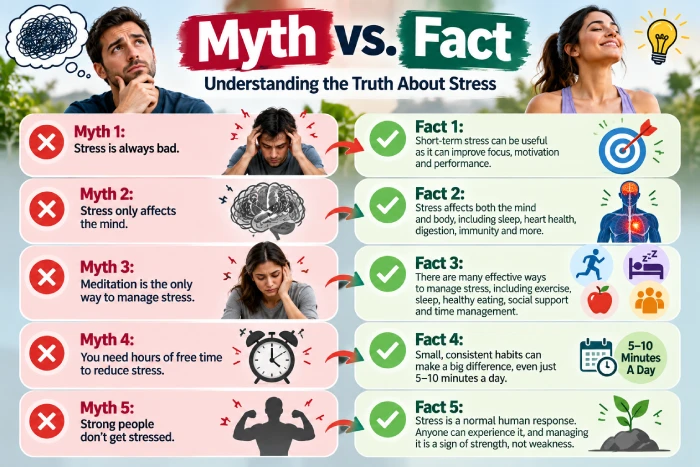
Myth: Stress Is Always Bad
Fact: Stress is a temporary human response to life challenges and could of help concentration and action.
Myth: Stress Management Means Meditation
Fact: Meditation is one method among others. Exercise and sleep patterns, time management skills, relaxation, healthy relationships and challenging problems can be employed in stress management.
Myth: You Need an Hour a Day
Fact: Little things can be fitted into your entire day, a couple of minutes walk, a breathing break or an achievable priority list are a good place to begin.
Myth: Strong People Don‘t Get Stressed
Fact: stresses is a common human reaction. learning to manage stress is about learning how you notice, react to and recover from it.
Troubleshooting: What If Stress Management Isn’t Working?
First, look at what you are trying to solve. If your stress comes from a temporary busy week, basic recovery habits may help. If your stress comes from an ongoing problem, you may also need to address the underlying situation.
Ask:
- Is the stressor temporary or ongoing?
- Is it within my control?
- Am I sleeping enough?
- Am I recovering between demanding periods?
- Am I expecting one technique to solve a bigger problem?
- Do I need support?
Recognizing the limits of stress management is important. It is never a substitute for a mental health professional or other medical help. MedlinePlus states that if symptoms have existed for two weeks or more or interfere with normal functioning, one should seek help. Anyone who is having thoughts of suicide or inability to cope or drastically increases drug or alcohol use should seek help immediately. The U. S. offers the 988 Suicide & Crisis Lifeline, available by phone, chat, or text 24/7.
A Simple Daily Stress-Management Example
You don’t have to redesign your life overnight.
Try this framework:
| Time | Habit | Purpose |
| Morning | 5–10 minutes of movement | Start actively |
| Breakfast | Eat without checking work constantly | Reduce immediate stimulation |
| Midday | Short outdoor walk | Mental break |
| Afternoon | Review top priorities | Reduce task overload |
| After work | Exercise or relaxing movement | Transition away from work |
| Evening | Connect, relax or enjoy a hobby | Recovery |
| Before bed | Reduce work and stimulating screens | Prepare for sleep |
Use it as a template, not a rulebook. Someone working night shifts will need a different schedule. A parent with young children will need more flexibility. Someone training for an athletic event needs to consider exercise recovery too. Personalization matters.
Stress Management and the Future of Wellness
Stress management is becoming increasingly connected with broader lifestyle health. Wearables can estimate measures such as sleep, heart rate and heart-rate variability. Apps can guide breathing, meditation and habit tracking. Artificial intelligence can help organize schedules or identify patterns. But technology has limitations. A device cannot fully understand your relationships, financial situation, workplace culture or emotional experience.
Interestingly, technology itself can also become a stressor. In APA’s 2025 U.S. survey, 57% of adults identified the rise of artificial intelligence as a significant source of stress, compared with 49% in 2024. The future of stress management therefore probably isn’t simply “more technology.” It is likely to involve using technology selectively while protecting basic human behaviors: Movement. Sleep. Recovery. Relationships. Boundaries. Meaningful offline time.
Final Conclusion
Learning how to cope effectively with stress is not about eliminating stress, but about dealing with it more healthily, handling the effects and moving on.
Start small.
Determine what‘s actually causing stress. Alter the things you are able to control. Maintain your sleep and rest. Get your body moving. Dedicate time to unwinding. Keep in touch with the people who are there for you. And know when it‘s time to seek help.