

Last Updated: September 16, 2026
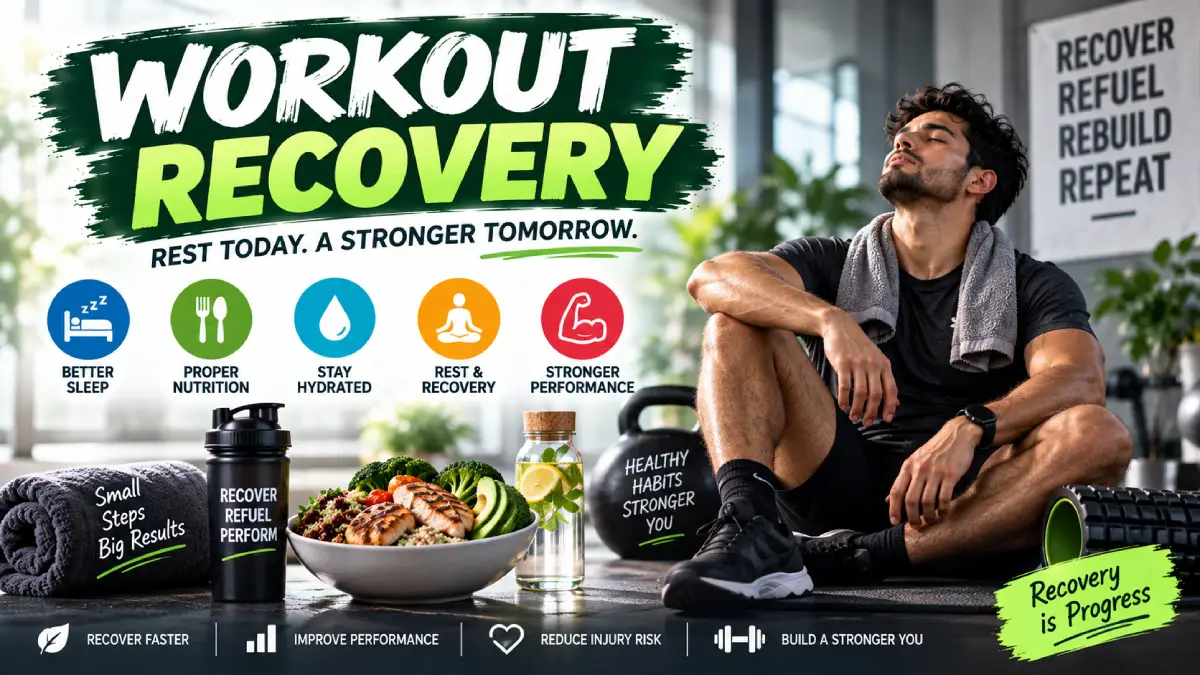
Workout recovery occurs after the workout. During this time your body repairs damaged tissues, replenishes depleted energy sources, adapts to the workout and prepares for your next training session. When it comes to training, it‘s pretty easy to be consumed with the workout itself. You‘re watching the stopwatch, jotting down reps and total tonnage, or adding intensity by increasing the run pace. But training is only one side of the coin; recovery is where you body has the opporcun ty to adapt to that training.
But it is not saying you have to sit on the couch all day during each rest day. It is about recovery strategies with sleep, healthy/hydrating eating, rest, mobility work, a little light activity, I.e. walking, and training smarter, not just harder (depending on what you‘ve been doing). Your hard leg workout, long run, HIIT workout, casual walk, and yoga class. All of these are training, but they do not all stress your body in the same way. Use this guide to understand the (basic) science of workout recovery and then direct you to the more comprehensive resources for each step.
What Is Workout Recovery?
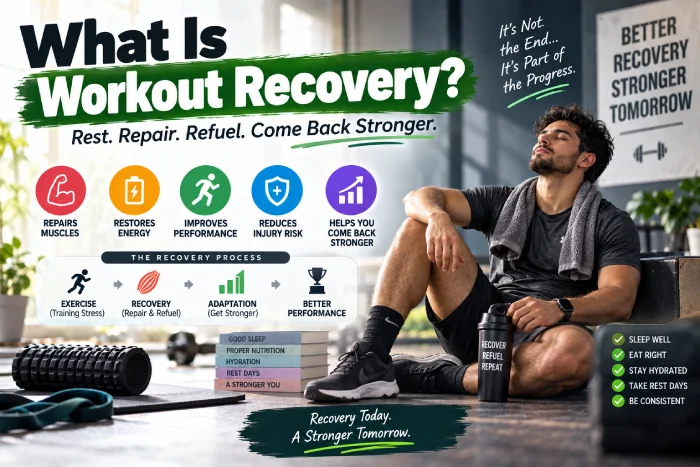
Workout recovery is the time and series of processes by which your body returns to a near-normal state post-exercise, refueling, repairing, and adapting to the training load. In intense exercise your muscles, cardiovascular, respiratory, endocrine, metabolism, and musculoskeletal systems are taxed. We need to time periods in between stress to repair tissues, replace energy, re-hydrate, and modify to the workload. Thus recovery is not downtime, it is time ‘in between’.
Key Takeaways
- Recovery begins when training stress decreases.
- Sleep, nutrition, hydration, and rest all contribute.
- Recovery can take hours or several days.
- Soreness is only one possible sign of recovery status.
- Your next workout should reflect how well you have recovered.
A Simple Example
Think of this example. You do a very intense lower-body strength training on a Monday. You might not feel anything right after the training, but the day after you‘ll definitely be feeling sore. Instead of doing the same heavy leg training again on a Tuesday, you could do a less demanding activity, like walking, mobilizations or a very light upper-body session. This gives the heavily trained muscles more time for recovery.
Mini Summary
Training creates the stimulus. Recovery allows your body to respond to it. For a more detailed explanation of the physiology and phases involved, look out for our next cluster guide on what workout recovery means.
Why Is Recovery Necessary After a Workout?
Recovery is important because you need to allow your body time to adapt to the current stress of training. Training too frequently without proper recovery can lead to fatigue, poor work sessions and hinder progress. It can also help you tell the difference between training effectively and just accumulating fatigue.
Recovery Supports Adaptation
Exercise provides a challenge. Your body soon adjusts to this stress. Proper rest and recovery can help you gradually increase strength, fitness, coordination and conditioning. This is part of why simply doing more work is not necessarily the solution. Cleveland Clinic suggests that incorporating recovery into your training program can help prevent injury breaks in training.
Recovery Helps Restore Energy
Exercise depletes those stores, especially muscle glycogen in most moderate and high intensity exercises. Consuming food in the post-exercise period can then assist with replenishing these stores. As recommended by the Mayo Clinic‘s recovery advice, uppermost in priority are carbohydrate, protein and fluid intake respectively.
Recovery Helps You Train Again
The goal is not simply to feel comfortable after exercise. The goal is to be prepared for your next appropriate training session. When you become all but exhausted for several days following each workout, your workload might be excessive relative to your present rate of recovery.
Key Takeaways
- Recovery supports adaptation.
- It helps restore energy.
- It can improve readiness for future workouts.
- It allows training to remain consistent.
- More exercise is not automatically better.
Practical Example
Somebody training for general fitness might perform:
| Day | Activity |
| Monday | Strength |
| Tuesday | Easy cardio |
| Wednesday | Strength |
| Thursday | Rest or walking |
| Friday | Strength |
| Saturday | Easy cardio |
| Sunday | Rest |
This is a sample only, not a rule of thumb. Your perfect training schedule will reflect your present level of fitness, your goals, the power, effort and intensity of your workouts, and your recovery capacity.
Mini Summary
Recovery is not time wasted between workouts. It is part of the training program itself. The following also address the advantages, a further cluster should explain the reasons why recovery works well after exercise.
Duration of workout recovery is there an optimal time?
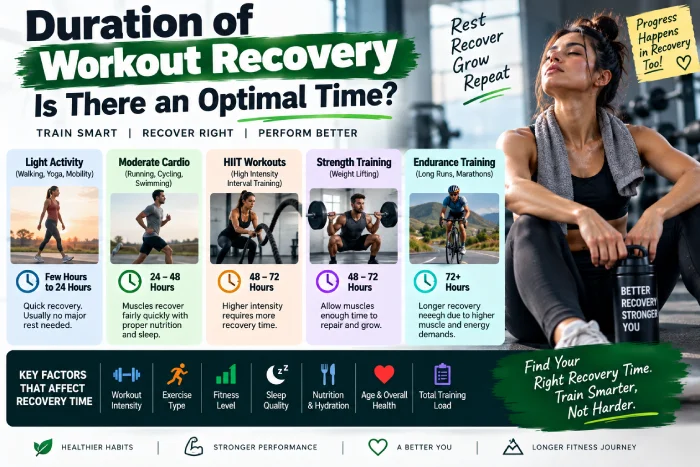
It’s the individual that determines how long the recovery takes. For most grueling workouts, a helpful rough estimate is about 24–72 hours but this will vary greatly by the nature and intensity of the training. According to Verywell Fit a general recommendation is about 24–72 hours for high intensity exercise or heavy lifting; more intense training as part of more demanding strength workout can require longer recovery.
Recovery Depends on the Workout
| Workout | Typical Recovery Consideration |
| Easy walking | Often minimal recovery needed |
| Easy mobility/yoga | Usually low recovery demand |
| Moderate cardio | Depends on duration and intensity |
| HIIT | Often requires more recovery |
| Heavy strength training | Frequently needs substantial recovery |
| Long endurance session | May require extended recovery |
| Competition-level effort | Can require several days |
These are broad categories somewhat than strict rules.
Muscle Group Matters
You can get your upper body fully recovered from a workout when your legs are gassed from an intense lower body workout that‘s why many strength programs alternate between the two.
Training Experience Matters
Newbie will might get sore with an workout that an hardened athlete can do without feeling pain. Training novelty may make you feel more sore or fatigued as your body is not yet adapted to that motion or magnitude.
Sleep and Nutrition Matter
People have varying recovery. Two people can do the same workout, and one could be recovered easier if they get good sleep, consume adequate calories, manage their training volume, and stay hydrated.
DOMS Can Appear Later
Here is: ‘Delayed-onset muscle soreness, peak at 1-3 days following difficult exercise’. Just because you feel good right after your workout doesn‘t mean you‘ve completed the recovery process.
Key Takeaways
- Recovery time will vary from person to person.
- Harder is typically more difficult.
- Muscle groups recover at different rates.
- Moving to more difficult training may cause more sore from new training, especially for beginners.
- The different stressors that impact on recovery include sleep, diet, fluid intake and training load.
Practical Example
Assuming you perform a hard squat workout on Monday and your legs are still really exhausted on Tuesday, perhaps doing another tough leg workout would not be the smartest move. An easier walk or some upper body work may be more logical.
Mini Summary
Don‘t make 48 hours some magic number 43. Use recovery time as a rough estimate for guidance; and watch for signs of performance decrements, feelings of fatigue, sore muscles, quantity and quality of sleep, and overall feeling during warm-ups. In context, this deeper cluster should help determine how long the workout recovery interval is for strength training, cardio, high intensity interval training, running, and other fitness levels.
The 5 Foundations of Effective Workout Recovery
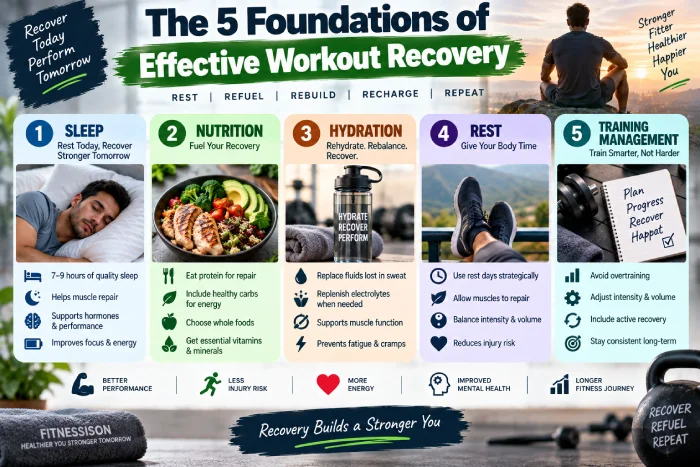
Most people do not need an elaborate recovery routine. Start with the basics.
1. Sleep
Sleep is one of the most vital recovery habits. While you sleep, your body engages in many restoring activities, and it can hamper your physical and mental performance if you don’t get enough. Most adults require a minimum of 7 hours of sleep per night although this varies from person to person.
The 11 Cleveland Clinic‘s recovery advice calls for about 7-9 hours of sleep for most adults. If you are training hard consistently and sleeping badly, simply plugging in another recovery device is most certainly not going to be the answer.
Try this: Maintain a regular sleep time and secure your sleep opportunity following tough training sessions.
2. Nutrition
Recovery requires energy and nutrients. It is argued that protein is needed to supply the amino acids which aid in the repair and maintenance of tissues. Carbohydrates are required to restore muscle glycogen levels, especially if the workout was intense or lasted a long time. As a result, the Mayo Clinic recommends following a recovery formula consisting of ‘refueled with carbohydrate, repaired with protein and rehydrated with fluids’.
A practical recovery meal might include:
- Chicken with rice and vegetables.
- Smoked salmon accompanied by potatoes and salad
- Fruit and oat Greek yogurt
- Eggs served with toast made from whole-grain bread and fresh fruit
- A tofu dish served with rice and vegetables
- Any bean and rice plus vegetables:]
There is not any need to have a special “recovery food”. A very good recovery can be a normal meal.
Give it a shot: Construct your post-exercise meal based on protein + carbohydrate + fluids.
3. Hydration
The more we exercise, the more fluid we lose in sweat (and much of this is exaggerated in hot or humid environments). The quicker we can replace these fluids, the more successful our recovery. However, from the perspective of fluid replacement alone, plain water is generally sufficient for most normal exercise. Electrolytes may be required in longer or more rigourous sessions, too much or too little depending on a range of factors including: method of exercise, time, heat & humidity, sweat rate, body mass, etc.
How about this: Consume during the entire day rather than gulping it when you‘re devastated after training.
4. Rest
Rest gives your body an opportunity to reduce accumulated training stress. A rest day does not necessarily mean total inactivity. Some people feel better with gentle movement. Others genuinely need a quiet day. It‘s good to be able to differentiate.
Test this by: If you are feeling very tired, not sleeping well or just out of sorts, cut back the intensity, not another hard workout.
5. Training Management
The best way to recover in some cases is to switch to a different workout. Constant training at intensities that are too high makes recovery impossible. Progressive training should include periods of lower stress.
You can manage training load by adjusting:
- Weight
- Sets
- Repetitions
- Workout duration
- Intensity
- Frequency
- Exercise selection
Mini Summary
The foundation is simple:
Sleep. Eat. Hydrate. Rest. Manage training stress. For a detailed guide, the future cluster The best methods for aiding muscle recovery should also investigate each method individually.
Best Ways to Support Muscle Recovery
Muscle recovery involves more than just stretching after an exercise session. Your body requires sufficient calories, protein, fluids, sleep and recovery time to facilitate the effects of resistance training. A systematic review and meta-analysis concluded that there is evidence that protein intake surrounding resistance exercise may have a protective effect and aid in reduction of some indicators of muscle damage, however it did not always lead to a reduction in DOMS.
Prioritize Daily Protein
Your individual‘s quantity of protein needed is relative to body size, training, age, food habits, goals etc. Instead of focusing on one post workout protein shake, think of your entire macro intake.
Protein-rich options include:
- Eggs
- Fish
- Chicken
- Greek yogurt
- Cottage cheese
- Milk
- Tofu
- Tempeh
- Lentils
- Beans
- Chickpeas
Include Carbohydrates
Carbohydrates are especially important when you are doing endurance training, high-intensity interval training, long sessions, or training two or more sessions close together. The Mayo Clinic defines carbohydrates as a great refueling choice stating, “they are vital for restoring muscle glycogen.
Use Active Recovery Strategically
Active recovery occurs when a low intensity activity is carried out in place of another high intensity training session.
Examples include:
- Easy walking
- Gentle cycling
- Light swimming
- Mobility work
- Gentle yoga
According to Cleveland Clinic, active recovery consists of low-intensity activity to be utilized following intense exercise or on the “off days” in between two more intense sessions. The key word is easy. If your “recovery workout” leaves you exhausted, it is probably becoming another training session.
Try Mobility Work
Mobility work can be effective if stiffness prevents comfortable movement. Keep the movements light. You won‘t need to aggressively stretch a tender muscle.
Consider Massage or Foam Rolling
Foam rolling and massage may be implemented for some individuals as a supplemental approach, especially in terms of perceived soreness or functioning. However, should not be thought of as replacements of good sleep, nutrition, hydration and proper training.
Key Takeaways
- Protein supports muscle repair.
- Carbohydrates help replenish energy stores.
- Active recovery should remain low intensity.
- Mobility can help maintain comfortable movement.
- Massage and foam rolling are optional tools.
Practical Example
After a hard lower-body workout:
- Immediately: Cool down and hydrate.
- Later: Eat a balanced meal containing protein and carbohydrates.
- That night: Prioritize sleep.
- Next day: Walk or perform easy mobility if it feels good.
- Following session: Train the legs hard only when performance and readiness have returned appropriately.
Mini Summary
The best muscle recovery strategy is usually not one technique. It is a combination of nutrition + sleep + hydration + appropriate movement + enough time.
Active Recovery vs. Complete Rest
Active recovery is widely used these days under the reason that more activity is necessary. That is not the case, the active recovery is effective depending on whether the said activity does not cause significant training load.
Active Recovery Examples
- Walking
- Easy cycling
- Gentle swimming
- Mobility exercises
- Easy yoga
- Light recreational activity
Cleveland Clinic recommends low-impact movement as one way to remain active while reducing the intensity placed on the body.
When Complete Rest May Be Better
Choose rest rather than active recovery when:
- You are sick.
- You are injured.
- You are severely fatigued.
- You have slept very poorly.
- Normal movement hurts.
- Your planned “easy” session keeps becoming difficult.
According to Cleveland Clinic, they do not advocate active recovery when someone is injured, sick, sleepy, or feels you have no more in the tank.
Key Takeaways
- Active recovery: Moving at a low intensity will enable you to keep moving.
- Complete rest: No scheduled exercise, permitting your body to recover without adding stress through training.
Neither of these options is necessarily better automatically.
Practical Example
If you come away from your strength session a little tight in the legs, then a short, gentle walk for 20 30 minutes could be what the doctor ordered. Rest if you are extremely fatigued or under the weather or experiencing pain.
Mini Summary
Recovery should reduce stress, not disguise another workout as recovery.
What Should You Eat for Workout Recovery?
Recovery nutrition should be relatively straightforward.
The basic priorities are:
Protein + carbohydrates + fluids + general calorie intake 50 kcal/kg.
You wouldn‘t need a complex supplementation protocol for a typical day of recreational training.
Protein
Protein delivers amino acids used for tissue maintenance and repair.
Good options include:
- Eggs
- Chicken
- Fish
- Greek yogurt
- Cottage cheese
- Milk
- Tofu
- Beans
- Lentils
The recovery recommendations at the Mayo Clinic currently indicate a convenient post-exercise protein range of around 0.25–0.4 g/kg, according to situation, and state that a 180–200 pound adult may choose about 20–35 grams after exercise.
Carbohydrates
Carbohydrates are useful in the recovery from long or heavy exercise due to their ability to replace glycogen.
Examples:
- Rice
- Potatoes
- Oats
- Bananas
- Whole-grain bread
- Pasta
- Fruit
Fluids
Replace fluid lost during exercise. If workouts are either long or high-sweat, then sodium and other electrolytes possibly matter.
Healthy Fats
Fats are included in the diet, though a very high fat meal would likely not be the best option directly after hard training if quick digestion is a priority.
Key Takeaways
- Protein supports repair.
- Carbohydrates restore energy.
- Fluids replace water losses.
Practical Recovery Meals
| Meal | Recovery Components |
| Yogurt grec + myrtilles + avoine, yorgut grec + berries + oats. | Protein + carbs |
| Eggs + toast + fruit | Protein + carbohydrate By combination of these foods, people felt satisfied with variety. |
| Chicken + rice + vegetables. We could choose: grilled/roasted. Special care should be taken with rice as it is mostly dry rice cooked on small heat. Rice has to be cooked- even in phase. | Essential proteins, carbohydrate‘s and micronutrients |
| Salmon + mash + veg A meal from the basic diet block, balanced nutrients, nine taste buds. | Protein +carbohydrates +fats |
| Tofu, rice and vegetables | Plant protein, plus carbohydrates |
| Lentils + rice + yogurt. In the state of Kerala, an interesting granule top sheet exists. The lentil grains are present on the top. Sometimes even they are in the rice paste. Only the gel part and the dust particle, the surrounding tea, are visible through the lid, when the pack is packed. | Protein + carbs + fluids. |
Mini Summary
No special recovery product is needed for you to recover well. Base your balanced meal on the needs of your workout.
Signs Your Body Needs More Recovery
Perhaps the most vital of the ‘recovery’ skills is learning how to identify when you are pushing a training load that your body simply cannot recover from. One tired day does not sound the alarm bells for overtraining.
Common Warning Signs
You may need to reduce training stress if you repeatedly notice:
- Performance dropping
- Persistent fatigue
- Poor sleep
- Unusual irritability
- Heavy or sluggish muscles
- Loss of motivation
- Persistent soreness
- Difficulty completing normal workouts
- Longer-than-usual recovery between sessions
These symptoms can have many causes, so they should not mechanically be blamed on exercise.
Performance Is a Useful Clue
Let‘s say you usually do 10 with a certain weight. Say you (uncharacteristically) fail to get even 6 or 7 repetitions with your form and intensity the same as normal. That is information you may want to pay attention to. One bad workout is not information. Followed by multiple failed workouts, they are.
Soreness Is Not the Only Measure
Is it okay to workout sore? Yes, absolutely! As long as the pain isn‘t of injury type and your soreness isn‘t extreme (meaning you‘re still able to complete all planned exercises). You can also feel relatively normal while carrying substantial fatigue. That is why recovery should be evaluated using multiple signals.
Key Takeaways
- Performance changes can be useful clues.
- Persistent fatigue deserves attention.
- Soreness does not equal injury.
- Pain and soreness are different experiences.
Practical Example
Imagine you normally train four times per week.
For three consecutive weeks, you notice:
- Week 1: Normal performance.
- Week 2: More soreness and worse sleep.
- Week 3: Lower weights, poor motivation, and persistent exhaustion.
Instead of adding another penetrating session, review your sleep, food intake, training volume, and rest days.
Mini Summary
Your body does not always send one obvious signal. Recovery is about looking at the pattern. The dedicated cluster page should explore Deeper into what your body is telling you that it needs additional recovery.
How Do You Know You Are Ready for Your Next Workout?
You don‘t need to feel completely fabulous before each session, just ask yourself some common sense questions.
Question 1: How do you feel in the warm-up period?
If this seems to have a settling effect on your body and movement feels more normal, this is usually a positive sign than if the movement makes you stiffer.
Question 2: Is Your Performance Close to Normal?
A small day-to-day variation is normal. A major and persistent decline is more concerning.
Question 3: Is the Discomfort Muscle Soreness or Pain?
General muscle soreness is distinguished from localized, increasing, joint feeling, crisp or sharp pains.
Question 4: How Was Your Sleep?
One bad night is not a reason to skip a workout. However, a few consecutive nights of poor sleep coupled with excessive fatigue may be justification for a less intense day.
Question 5: Are You Still Excited to Train?
Motivation is hardly an ideal measure but a sudden and sustained loss ofappetite combined with fatigue is worthy of note.
Simple Readiness Check
| Signal | Good Sign | Caution |
| Energy | Normal | Very low |
| Sleep | Normal | Repeated poor sleep |
| Soreness | Mild/improving | Severe/persistent |
| Performance | Normal | Declining |
| Mood | Normal | Irritable/run down |
| Movement | Comfortable | Painful |
Mini Summary
You don’t need a laboratory test to decide every one of your training decisions. Begin monitoring performance, energy, sleep, soreness, pain, and movement quality.
Common Workout Recovery Mistakes
Many recovery problems are actually training-program problems.
Mistake 1: Training Hard Every Day
Working all sessions at high intensity, means hardly any time for recovery. Make sure your weekly plan is varied.
Mistake 2: Treating Soreness as the Goal
Feeling a little worse for wear doesn‘t indicate that the workout was superior. An article on runner‘s world highlights that being sore isn‘t an indicator on whether a training session was good or not.
Mistake 3: Skipping Sleep
Attempting to make up for a lousy nights sleep with an additional workout is generally a bad strategy in the long run.
Mistake 4: Eating Too Little
Those on weight-loss regimes will often cut calories so severely it impacts training quality and recovery.
Mistake 5: Relying on Supplements
Other supplements protein powders, electrolyte products, recovery drinks may be quick and convenient. But they are not a substitute for regular poor food, sleep or rest.
Mistake 6: Turning Active Recovery Into Another Workout
If your recovery run turns into a hard run, you‘ve just used you recovery run up.
Mistake 7: Ignoring Pain
Normal muscle soreness can be confused with injury. If pain persists and becomes worse, it should be assessed professionally.
Mini Summary
Your biggest recovery mistakes are the most likely to be: over doing it, only doing a little or not listening to what your body is telling you.
Myth vs. Fact: Workout Recovery
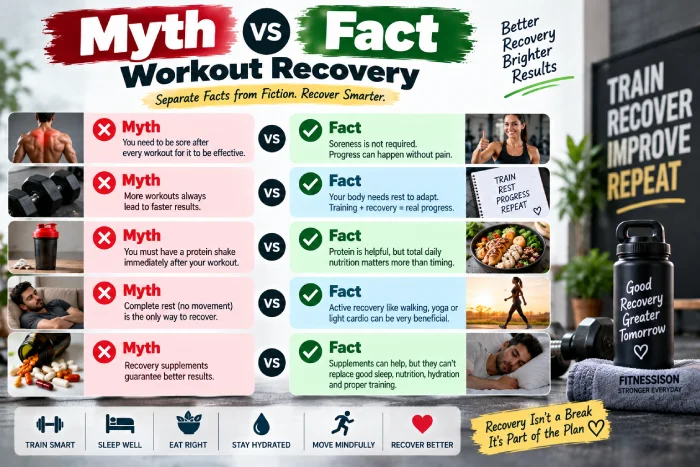
Myth: You Need to Be Sore After Every Workout
Fact:Dom‘s is not necessary for a good workout. DOMS is often experienced following an unusual or intense workout, but it alone is not a sign of an effective workout.
Myth: More Recovery Means Less Progress
Fact: Recovery is one of the processes that lets the body adapt to a training stimulus.
Myth: You Must Have a Protein Shake Immediately After Exercise
Fact: Protein (post training) may be helpful for recovering however total daily protein and nutrition levels are also crucial.
Myth: Complete Rest Is Always Better
Fact: Depending on the individual, some may find low intensity active recovery to be beneficial while others may need to rest entirely if they are feeling ill, hurt, extremely tired or sleep deprived.
Myth: Recovery Gadgets Are Essential
Fact: enhancements can be made with recovery aidsthey are beneficial but don‘t replace the basics of sleep, diet, fluid, training methods, and taking a rest.
Step-by-Step Workout Recovery Routine
A simple recovery routine can remove guesswork.
Step 1: Finish the Workout Gradually
Do not quit right away, take 2 or 3 minutes to cool down by walking or being lightly active. Mayo Clinic suggests that a brief low-intensity cooldown can bring you back to your baseline more slowly, but cooldowns should be considered by no means a sure-fire method to avoid soreness.
Step 2: Rehydrate
Drink fluids to match your body requirements and sweat losses.
Step 3: Eat
Select a healthy meal or snack, with protein and carbohydrate.
Step 4: Return to Normal Activity
The rays later in the day may be fine, but if you feel uncomfortable you may want to move to the darker side.
Step 5: Sleep
Safeguard this subsequent sleeping occasion.
Step 6: Check Your Readiness
Before the next hard workout, consider:
- Energy
- Sleep
- Soreness
- Pain
- Performance
- Motivation
- General health
Step 7: Adjust the Workout
If recovery is poor, reduce:
- Weight
- Sets
- Duration
- Intensity
Or choose a different activity.
Mini Summary
A good recovery routine is surprisingly simple:
Cool down → hydrate → refuel → sleep → reassess → train appropriately.
Recovery for Different Types of Exercise
Recovery does not look identical across every type of exercise.
Strength Training
Strength workouts can place substantial stress on specific muscle groups. Avoid automatically training the same muscles hard on consecutive days. A properly devised strength training program switches between different groups of muscles, the level of difficulty, or the days of training.
HIIT
While short, the high intensity of this type of workout can make it quite taxing. Simply take note of workout duration to determine the difficulty of recovery. Even 20 minutes of high intensity running can leave you more beaten down than hours walking easy.
Running
Mileage, pace, hills, interval, terrain, training of the past each should be taken into account. The recovery needed after an even easy short run will be different from that after a long one.
Cycling
Cycling recovery depends heavily on duration and intensity. An easy ride can function as active recovery, while a hard interval session creates much more training stress.
Yoga and Mobility
Gentle yoga may serve as active recovery. A physically demanding yoga session, however, can itself become a training stimulus.
Key Takeaways
Recovery depends more on training stress than simply workout duration.
Mini Summary
Ask:
“How demanding was the workout on my body?”
rather than:
“How long did the workout take?”
Workout Recovery for Beginners
Beginners often make one predictable mistake: they become excited about progress and increase everything at once.
- More workouts.
- More weight.
- More repetitions.
- More cardio.
- Less rest.
That combination can quickly become overwhelming.
Start Gradually
Allow your body to get used to the movements and work. For example, at first a beginner strength routine could be a number of sessions in a week, with a couple of days of rest or active recovery in between. Fitnessison‘s Guide to Strength Training balances beginner‘s need for consistency, progression, and recovery with the limitations of an inexperienced body, very well.
Do Not Compare Your Recovery
Your friend may recover quickly from a workout that leaves you sore. That does not mean your fitness is poor. Training history matters.
Focus on Technique
Good technique can take a lot of the hard work out of it and can help to prevent injury.
Key Takeaways
- Beginners often need more adaptation time.
- Start with manageable training volume.
- Increase workload gradually.
- Do not copy another person’s recovery schedule.
- Build rest into the program.
Mini Summary
For beginners, consistency beats intensity.
Workout Recovery for Weight Loss
Consistency is equally critical when using exercise as an adjunct for a calorie deficit. The mistaken belief is that more cardio and less calories will produce fat loss quicker. Such a method often becomes difficult to maintain.
Keep Training Productive
The aim is to stay in a manageable energy deficit while still nourishing properly and keeping active. Excessive exercise with insufficient intake can leave you drained and make training sessions more difficult.
Keep Protein Adequate
Provides protein as part of a low-calorie diet may be adequate for promoting and preserving muscle.
Keep Strength Training
Weight training could be beneficial for maintaining and developing muscle mass as well as controlling body composition.
Use Recovery Days
A rest day doesn‘t mean you are not working towards your weightloss goal. Walking and other light activity is still activity.
Mini Summary
For weight loss, recovery helps make your exercise routine sustainable rather than exhausting.
Recovery for Muscle Growth
Muscle growth depends on training as well as recovery. Resistance exercise creates the stimulus for adaptation, but your body needs sufficient nutrition and recovery in order to accommodate this. Protein is particularly important.
Research examining protein supplementation around resistance exercise has found potential benefits for maintaining strength and reducing certain markers of muscle damage, although the effect on soreness is less consistent.
Focus on the Basics
For muscle growth:
- Train consistently.
- Progress gradually.
- Eat enough protein.
- Consume adequate energy.
- Sleep sufficiently.
- Allow trained muscles to recover.
Mini Summary
You do not body muscle simply by lifting weights. You provide the stimulus through training and support the adaptation through nutrition and recovery.
Do Recovery Tools Really Work?
Recovery products are popular because they promise faster results. Some can help with comfort or perceived soreness. But they should be viewed in context.
Foam Rollers
Foam rolling can feel useful for plummeting muscle tightness and improving mobility.
Massage
Massage: Massage has been shown to lessen the sensation of soreness and fatigue following rigorous activity. A review by Mayo Clinic on recovery techniques lists massage as one of possible benefits:
Compression
Compression Garments may offer some advantages for perceived soreness or recovery (evidence inconsistent).
Cold-Water Immersion
However some have shown that cold exposure may lessen soreness for some individuals, it should not be used as an alternative for nutrition or sleep.
An additional significant training factor to consider is that some types of recovery interventions have the potential to affect the physiological signals that lead to adaptation, thus “feeling less sore” and “maximize training adaptation” do not have to necessarily coincide.
Sauna
Heat exposure can be relaxing, but it also increases fluid demands.
Recovery Devices
Massage guns and similar devices may be convenient, but they are optional.
Mini Summary
Think of recovery tools as the top layer, not the foundation.
When Workout Soreness Is Normal — and When It Is Not
Aim to achieve some soreness after difficult or unfamiliar activity. The symptoms of DOMS can occur 1 to 3 days after the exercise and will gradually settle as recovery takes place.
Typical Muscle Soreness
Normal post-exercise soreness is often:
- Dull
- Achy
- Spread across the trained muscle
- More noticeable when moving
- Gradually improving
Warning Signs
Seek medical evaluation for symptoms such as:
- Severe or rapidly worsening pain
- Significant swelling
- Major weakness
- Loss of function
- Sudden injury
- Joint pain that persists
- Dark-colored urine after unusually strenuous exercise
- Symptoms that do not improve
Severe pain or unusual symptoms should not simply be labeled “normal soreness.”
Mini Summary
Mild, differentiating muscle soreness is possible during standard recovery. Severe, prolonged or abnormal symptoms should be investigated.
What Does a Good Recovery Week Look Like?
A recovery-friendly week balances hard sessions with easier periods.
For example:
| Day | Training | Recovery Focus |
| Monday | Strength | Protein + sleep |
| Tuesday | Easy cardio | Hydration |
| Wednesday | Strength | Nutrition + sleep |
| Thursday | Rest/walking | Recovery |
| Friday | Strength | Refuel |
| Saturday | Moderate cardio | Hydration |
| Sunday | Rest | Sleep + preparation |
This is an example not a rule. The person in marathon training, the lifter, the person working out for just good health will all require different routines.
Mini Summary
A good week should not feel like seven consecutive tests. Hard days should have easier days around them.
The Future of Workout Recovery
Recovery technology continues to develop rapidly. Wearables can monitor sleep, heart rate, training load etc. and even recoveries devices are available that can give you personalized feedback. In the future we can expect AI driven fitness app‘s that integrate your whole life history into your training, sleeping, eating and performance to give personalized advice on how you should train.
But technology should be supportive to assist in natural recovery habits, not substitute for them. A wearable cannot sleep for you. Massage gun cannot replace adequate protein. A cold plunge cannot fix an unsustainable training schedule.
What Is Likely to Matter More?
The most useful future recovery systems will probably focus on individualization.
Instead of telling every person to rest exactly 48 hours, a smarter system can consider:
- Previous workout
- Training intensity
- Sleep
- Performance
- Heart-rate trends
- Muscle soreness
- Training history
- Upcoming competition
- Nutrition
- Overall workload
Mini Summary
The way of thinking about recovery in the future is probably to be more individual, but there are basics those will continue to be important:
FAQs
What is workout recovery?
Workout recovery refers to recovering from a workout in terms of restitution, repletion, and reconditioning in order for the body to return to a baseline and focus on future training.
How long does workout recovery take?
Recovery depends on the workout and the person. There are many intense episodes that need about 24-72 hours before repeat of similar vigorous training, lighter activity can take much less time.
Should I work out when I am sore?
Soreness, should not prevent you from training. Do not perform excessive training on muscles which are extremely painful and do not perform as usual any training which causes sharp pain, pain which gets worse and pain that is not typical.
Is active recovery better than complete rest?
- Neither is always the best. Doing a little bit of gentle activity can sometimes be a good idea when you‘re feeling well. Taking complete rest can sometimes be preferable when you are unwell, injured, very tired, or lacking sleep.
What should I eat after a workout?
The following is a manageable option for a balanced meal with some protein, carbohydrate, and fluid. Chicken and rice, eggs and toast with fruit, or Greek yogurt with oat and berries are an example of different combinations.
Final Conclusion
Workout recovery is not one action you perform after exercising. It is the entire process of giving your body the resources and time it needs to respond to training.
- Sleep provides a foundation.
- Rest reduces training stress.
- Active recovery can provide gentle movement when appropriate.
Smart Programming avoids every workout turning into an all out effort. Lesson Recovery should be nutrition, sleep, and rest appropriate to the training you do. We cannot treat a gentle walk the same as a max squat, an hard HIIT workout, or a marathon. Always consider your performance, sleep, energy, soreness, movement and persistent fatigue, not just one factor. Just remember soreness is not the goal. Progress happens when you create the proper training overload and allow your body adequate time to adapt. Since recovery becomes part of your program instead of an afterthought, recovering from a workout becomes another way to help you stay consistent with your training, get better results, and develop lifelong fitness.