

Last Updated: September 14, 2026
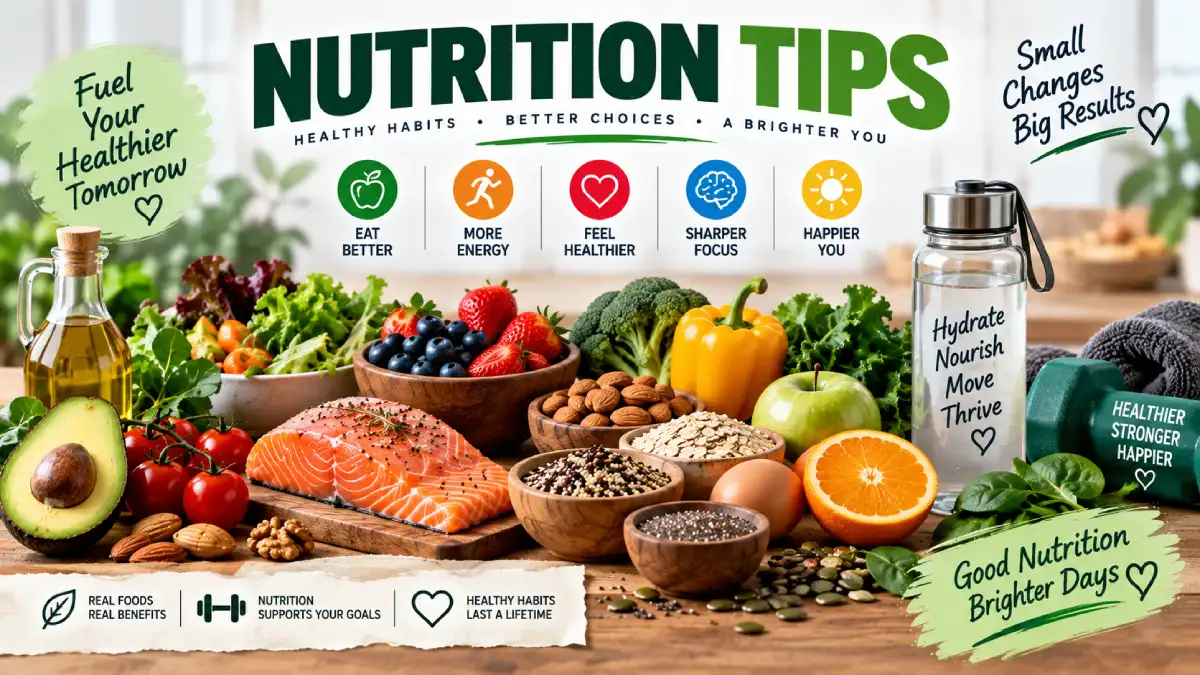
Nutrition tips do not have to involve long, tiring meal plans or difficult ‘rules’ about which foods you can and can‘t eat, or lecturing about how you shouldn‘t enjoy food (you know, stuff like that). Good nutrition is usually a way of eating that will support your lifestyle, needs and budget.
The US 2025-30 dietary guidelinessuggest targets consumed foods by compelling all Americans to ingest a diet full of unrefined “whole” foods (proteins, dairy, fruits, veggies, plenty of whole grains, nuts, hearts, oils, etc). This suggests that Americans should also have minimals of consuming eating highly refined foods filled with extra sugar, excess sodium, on everything processed carbs, and a assembly of lean fats.
What this isn‘t about: it doesn‘t mean to eat impeccably. It means to eat smarter more often.
What Is Good Nutrition?
Good nutrition refers to the daily intake of a variety of foods and beverages that will supply the body with the nutrients needed including protein, carbohydrate, lipids, vitamins, minerals, fiber and fluid.
In your healthy eating pattern there are, within reason, foods you like to eat. It doesn‘t have to [exclude] whole food groups unless you have a medical condition or choose to follow a way of eating that doesn‘t include specific food groups.
One meal isn‘t the end of the world. The bigger picture is to look at.
Key takeaways
- Tackling the complete eating pattern should be the priority.
- Eat a combination of foods high in nutrients.
- Avoid labeling foods as “good” or “bad”.
- Do not change something that is not changeable. There are limits to the interface.
- Think about your health objectives, as well as your tastebuds, culture, and cost.
Practical example
Instead of saying, “I can‘t eat pizza anymore,” try thinking:
What do I do to make this meal healthier?
You could have the pizza with a big vegetable salad, have a reasonable portion and go for water instead of a sugar loaded drink.
Mini summary
Good nutrition is about patterns, variety, balance, and moderation not perfection.
25 Simple Ways to Eat Healthier
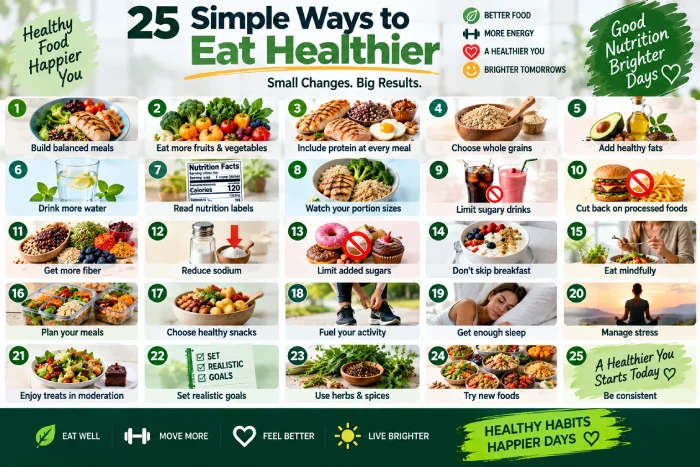
1. Build Meals Around Nutrient-Dense Foods
One of the easiest nutrition tips to follow is to always exploit the nutrient density of everything your consuming.
Nutrient solid foods are defined as containing vitamins, minerals, protein, fiber, or other valued nutrients for a given number of calories.
Examples include:
- Vegetables
- Whole fruits
- Beans and lentils (Barbunya and lentils)
- Whole grains
- Eggs
- Fish
- Lean poultry
- Nuts and seeds
- Yogurt
The Make Half Your Plate and About Nutrients of Concern sections of the current U.S. Dietary Guidelines emphasize eating a diet that is high in protein foods, dairy foods and products, vegetables, fruits, oils and solid fats, and whole grains.
Key takeaways
Select less caloric food to begin with look for food with more nutritional value.
Practical tip
Once grocery shopping.
What nutrients am I procurement from this food?
That question can be more helpful than hunting for a “perfect” ingredients list.
Mini summary
Make most of your diet foods that are high in nutrition and eat the less nutritious foods more sparingly.
2. Use a Simple Balanced-Plate Formula
You need not do on an hourly basis your calculations of how much carbohydrate, fat and protein you are consuming.
A straightforward visual explanation may be useful.
According to the Harvard‘s Healthy Eating Plate about half of one‘s plate should be of vegetables and fruits, a quarter of whole grains and a quarter of healthy source of protein with use of healthy oil and water or other beverages low in sugar.
Example plate
¼ plate:
As such, brown rice, oats, quinoa, whole-wheat pasta, whole grain or other whole-wheat.
¼ plate:
Offer protein e.g. fish, chicken, eggs, beans, lentils, Tofu, etc. Another source of protein.
Add a little healthy fat such as olive oil, nuts, seeds, or avocado.
Key takeaways
- Always include the same kinds of produce.
- Inside the sandwich, add in some sources of protein.
- Use as much as possible minimally processed carbohydrate sources.
Practical example
What about a humble dinner of grilled salmon, cooked vegetables, and some quinoa with a teaspoon of olive oil?
Mini summary
A balanced plate provides an easy reference without the need for complex calculations.
3. Make Protein Part of Every Main Meal
Proteins are responsible for providing the body with amino acids which can be used to make tissues.
Protein-rich foods include:
- Eggs
- Fish
- Poultry
- Lean meats
- Greek yogurt
- Cottage cheese
- Beans
- Lentils
- Chickpeas
- Tofu
- Tempeh
- Nuts and seeds• Induction of phytobezoaires. Including pine nuts, sunflower seeds and caraway and fennel seeds. We need material that is astringent, high in residue/forming to get these to deconcentrate. As a wider group, astringence is necessary for the digestion aid need.
Giving to My Plate from the USDA, one should include “protein foods such as seafood, lean meats, poultry, eggs, beans, peas, lentils, nuts, seeds, and soy products.”
Key takeaways
Protein doesn‘t have to mean meat plant sources can also be used.
Practical tips
Try adding:
- Eggs for breakfast
- Greek yogurt added to a snack
- Eat beans for lunch 🙂
- Preparation of fish or chicken for the dinner, mashing potatoes! (Lots of chopping)
- Tofu or lentils to any vegetarian based dishes.
Mini summary
Mix up your proteins. Eating a change of proteins (fish, lean meat, vegetarian) can help “ease” balanced eating and also help with muscle upkeep and recovery.
4. Eat More Vegetables and Fruits
Vegetables and fruits contain fiber, vitamins, minerals and thousands of naturally occurring compounds. Based on the CDC summary, eating a wide variety of brightly colored fruits and vegetables is guided, while fiber-dense foods are known to assist in maintaining digestion health and satiety. Stop worrying about single “superfoods” and enjoy a varied diet.
Try the color strategy
Include different colors throughout the week:
- Orange: carrots, oranges and sweet potatoes.
- Blue/purple: blueberries, blackberries, eggplant.
- White: cauliflower, onions, mushrooms
- Green- green apple, green beans, green grapes, green peppers, green salad, green vegetables.
- Red: tomatoes, peppers, strawberries
Key takeaways
What is more exciting and bringing more unique taste, which is so called “perfection”, “more existing and more comfortable to wander around” is a different kind of life called additional other food intake which surely consists of a number of tastes, instead of eating the same one.
Everyday tips
- Take some berries with your breakfast.
- Cut vegetables to snack on.
- Include some spinach or peppers in your eggs.
- To quick dishes add frozen vegetables.
- Unsurprisingly, this is the only tip I haven‘t yet tried. I‘ll keep my fruit on show on the kitchen surface instead.
Mini summary
Make produce appealing by making it suitable, visible and incorporating it into your existing food.
5. Choose Whole Grains More Often
We should not automatically condemn carbohydrates. You can obtain different results depending on. The quality of the carbohydrate used ie.
Whole grains can deliver fiber, vitamins, minerals, and other nutrients. Examples include:
- Oats
- Brown rice
- Whole-wheat pasta
- Quinoa
- Barley
- Whole-wheat bread
- Whole-grain cereals
Harvard‘s approach to diet and nutrition acknowledges the importance of the type of carbohydrate and ranks whole grains, vegetables, fruit and beans as more nutritious carbohydrate resources.
Key takeaways
Remember “carbohydrate” is not the same item as “junk food.”
Practical example
Instead of automatically eliminating rice, try changing the meal around it:
Less balanced:
A Big portion of processed white rice, plus deep fried food and sweetened beverage.
More balanced:
Rice portions medium + Grilled meat + Vegetables + water.
Mini summary
You may not even need a reduced carbohydrate diet. It may just be a question of having the right types and amount of carbs.
6. Include Healthy Fats
Fat is an essential nutrient and should not be immediately removed from a healthy diet.
Bases of unsaturated fats include:
- Olive oil
- Avocado
- Nuts
- Seeds
- Fatty fish
- Some other vegetable oils are:
The American Heart Association (AHA) also recommends, ‘picking unsaturated fats (oils and spreads) instead of saturated fats (butter, lard, and ghee).
Key takeaways
- Fat is a rich source of energy and is a good source of essential nutrients.
- Portion sizecontinues to be relevant becausefat is high in calories.
- Do not stop taking any type of fat, just the type of fat.
Practical tip
Make a meal using olive oil or a salad dressing, mix nuts into yogurt or have avocado as part of a nutritious meal.
Mini summary
Healthy eating is not a battle for the lowest fat intake. Enjoy healthy sources of fat and have a bit (or a fair bit) of everything.
7. Learn How to Read Nutrition Labels
Nutrition labels can be useful for quickly making contrasts between packaged foods.
The initial thing to evaluate is the serving size.
The FDA states, “The serving size you see on a product label is not a recommendation for how much to eat. It is a measure of the amount that you would normally eat.
A simple label-reading order
Step 1: Sizing.
Inquire about the quantity. Eat as much of the described nutritional value as you can.
Step 2: Calories
Think of how the calories will fit into the entire meal or day.
Third Step: Protein and fiber correct value to approximately 40%.
They can assist you in determining nutritional value and satiety.
Step 4: Added sugars
Instead of concentrating solely on the total sugars, look exactly at added sugars.
- Saturated fat and sodium
A suitable substitute should be compared in order to reduce these components.
Step 6: list of ingredients
An example is what the product actually consist of.
What does %DV mean?
The % Daily Value (DV) shows you how a exact nutrient fit into a broad daily diet. Help consumers understand their labels are often the FDA and American Heart Association, 5% DV or less is low and 20% DV or more is high.
Key takeaways
Not all there is to a product can be deduced from the front of a package.
Real-world example
A cereal may say “high protein” on the front. Turn the package around and check:
- Protein per 100g
- Added sugar
- Fiber
- Calories
- Serving size
- Ingredient list
Mini summary
The food label can be more helpful than the marketing hype.
8. Practice Portion Control Without Obsessing Over Food
Portion control doesn‘t refer to small meals.
It‘s about recognizing how much food you‘re really eating.
Serving size and portion size are not equal. both point out that a serving size listed on a label doesn‘t mean it is the recommended amount to eat.
Practical portion-control strategies
- The calorific dense snacks should be in a smaller bowl.
- Serve snacks in a bowl rather than out of the packaging.
- Eat slowly.
- Wait before taking seconds.
- Trust your hunger and full cues.
Restaurant portions
Restaurant portions are often much bigger than required.
Try:
- Entrée partage.
- Eating half the meal to take home.
- Ordered a vegetable instead of a second high-calorie side.
- Selecting the sauces and dressing independently
Key takeaways
Portion awareness is about having the power, without being too limited
Mini summary
You don‘t need to weigh all your food. Firstly, develop greater awareness of portion sizes.
9. Make Water Your Default Beverage
Water is vital for normal operative of the body. Furthermore, the CDC mentions that substituting water for sweetened beverages can lead to a decreased calorie intake.
However, there‘s no fixed number of drinks that suits all.
Water requirements vary according to:
- Age
- Sex
- Body size
- Activity
- Climate
- Pregnancy
- Breastfeeding
- Illness
- Fluid losses
Real-world hydration habits
- Drink water with meals
- Eat foods high in water content (fruit and vegetables).
- Increase your intake during exercise and hot weather.
- Opt for water over soft drinks on more occasions.
Key takeaways
Everybody is different in the amount they drink don‘t over-do it just because someone told you that you should have X glasses.
Mini summary
Follow these indicators: thirst, habit, level of activity, climate and personal situation.
10. Don’t Fear Carbohydrates
The first, and perhaps one of the longest running, diet myth is that carbohydrate automatically leads to weight gain.
They don’t.
Foods high in carbohydrates include those that are very processed such as refined sugars and rices, but can also include fraits, beans, vegetables, oats, and wheat.
NIDDK also takes a stand against the misconception that bread, pasta, and rice should be eliminated from the diet in order to lose weight appropriately. Instead, NIDDK advises whole grains should be selected over refined grain products rather than excluding grains.
Better questions to ask
Instead of:
“Are carbs bad?”
Ask:
- Which food is the source of the carbohydrate?
- How many am I consuming?
- Is it rich in fiber?
- What else do I have cooking?
- Does it match my activity and needs?
Key takeaways
Class of carbohydrate, amount, and context are relevant.
Mini summary
You don‘t have to be afraid of carbs to eat healthy.
11. Don’t Eliminate All Dietary Fat
One other trap we can fall into is assuming that all sources of fat are bad.
Your body requires fat from food
It is advisable to focus on unsaturated fat sources and consume sparingly the foods that are rich in saturated fats.
NIDDK points out that people don‘t have to cut out all fat for their health or weight.
Practical swaps
Try:
- More use of olive oil over butter.
- Highly refined snacks should be replaced by nuts.
- Avocado in place of various creamy sauce types.
- Fish instead of manufactured meats.
Key takeaways
It is important to consider quality of fats as well as quantity rather than zero fat.
12. Get Enough Fiber
Fiber happens naturally in plant foods.
Good sources include:
- Beans
- Lentils
- Fruits
- Vegetables
- Whole grains
- Nuts
- Seeds
Fiber also aids normal digestive functioning and satiety.
Practical ways to increase fiber
- Add beans to the salads.
- Have porridge for breakfast.
- Consume whole fruit in preference to juice.
Important tip
Add fiber to your diet slowly and drink plenty of fluid, particularly if your current intake is quite low.
Mini summary
In addition to their nutritional benefit, fiber foods increase satiety and energy.
13. Limit Added Sugars Without Banning Every Sweet Food
Many added sugars add extra calories with few of the necessary nutrients.
Common sources include:
- Sugary sodas
- Condensed or sweetened coffee.
- Desserts
- Candy
- Sweetened cereals
- Others in the package, for example
- Sweetened beverages
According to CDC, limits the intake of added sugars and specifically advises you to replace sugary beverages by water or a lower sugar alternative.
A realistic approach
There‘s no need to label dessert as “off-limits. ”
Instead:
- Reduce frequency.
- Reduce portions.
- Select less-sweet beverages.
- Have fruit readily accessible.
- Verify added sugar on pre-packaged goods.
Mini summary
Cutting down on added sugar is less about willpower and more about changing your default choices “I did it by just making my default a little bit better, my default snack, say, being a banana, as opposed to a candy bar.
14. Watch Sodium, Especially in Packaged Foods
Although it‘s a vital nutrient, Americans consume too much sodium.
According to the CDC, over 70% of the sodium consumed in the U.S. is acquired from packaged and prepared foods.
Common sources include:
- Processed meats
- Packaged soups
- Pizza
- Sauces
- Salty snacks
- Some breads
- Prepared meals
Practical strategies
- Compare sodium on equivalent items.
- Keep an eye on sauces and condiments.
Mini summary
It is not necessary to totally banish salt from the kitchen, instead focus on your biggest sodium sources.
15. Make Healthy Eating Convenient
Nutrition doesn‘t work if it‘s not easy.
If the readily accessible food supply is cookies, chips, or take-out, then that becomes the food the children are used to eating.
Instead, let the unhealthy option be out of reach
Keep these foods available
Refrigerator
- Greek yogurt
- Eggs
- Vegetables
- Fruit
- Hummus
Freezer
- Frozen vegetables
- Frozen fruit
- Fish
- Chicken
Pantry
- Oats
- Beans
- Lentils
- Tuna
- Brown rice
- Nuts & seeds
Key takeaways
In environments surrounds us, has a tendency to over magic of willpower..
Mini summary
You can encourage eating healthy by safeguarding your kitchen promotes the behavior you desire.
16. Plan Meals Before You’re Very Hungry
Meal planning doesn‘t have to mean that every Sunday you cook the same meal for the entire week.
May even be overcomplex. A simple compromise is surprisingly often the best approach in the end.
Choose:
- 2–3 choices of breakfast
- Lunch options (2-3)
- 3–4 choice of main meal for dinner.
- Easy to grab snacks like:
Keep fixings handy.
Example
- Breakfast: eggs + wholemeal toast + fruit
- Lunch: Chicken, rice, and vegetables.
- Snack: Greek Yogurt and berries
- Dinner: Fish & potatoes and salad
Key takeaways
Planning stops procrastination.
Mini summary
A simple food plan will help keep you focused and will stop it from feeling like a set regime.
17. Don’t Rely on Supplements to Fix a Poor Diet
Supplementation is useful in certain circumstances but shouldn‘t replace healthy food.
The foundation should remain:
- Vegetables
- Fruits
- Protein foods
- Suitable milk and fortified alternatives
- Adequate fluids
Supplements could be used when a person has a diagnosed deficiency, greater nutritional needs, limited food intake or other cause identified by health professional..
Practical perspective
An ultra-processed foods majority diet is not made healthy by taking a multi vitamin.
Mini summary
Food first always, when feasible, supplements when necessary.
18. Adjust Nutrition to Your Fitness Goals
Your diet may need to be adapted based on what you hope to achieve.
For weight management
Focus on:
- Protein
- Fiber
- Vegetables
- Whole foods
- Portion awareness
- Lower-calorie beverages
For muscle growth
Focus on:
- Sufficient calories
- Sufficient protein
- Training carbohydrates. The only carbohydrate source that will be used for training is sports drinks. These will be used in the performance phase when, due to the increased intensity, more carbohydrate will be needed to train aerobically.
- Resistance exercise
- Recovery
For endurance
Pay particular attention to:
- Carbohydrate availability
- Electrolytes as needed.
- Adequate calories
- Recovery nutrition
For general wellness
Prioritize variety over optimizing every nutrient.
Mini summary
There is no such thing as the ideal diet. It is your diet that should be directed towards your real goal.
19. Learn the Difference Between Serving Size and Portion Size
However, it is worth paying particular attention to this fact A standard measure as set on a nutrition label; the serving size.
The actual amount you decide to consume is the “Portion size”.
Example If a package states a serving size of 1 cup and you consumed two cups, then you consumed two servings.
The Food and Drug Administration (A healthcare agency concerned with nutrients in our body) points out specifically that serving size is not a guide to how much to eat.
Why this matters
A snack might list that it has 150 calories but if there are two servings in the packet, and you eat the entire packet, you‘ve consumed 300 calories.
Mini summary
Never read past the serving size per container until you understand what the other nutrition information on the label is telling you.
20. Practice Flexible, Sustainable Eating
Here‘s one of the most undervalued nutrition tips out there: Don‘t try to be perfect. A healthy eating pattern may also contain foods that are not particularly nutrient dense. Frequency, volume and volume balance are the key.
According to MedlinePlus, eating healthy means that you don‘t necessarily need to follow a restrictive diet, and can still eat some of your favorite foods.
Try the 80/20 mindset carefully
There is no exact 80/20 rule that has to be followed.
Instead, think:
Most of the time:
Nutrient-dense foods.
Sometimes:
Foods you like that incline to be a bit higher in calories, sugar, salt, or saturated fat.
Mini summary
Your sustainable diet needs to fit into your actual life.
21. Nutrition Myths vs. Facts
Nutrition misrepresentation spreads quickly because simple answers are attractive.
Myth:Carbs Will Make You Fat
Fact: Carbohydrates are naturally occurring in a variety of foods. Try including whole grains, dried beans, and fruits and vegetables in your diet.
Myth: You can‘t be healthy without losing body fat
Fact: The body requires fat from foods. Good sources of unsaturated fat with restricted intake of saturated fat.
Myth: Food labeled as gluten-free is inherently safer for your health18. Despite the popularity of gluten-free foods, this literature review has largely failed to find any indications that such products can actually benefit people with existing digestive problems, let alone the general population.18
Fact – avoiding gluten does not necessarily make food choice healthier for those without the disease of coeliac disease or any other medical reason for not consuming gluten.
Myth: You need to give up foods you love in order to lose weight
Fact: Favorite foods can be incorporated into a healthy eating pattern if they are eaten in moderation and calorie consumption is controlled.
Myth: Four to eight glasses of water a day are sufficient for everyone
Fact: Fluid requirements are not the same, drinking water intake will also take into account the food we eat. Activity, weather, age, health status of the individual can alter requirements.
Myth: one food can “detox” your body.
Fact: Beware of tempting health claims that any particular food, beverage or supplement has the power to zap out the toxins and change your health.
Mini summary
When nutrition advice sounds extreme, ask whether the claim is supported by reputable evidence.
Continue deeper: Read our complete nutrition myths debunked guide.
22. Eat Mindfully
Mindful eating means paying care to the experience of eating instead of mechanically consuming food while distracted.
Try:
- Eating more slowly.
- Putting your phone away.
- Noticing hunger before eating.
- Pausing during meals.
- Paying attention to fullness.
Mindful eating doesn’t mean every meal needs to be silent or flawlessly intentional. It’s simply about flattering more aware.
Mini summary
Awareness can be just as useful as restriction.
23. Make Better Choices When Eating Out
Healthy nutrition doesn’t stop when you leave home. The American Heart Connotation notes that healthy eating principles can be applied irrespective of where food is prepared or purchased.
Practical restaurant tips
- Add vegetables where possible.
- Ask for sauces or dressings separately.
- Choose water or unsweetened drinks.
- Consider sharing large portions.
Example
Instead of:
Fried entrée + fries + sugary soda
Try:
Grilled protein + vegetables + moderate carbohydrate portion + water
You can still enjoy the restaurant.
Mini summary
Healthy eating must travel with you.
24. Build Nutrition Habits One at a Time
Trying to change everything on Monday morning often leads to exhaustion by Friday. A better approach is to choose one or two behaviors.
Week 1
Drink water instead of sugary drinks most of the time.
Week 2
Complement a vegetable to lunch or dinner.
Week 3
Complement a protein source to breakfast.
Week 4
Study to read the Nutrition Truths label.
Week 5
Work on portion consciousness.
Key takeaways
Small developments compound.
Mini summary
The best nutrition plan is usually the one you can repeat.
25. Use the 5-Question Nutrition Check
When you’re uncertain whether a meal is balanced, ask:
- Where is my protein?
- What is my main carbohydrate source?
- Where are my vegetables or fruit?
- Am I getting a reasonable amount of healthy fat?
- What am I drinking?
You don’t need a perfect “yes” to all five every time. The checklist simply gives you a quick way to identify what may be missing.
A Simple One-Day Healthy Eating Example
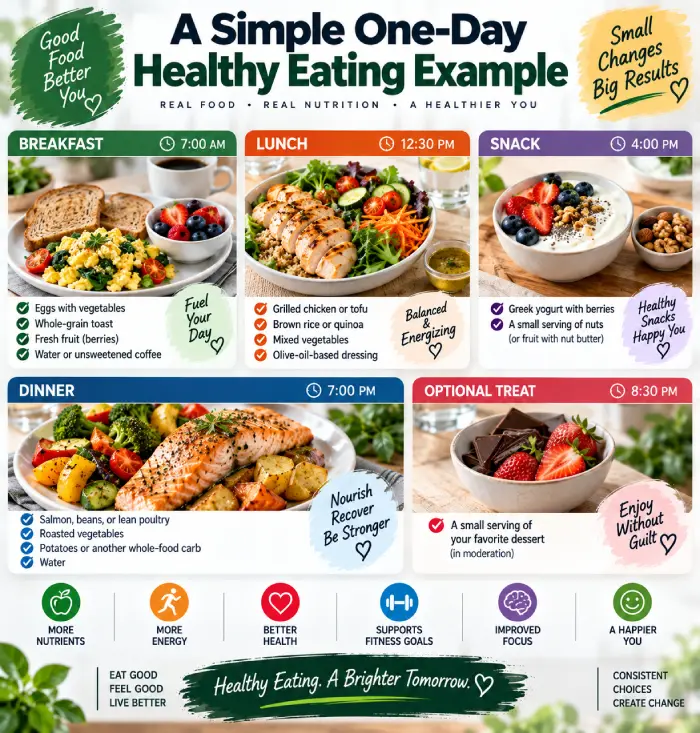
Here’s what practical nutrition can look like without following a rigid diet.
Breakfast
- Whole-grain toast
- Fruit
- Eggs with vegetables
- Water or unsweetened coffee
Lunch
- Mixed vegetables
- Olive-oil-based dressing
Snack
- Greek yogurt with berries
Dinner
- Roasted vegetables
- Water
Optional treat
A small serving of your favourite dessert. The point isn’t that this is the only healthy menu. It’s an example of how protein, produce, carbohydrates, healthy fats, and liquids can fit together.
How to Troubleshoot Your Diet
If your current diet isn’t working, don’t immediately start another extreme plan.
If you’re always hungry
Look at:
- Protein
- Fiber
- Meal volume
- Portion balance
- Sleep
- Overall calorie intake
If you’re struggling to lose weight
Review:
- Liquid calories
- Portion sizes
- Snacks
- Restaurant meals
- Added sugars
- Overall calorie intake
- Physical activity
If you’re tired
Don’t automatically assume you need a supplement. Consider overall food intake, sleep, hydration, activity, and possible medical causes.
Persistent or unexplained symptoms deserve professional evaluation.
If healthy eating feels expensive
Use:
- Beans
- Lentils
- Eggs
- Frozen vegetables
- Seasonal produce
- Oats
- Brown rice
- Canned fish
- Bulk whole grains
Healthy eating doesn’t have to mean buying expensive “health foods.”
How Nutrition and Exercise Work Together
Nutrition and exercise are complementary. Food provides energy and nutrients. Exercise creates demands for recovery, adaptation, and performance.
For people who train regularly, useful priorities include:
- Adequate protein
- Sufficient carbohydrates
- Appropriate calorie intake
- Hydration
- Micronutrient-rich foods
- Adequate recovery
The exact strategy depends on whether you’re training for muscle growth, endurance, weight management, general fitness, or another goal.
Nutrition should support your training—not punish you for it.
What Does “Healthy Eating” Mean in 2026?
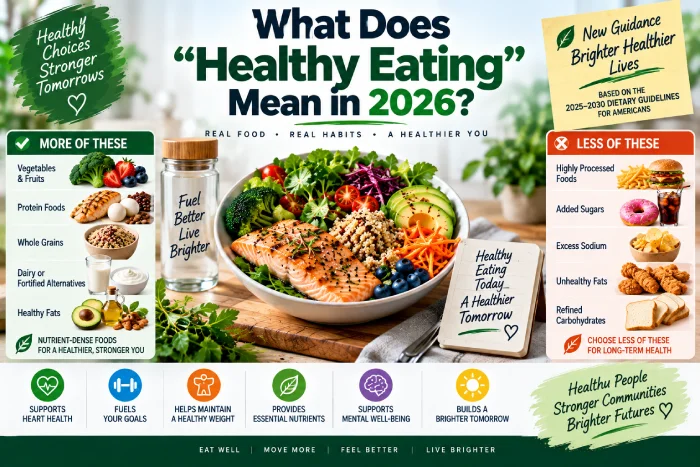
Nutrition advice continues to evolve, but the current U.S. guidance reinforces several familiar themes. The 2025–2030 Dietary Guidelines for Americans emphasize eating more whole, nutrient-dense foods and reducing highly processed foods, added sugars, excess sodium, refined carbohydrates, and unhealthy fats. The important takeaway is not that one food has suddenly become magical or another has suddenly become forbidden.
Instead, think in terms of a dietary pattern:
More often:
- Vegetables
- Fruits
- Protein foods
- Whole grains
- Nutrient-dense dairy or fortified alternatives
- Healthy fats
Less often:
- Highly processed foods
- Sugary beverages
- Foods high in added sugars
- Foods high in sodium
- Foods high in saturated fat
- Refined carbohydrates
This approach also leaves room for personal preferences, cultural foods, budget considerations, and different fitness goals.
When Should You Talk With a Healthcare Professional?
General nutrition tips are useful for healthy adults, but individual needs can be very different.
Talk with a qualified healthcare professional or registered dietitian if you:
- Have kidney disease
- Have diabetes
- Are pregnant or breastfeeding
- Have significant food allergies
- Have a gastrointestinal condition
- Have been diagnosed with a nutrient deficiency
- Are taking medications affected by diet
- Are experiencing unexplained weight changes
- Have persistent digestive symptoms
- Need a medically prescribed diet
Personalized nutrition can be particularly important when a medical condition changes nutrient requirements.
Final Takeaway
The existing U.S. dietary guidelines simply recommend. Choosing more nutrient-rich, less-processed foods and fewer foods that are high in added sugars, sodium (salt), refined starches, and fats. Most notably, don‘t shoot for perfection. It‘s a healthful approach in which you can keep going for next week, next month, next year because small changes that you practice persistently are often more effective than a crash program you do for five days and give up on.