


Mohd Arbaaz is an Editor and Writer at Fitnessison.com with 5 years of experience in SEO and digital content creation. He creates informative, reader-focused content covering fitness, workouts, nutrition, health, healthy lifestyle, technology, and computers.

Shashi Teja is a Reviewer at Fitnessison with over 6 years of experience in SEO, content strategy, digital publishing, and content optimization. He reviews content for clarity, research quality, topical relevance, readability, structure, and overall usefulness to readers.
Last Updated: September 8, 2026
Misinformation and mistakes surrounding fasting can turn the reported ease of this method of eating upside down. The main difference between intermittent fasting and most of the other diets is that the former is not based on guiding what to eat, but what time you eat. The most popular fasts are: 12/12, 14/10, 16/8 and 5:2.
For some individuals, the reduction of time for eating from the shorter time frame of 2 meals to the more extended time frame of 3-4 meals associated with intermittent fasting might aid in calorie (and consequently weight) management.
However, fasting is not a solution and extended fasting does not mean success. No One Diet Is Best For Everyone. The most successful diet will be one that you can live with that provides complete nutrition. For our part, let us take a look at the biggest myths and mistakes on intermittent fasting.
What Is Intermittent Fasting?
Intermittent fasting, at in which a schedule of eating alternates with a schedule of fasting is a suggested management strategy. The one which most people do is 16/8 fasting, which means you eat in an eight hour span and fast for about 16 hours.
For example:
– 12 p.m. – 8 p.m.: Time to eat.
- 8 p.m. – 12 p.m.: periods of fasting.
Others may prefer a looser 12/12 or 14/10 regimen.
Intermittent fasting has been found to be effective for weight loss and some markers of health but overall the health benefits are just due to the overall diet pattern and calorie consumption and not due to fasting as a particular shortcut to fat loss.
10 Intermittent Fasting Mistakes and Myths
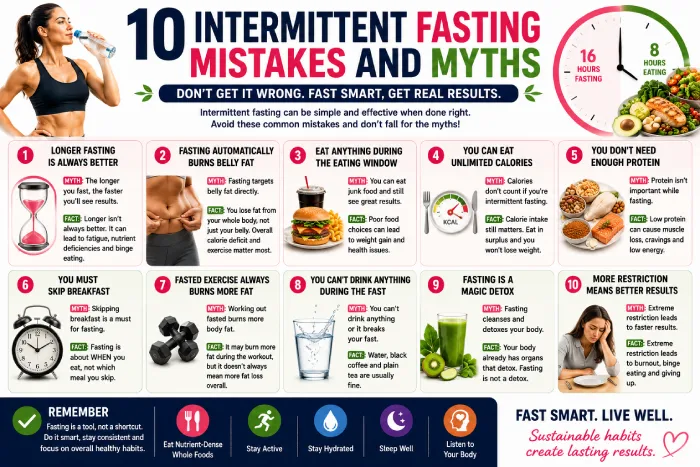
1. Myth: Longer Fasting Is Always Better
Another of the big misconceptions about intermittent fasting is that the longer you go, the more successful your fasting will be. There are certain people who think if 16 hours works, it seems logical that 20 or 24 hours must works even more.
That‘s only the nature of the case at the time for example, but doesn‘t have to be true. Going for longer time periods can cause difficulty in maintaining a high enough intake of protein, calories, vitamins and minerals. Longer fasts also could cause some individuals to begin feeling, dull, hungry or all over the place.
Better approach
Start with a manageable schedule such as:
- 12/12
- 14/10
- 16/8
You can stick with the shorter fast if it is working for you.
2. Myth: Intermittent Fasting Automatically Burns Belly Fat
Eating less will not burn off that belly fat. Not all parts of your body are guaranteed to lose fat when you are dieting. Where the fat comes off will depend on: things like genetics, hormones, energy situation, body composition. While intermittent fasting can help you lose body fat, it won‘t necessarily lead to specific loss of body fat from particular areas, if it just means you‘ll end up in a calorie deficit.
Better approach
Combine fasting, if appropriate for you, with:
- Strength training
- Cardio
- Regular walking
- Balanced nutrition
- Adequate sleep
3. Mistake: Eating Anything During the Eating Window
One of the other things I personally see (especially on the discussion forum) is people defining their eating window for the day and then consuming a large number of processed foods throughout it. Even if youfast for 16 hours., the sugar sweetened beverages, fried foods, candies, and ultra processed snacks, will not be healthy. Good diet still counts.
Better approach
Build meals around:
- Lean protein
- Vegetables
- Fruits
- Whole grains
- Healthy fats
A healthy eating window should give you the nutrients your body needs.
4. Myth: You Can Eat Unlimited Calories
An eating window doesn‘t dismiss calories. You may not lose weight even if you fast every day if you regularly eat more calories than your body uses. For some individuals, fasting naturally results in decreased overall food consumption due to the abbreviated eating window.
Better approach
Instead of viewing the eating window as a free-for-all, focus on hunger and fullness cues, foods, and serving sizes.
5. Mistake: Not Eating Enough Protein
Protein needs to be more significant if you‘re working out at the same time as trying to lose fat. If you‘re only eating once or twice you are likely to find it hard to get enough protein in with reduced eating window.
Protein-rich foods include:
- Eggs
- Chicken
- Fish
- Greek yogurt
- Cottage cheese
- Tofu
- Lentils
- Beans
Better approach
Add protein to your main meals. If you consistently do strength training, establish sufficient protein requirements as an important target.
6. Myth: You Must Skip Breakfast
Not everyone may be required to do fasting. Some like to eat from 8 a.m. to 6 p.m., others 12 p.m. to 8 p.m. Both are schedulted eating routines.
Better approach
Choose a schedule that works with your:
- Work routine
- Sleep schedule
- Exercise
- Hunger levels
- Family meals
- Social activities
The schedule that is best is the one that can be maintained.
7. Myth: Fasted Exercise Always Burns More Fat
You might be able to burn more fat in some fasted workouts, but that doesn‘t necessarily translate to burning more body fat over the long-term. Long term fat loss is all about total energy balance, food, exercise, sleep and consistency.
Better approach
I can do it at my best when I am at my strongest, fit and able to do it safely; Additionally, if doing your workout fasted is leaving you feeling dizzy and weak or just unable to train effectively then bring your workout nearer to your eating period.
8. Mistake: Forgetting Hydration
Fasting does not have to mean going without fluids. In most cases of non-religious intermittent fasting techniques water during fast are acceptable. Calorie free fasting can be also achieved by the simple intake of plain tea and black coffee. Staying well-hydrated is very important if you are undertaking physical activity or if you are perspiring heavily
Better approach
Never wait until you are very thirsty before you have a drink. Instead, make sure you drink water regularly during the day.
9. Myth: Intermittent Fasting Is a Detox
Some advocate intermittent fasting as detoxification or cleansing measures:
This is a bit of an over-simplification. You have existing processes and systems in your own body. Fasting is to be seen as quite simply a eating plan rather than how to cleanse one‘s system.
Better approach
Support overall health through:
- Nutritious foods
- Hydration
- Exercise
- Sleep
- Normal weight
- Consequent medical attention
10. Mistake: Starting Too Aggressively
Newcomers often fast for impossibly long durations early in their journey in the hopes that the greater results will be achieved more quickly. We can make fasting so unnecessarily difficult.
You don‘t need to start with 16/8.
A simpler progression
12/12: 12 hours Fasting and 12 hours Eating
14/10: 14 hours fasting /: 10 hours eating
16/8: fast for 16hrs then eat for 8hrs
Only advance if the schedule is comfortable and meets your needs.
Intermittent Fasting Myths vs. Facts
| Myth | Fact |
| Assuming there‘s being an effect, the broader the window the more powerful the fast. | Longer does NOT mean flatter. |
| Fasting specifically burns belly fat | Everyone has the ability to lose fat all over the body. |
| You are free to eat any or all during your eating window. | Food quality is still important. |
| Consume as many calories as you want. | Calorie intakes still count overall. However, if your intake is high then you should not be consuming excess frying fats or alcoholic beverages. |
| Anywhere you go in the world you will find people will skip breakfast. | Flexible Departure/arrivals/meal timing: Aircraft can arrive/depart at the airport or be served up to two hours before the published departure/arrival time. Meals can be served up to two hours before scheduled meal departure/service time. |
| Fasted exercise always results in greater fat loss | More fat burned during exercise does not mean more long-term fat loss. |
| Fasting can be a detox | It‘s more like a lifestyle and an eating pattern. |
| Everyone should join 16/8 | What suits others, may not suit you. |
| You don‘t require protein during fasting states. | Proteins still found during the eating window |
| More restriction means faster results | Sustainable practices usually are better. |
What Should You Eat During Intermittent Fasting?
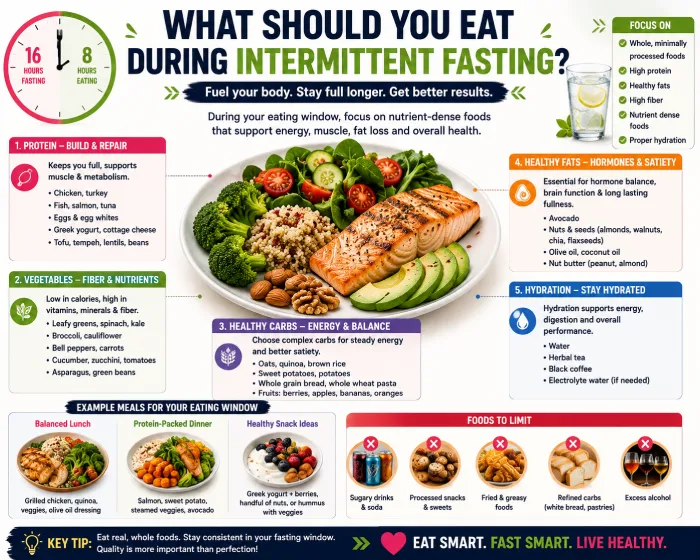
Your eating window should emphasize on nutritious foods.
Protein
Select eggs, chicken, fish, Greek yogurt, tofu, beans and lentils.
Vegetables
Add in green leafy vegetables, such as spinach, kidney beans, abocado, datiles, yellow, zucchini etc.
Fruits
Berries, apples, oranges, bananas, and other whole fruit can provide fiber and valuable nutrients.
Whole Grains
Oats, brown rice, quinoa and whole-grain bread are also valuable carbohydrate sources as well as being a good source of fiber.
Healthy Fats
Moderate amount of avocado, nuts, seeds, olive oil and nut butters.
Common Signs That Your Routine Needs Adjusting
You should not be feeling rough all the time from intermittent fasting.
Consider changing your approach if you experience:
- Persistent dizziness
- Severe fatigue
- Frequent headaches
- Weakness
- Poor concentration
- Weakness while exercising.
- Sleep problems
- Excessive hunger
If any symptoms persist or are worrying it is advisable to see a health professional.
Who Should Be Careful With Intermittent Fasting?
Not all types of fasting are suitable for all people. Pregnant or breast feeding women; overweight persons; persons with a history of malnutrition; Persons with an eating disorder or recovering from eating disorder; persons on particular kind of medications.
Persons with diabetes may need to get personalized medical advice, because the impact that fasting will have on blood glucose levels and the changes that will be made to medication are not necessarily the same for everyone. Health condition- If you have a health condition or are taking prescription medications ask your medical provider before starting an intermittent fasting program.
How to Make Intermittent Fasting Sustainable
A few simple habits can make fasting easier:
Start Slowly
There‘s no reason that you need to start out with an aggressive fast.
Prioritize Nutrition
Choose foods that contain nutrients as well as calories to make your eating window go further.
Eat Enough Protein
Eat protein rapidly and frequently during the eating window.
Stay Hydrated
Keep well-hydrated. Aim to consume 8 cups of water a day.
Exercise Wisely
Add in structural training (strength training) and cardio. And, add in movement. Moving around, doing things. Being active.
Get Enough Sleep
Dysfunctional sleep can increase the effort needed to hunger and recover.
Avoid Extreme Restriction
Our goal is a sustainable routine, not the marathon of fasting.
Frequently Asked Questions
What is the biggest intermittent fasting mistake?
The biggest mistake is to think that the length of the fast is the only factor. It isn‘t. Nutrition, calories, working out, sleeping and consistency all matter too.
Is 16/8 intermittent fasting a myth?
No. 16/8 is a real, time-restricted eat- ing. To make blanket statement that 16/8 must be adopted by everyone is false.
Can I eat junk food while intermittent fasting?
It‘s technically okay to consume processed foods during your eating window, however trying to rely on them heavily may hinder your ability to reach your nutritional requirements.
Can I exercise while fasting?
Most people can workout during fasting, mostly at light or moderate intensity, but workout tolerance is different for everyone.
Can intermittent fasting cause muscle loss?
Some loss of lean mass may be experienced during weight loss. Strength-training and a high protein intake can aid the preservation of lean tissue.
Can I drink water while fasting?
In most non religious intermittent diets and fastings water during fasting is fine and indeed sought after.
Conclusion
This number of errors and misconceptions about intermittent fasting can turn a very simple pattern of eating into a complicated undertaking. Intermittent fasting may be an effective approach for certain people attempting to lose weight or create a less flexible eating routine. However, it is not a miracle cure, and longer periods of fasting do not give better results.
Priorities. Stick with a consistent routine, eat healthily, keep your protein intake up, stay hydrated, include cardiovascular training and sleep sufficiently. And most importantly, do not let fasting dry up the challenge. Having a health supporting eating pattern is still more important than trying to fast as long as possible.