


Mohd Arbaaz is an Editor and Writer at Fitnessison.com with 5 years of experience in SEO and digital content creation. He creates informative, reader-focused content covering fitness, workouts, nutrition, health, healthy lifestyle, technology, and computers.

Shashi Teja is a Reviewer at Fitnessison with over 6 years of experience in SEO, content strategy, digital publishing, and content optimization. He reviews content for clarity, research quality, topical relevance, readability, structure, and overall usefulness to readers.
Last Updated: September 9, 2026
If you‘ve ever looked for yoga and been put off by confusing Sanskrit words, complex poses, and contradictory advice you‘re in the right place.
Yoga asanas are the physical postures that constitute the movement component of the yoga practice. The term asanas, which is derived from the Sanskrit term which refers specifically to a ‘seat’, was originally used to refer to yoga poses designed as aides to meditation and to bring about a comfortable sitting position for meditation (a body which could sit motionlessly for long periods with ease). They now include hundreds of standing, sitting, balancing, twisting and inverted poses.
However, most of the yoga products and information out there miss out this detail: The asanas are merely an eighth-limb of yoga, which Patanjali‘s ancient yoga sutras describe. Breathing control, things about the soul or our spirit that we should transcend in an enlightened way, meditation every one of these are a crucial element of the whole system. The asana-centered practice dominant in the West is a modern evolution — not the complete traditional picture.
Nonetheless, simply doing yoga asanas without the entire philosophy still produces quantifiable, scientifically proven results in flexibility, strength, pain reduction, stress relief and human health. A 2016 systematic review with 17 studies of the highest quality published in the Journal of Alternative and Complementary Medicine concluded that practicing yoga (asana 1-41) regularly improves depression, pain, stress, and anxiety.
This is your headquarters for understanding every asana in depth what they are, why it makes sense to do them, how many types you have access to, how to approach them without getting lost, and who to see for the best advice on each.
Yoga Asanas Resource Center
Explore our complete collection of yoga guides covering beginner and basic poses, yoga pose names, advanced asanas, movements for back pain, and yoga poses that support weight-management goals.
The History and Origin of Yoga Asanas
Understanding the Historical Origins of Asanas will dramatically alter your practice.
Yoga India. The history of yoga is old and was officially around 5000 years ago in the Indian civilization Indus Valley. The full practice of Yoga was first described in the Vedas; early texts that not only outlined the practice of Yoga but chronicled most of the ritual heaths and philosophy. In 400 CE the Yoga Sutras of Patanjali compiled the central eight-limbed path of yoga including the asana as a cockney “a pleasant, comfortable seat”.
The extensive range of bodily positions we now think of as yoga asanas was in fact well established by the Medieval period as evidenced by the Hatha Yoga Pradipika (15 th century) and reached its zenith with the rise of an ashta side to eclectic posture-based yoga in the late 20 th century by teachers such as Tirumalai Krishnamacharya, B.K. S. Iyengar, and K. Pattabhi Jois.
Why this matters for your practice:
- Asanas were never designed as a workout — they were designed to prepare the mind and body for meditation
- This explains why breath coordination, holding poses with awareness, and transitions between poses are emphasized in traditional teaching
- Today‘s variety of styles of asana (Hatha, Vinyasa, Iyengar, Ashtanga, Yin) merely represents different lineages and schools of the same line of thought, not different “brands” of the same single concept.
15000 Yoga Asanas?
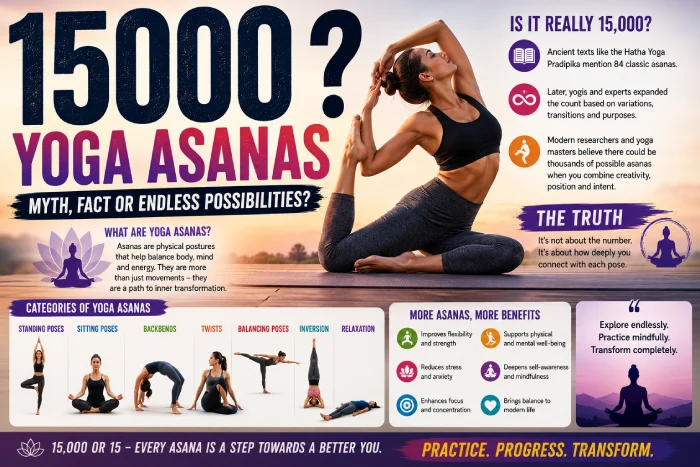
The question I am asked most OFTEN maybe the answer you will find most interesting.
Old yogic texts however, give number to different series: The Hatha-Yoga-Pradipika mentions 84 classical asanas and The Gheranda Samhita 32. Most teachers nowadays use all to speak of 84 000 asanas (the whole practice of yoga, taken as an allegory, a number not to be taken literally).
In practical modern yoga:
- Most practitioners work with 50–100 core asanas regularly
- Major yoga styles draw from 30–60 asanas for their primary sequences
- Beginner practice 15–25 basic poses after thoroughly learned before proceeding to new poses4
What‘s the point: Don‘t get overwhelmed. 20 clearly understood poses, practiced persistently, will have surprising benefits. The practice isn‘t about distention it‘s about intensity and persistence.
Types of Yoga Asanas: The 6 Main Categories
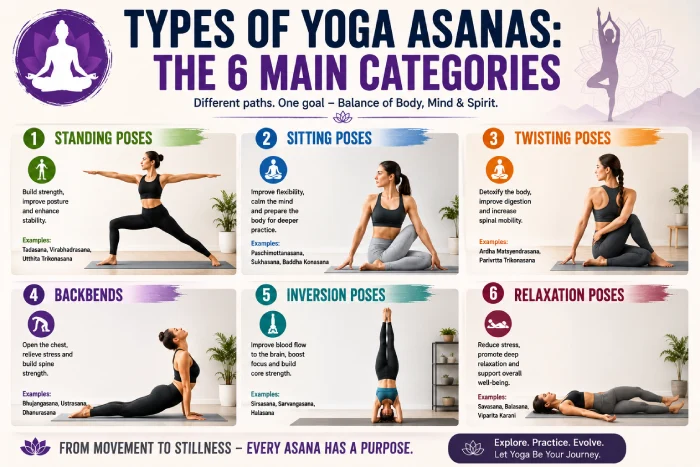
All yoga asana can be classified into one or more of these basic groups. Once you know what category a pose is in, you know what it mainly does to your body.
1. Standing Asanas
Standing poses give us opportunity to focus on strengthening the leg, the buttocks and the abdomen while increasing awareness of our stability, balance and postural relationship. The yoga asanas that are the most physically strenuous are the ones most frequently used within the ‘active’ phase of a yoga sequence.
Any of these, Urdha Mukha Svanasana (Upward Facing Dog), Dog Facing Downward, (Adho Mukha Svanasana), Cobra, (Bhujangasana), Camel, (Udhva Mukha Svanasana)
Primary positive features: useful for strengthening and toning the legs and buttocks, alignment of the body, balance, opening out of the hips, energizing the entire kinetic chain.
2. Seated Asanas
Seated poses are typical in developing flexibility within the hips, hamstrings and back. The poses are often less energising than standing poses and so in a class are normally viewed at the end or in the latter half of the class as a cooling down activity.
Examples:Staff Pose (Dandasana) Seated Forward Bend (Paschimottanasana) Butterfly/thorn Angle (Baddha Konasana) Seated twist (Ardha Matsyendrasana) Pigeon (Eka Pada Rajakapotasana)
Main benefits: increased flexible movement of the hip, elongation of the hamstring, rotation of the spine, release of tension from the lumbar region and opening of the flexors of the hip.
3. Balancing Asanas
Balance poses challenge your proprioception, prepare you to be strong on one leg, and place a tremendous amount of mental focus what the Buddhists call ‘moving meditation’.
Additional postures might include: vrikshasana (tree stand), virabhadrasana 3 (warrior 3), garudasana (eagle stand), arha chandrasana (half moon), bakasana (crow pose)
Early benefits: Proprioception, one foot/stability, mental alertness, ankle/stability knee/knee stability, core activation
4. Backbend Asanas
Backbends open the front of the body pecs, shoulders, hip flexors, quads and strengthen the back side of the body. Energizing poses that are also affectionately called “heart openers.”
Some naming examples: Cobra pose/Bhujangasana, Upward Dog/Urdhva Mukha Svanasana, Camel/Ustrasana, Bridge/Bhuja Bandhaasana, Bow/Ustrasana, Wheel/Upward Bow/Urdhva Dhanuaerasana.
Principal advantages: opening of the chest, extension and mobility of the spine, stretching of the hip flexors, strengthening of the posterior chain, mitigating the effects of the forward-hunched position of desk work
5. Twisting Asanas
Twists compress and then relax the abdominal organs, stimulate digestion, and rotate the thoracic and lumbar areas of the back. Twists are the only poses that have a direct influence on internals.
Other Twists are: Seated Twist (Ardha Matsyendrasana), Revolved Triangle (Parivrtta Trikonasana), Supine Twist (Supta Matsyendrasana), Revolved Chair (Parivrtta Utkatasana)
Advantages: – spinal mobility, rotation;- digestion stimulations;- supporting of detoxication;- relaxation release in thoracal spine
6. Inversion Asanas
Inversions where the heart is above the head or partly above, turns the body upside down (reversing the influence of gravity on blood flow). Inversions are however, varying types from the popular Legs-UP-the-Wall to more complex poses like Handstand to headstand and they are some of the most systemic beneficial asanas.
They could be: Downward Facing Dog; Legs up the Wall; Shoulderstand; Headstand; Handstand.
Key benefits: enhanced circulation, controlled lymphatic drainage, nervous system relaxation (more gentle inversions), mental clarity, gain in arm strength (more advanced inversions)
Category Summary Table
| Category | Primary Effect | Example Pose | Best For |
| Standing | Strength, stability | Warrior II | Leg strength, posture |
| Seated | Flexibility, hip opening | Pigeon Pose | Flexibility, recovery |
| Balancing | Focus, coordination | Tree Pose | Mind-body connection |
| Backbend | Chest opening, spinal extension | Cobra | Posture, energy |
| Twisting | Spinal rotation, digestion | Seated Twist | Back health, digestion |
| Inversion | Circulation, calm | Legs-Up-the-Wall | Recovery, stress |
The Proven Benefits of Yoga Asanas
The scientific evidence base for yoga asanas has grown substantially in the last 15 years. Here’s what the research consistently shows:
Physical Benefits
Flexibility and mobility. An Israeli study published in the International Journal of Yoga (2016) showed increased hamstring flexibility, shoulder range of motion and spinal mobility after 8 weeks of Yoga in sedentary subjects.
Strength: Many standing poses, arm balances, and poses that require the muscles of the core to be working hard help to develop functional strength. The muscles used in the yoga push-up (Chaturanga Dandasana), are comparable to those working in a traditional push-up; however they‘re much more dependent on core activation:
Reduction in chronic pain: A review in Annals of Internal Medicine in 2017 showed yoga is some effectiveness in reducing chronic lower back pain so much so that it is included with other more traditional non-pharmaceutical interventions in guidelines issued by the American College of Physicians.
Balance and prevention of falls: a meta-study in Age and Ageing, demonstrated that practicing yoga produce significant improvement in balance and reduction in risk for falls of individuals over 60. An intervention with the most research behind it for aging populations.
Mental and Emotional Paybacks
Stress reduction: According to investigators, yoga decreases cortisol. The main stress hormone is the cortisol. In a study conducted in 2013 a significant reduction in the levels of cortisol was observed in yoga practitionersonly after 10 days of yoga practice as compared to controls.
Anxiety and depression: Several meta-analyses have shown that doing yoga asana results in reductions in symptoms of anxiety and depression to an extent comparable with moderate intensity aerobic exercise.
Sleep quality A 19 trial review of randomized controlled trials described a better quality sleep and an increased sleep time and efficiency following the practice of yoga.
Mini Summary: yoga poses offer measurable benefits in flexibility, strength, pain relief, balance, stress and mental health supported by an increasing body of clinical studies. The benefits are available at all fitness levels.
Yoga Asanas for Beginners: Building Your Foundation
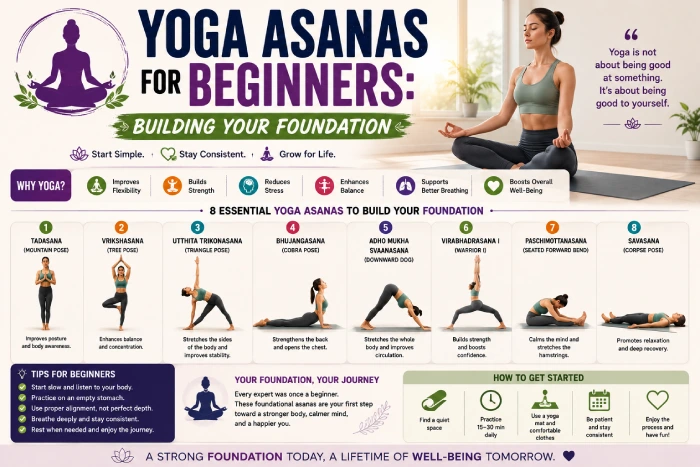
The single most beneficial tip I can give is for extreme beginners to avoid copying the show-off movements of highly advanced poses on Pinterest. Instagram yoga does not represent what 95% of yoga practitioners do — or what beginners should attempt.
The real foundation of yoga asana practice is body awareness, breath coordination, and alignment — not flexibility or advanced postures. A beginner who practices Mountain Pose with full awareness gets more from yoga than someone forcing themselves into a split with poor form.
The 5 Foundation Asanas Every Beginner Should Master First
- Mountain Post (Tadasana) The foundation for all standing poses. Teaches alignment, distribution of weight and sustained muscular engagement while simply “standing.” All standing poses begin and finish here.
- Downward Fronting Dog (Adho Mukha Svanasana). The most popular yoga pose but the same as the dead corpse pose, it is the one most worshipped. It opens the back of the leg, extends the spine and works the shoulders and arms. The most popular mistake made by the beginner is to relax the spine by reaching for the floor and keep the feet flat. Bend your knees to preserve the integrity of the back.
- Child‘s pose (Balasana) The most common resting pose. Provides a gentle release for the hips, low back, and shoulders. Essential function: always take a Child‘s Pose if you wish to rest during class. You never need feel self-conscious about taking child poseait‘s not a cop-out from practice.
- Warrior II (Virabhadrasana II) The simplest of the standing strength poses. Develops the legs and hips, opens the chest and prepares you to work on a number of areas concurrently.
5.Cat-Cow (Marjaryasana-Bitilasana) A two stage segment of movement performed from a prone position, which stretches the spine, synchronizes the breath with the movement and relieves tension in the bottom and middle back. Great Beginning pose; Good as a warm up for the spine.
Beginner Practice Principles
- Honor your current range of motion — the goal is awareness, not the deepest expression of a pose
- Breath is always the priority — if you’ve lost your breath, back off the pose
- Use props without shame — blocks, straps, bolsters, and blankets are not “beginner” tools; they’re precision tools used by experienced practitioners
- Practice 3 times per week minimum — flexibility and strength adaptations require consistent repetition; once a week produces slow progress
- Start with 20–30 minute sessions — shorter consistent practice beats infrequent long sessions
Mini Summary: Beginners build a successful yoga asana practice on five foundational poses, steady breathing, and proper alignment — not flexibility or advanced posture attempts.
Read More: Everything you need to know about all beginner poses, modifications for tight hips and shoulders and 4 weeks of beginner yoga sequences our comprehensive yoga poses for beginners guide.
Yoga Asana Names: Sanskrit vs. English
What is disconcerting for the novice practitioners of yoga is the dual nomenclature that almost all postures hold, since they tend to appear with a Sanskrit term or with an English one (that is used in alternance sometimes even in the same environment!)
Understanding the Sanskrit Structure
Sanskrit yoga asana names typically follow a pattern:
[Describing element] + [Body position or shape] + Asana
Examples:
- Adho Mukha Svanasana = Adho= descending facing +Mukha=face + Svan= dog + Asana = pose /posture = downward facing dog
- Virabhadrasana=Virabhadra (a warrior of the Hindu religion)+Asana (posture) = Warrior‘s pose4
- V Setu Bandha Sarvangasana= Bridge (Setu) + Lock (Bandha) + the whole body (Sarvanga)+ pose(asana).
Quick Reference: Most Mutual Asanas (Sanskrit → English)
| Sanskrit Name | English Name | Category |
| Tadasana | Elevation Pose | Standing |
| Adho Mukha Svanasana | Downward Facing Dog | Inversion/Standing |
| Virabhadrasana I | Warrior I | Standing |
| Virabhadrasana II | Warrior II | Standing |
| Trikonasana | Triangle Pose | Standing |
| Utkatasana | Chair Pose | Standing |
| Vrikshasana | Tree Pose | Balancing |
| Balasana | Child’s Pose | Seated/Restorative |
| Bhujangasana | Cobra Pose | Backbend |
| Setu Bandhasana | Bridge Pose | Backbend |
| Paschimottanasana | Seated Forward Fold | Seated |
| Ardha Matsyendrasana | Half Lord of Fishes (Seated Twist) | Twisting |
| Savasana | Corpse Pose | Restorative |
| Sirsasana | Headstand | Inversion |
| Bakasana | Crow Pose | Balancing/Arm Balance |
Mini Summary: Knowing the Sanskrit is not essential, it makes practice more fun if you learn the Sanskrit, but a typical US class will either use English or a combination; knowing both allows you to be self-guided or follow any teacher.
Read More: Complete alphabetical reference of yoga pose names in both Sanskrit and English, pronunciation guide, and pose categories — see our full yoga poses names guide.
Basic Yoga Poses: The Core Vocabulary of Practice
If Sanskrit names represent yoga’s language, basic yoga poses are its alphabet — the foundational vocabulary from which all more complex postures are built.
Every advanced yoga pose is a modification, combination, or evolution of basic poses. Tree Pose leads to Warrior III. Cobra leads to Upward Dog leads to Full Wheel. Child’s Pose leads to Thread the Needle leads to Pigeon. Understanding this lineage makes advanced poses feel approachable rather than foreign.
The 10 Basic Yoga Poses Every Practitioner Returns To
| Pose | Why It’s Foundational | What It Builds Toward |
| Mountain Pose (Tadasana) | Alignment baseline for all standing poses | All warrior and balance poses |
| Downward Dog | Full-body stretch + arm strength + inversion | Handstand, Three-Legged Dog |
| Plank Pose | Core strength, spinal alignment | Chaturanga, Side Plank, Crow |
| Child’s Pose | Rest position, hip opener | Pigeon Pose, seated poses |
| Cobra | Gentle backbend, spine extension | Upward Dog, Camel, Wheel |
| Bridge Pose | Glute and hip flexor activation | Wheel, Shoulder Stand |
| Cat-Cow | Spinal warm-up, breath-movement sync | All vinyasa transitions |
| Warrior I | Foundational hip alignment and strength | Warrior III, Crescent Lunge |
| Warrior II | Hip opening, sideways strength | Triangle, Lengthy Side Angle |
| Sat Forward Fold | Constrain flexibility, spinal decompression | Splits, Seated Twist |
Mini Summary: Knowing how to do the fundamentals is like having all the essential building blocks for what will come next. There is no such thing as “too much time” spent on basics in yoga.
Read More: Detailed alignment cues, breathing guidance, and common form errors for every basic pose — see our complete basic yoga poses guide.
Yoga Asanas for Back Pain: A Therapeutic Approach
Back pain is one of the most common complaints and affects nearly 80% of Americans at some time. It is also among the best researched non-drug therapies for this condition using yoga asanas.
The American College of Physicians (in their revised 2017 clinical guidelines) formally recommends yoga before medication as a first line approach to chronic lower back pain. This is a serious institutional validation and placebo-controlled stimulation for the practices.
Why Yoga Helps Back Pain
- Facilitates the activity of the deep stabilizers (transversus, Multifidi) of the lumbar spine, which are often weak in back-pain sufferers;
- Releases chronically tight hip flexors and hamstrings that pull the pelvis out of neutral and thereby place undue stress on the spine.
- Increases mobility of the spine with mild extension, flexion and rotation to alleviate stiffness
- Downs reducing the psychological component of chronic pain – Yoga‘s stress reduction effects reduce pain perception and pain catastrophizing
Best Yoga Asanas for Back Pain
| Pose | How It Helps |
| Cat-Cow | Gentle spinal mobilization, warms lumbar muscles |
| Child’s Pose | Opens lumbar spine, stretches lower back |
| Supine Twist | Releases tautness in paraspinal muscles |
| Bridge Pose | Reinforces glutes and hamstrings, dismissing lumbar load |
| Legs-Up-the-Wall | Passive lumbar decompression, anxious system calming |
| Thread the Needle | Opens piriformis and external rotators (piriformis syndrome) |
| Sphinx Pose | Gentle lumbar extension, counteracts flexion-dominant pain |
What to Avoid With Back Pain
- Deep forward folds with straight legs (Paschimottanasana) in acute pain phases
- Full backbends like Wheel or Camel until lumbar is stable
- Seated twists with rounded spine
- Any pose that reproduces or sharpens pain — honor the signal
Mini Summary: Yoga asanas are clinically proven for back pain relief — the right poses build the deep stability and flexibility that most back pain sufferers lack. The wrong ones can aggravate — proper guidance matters.
Read More: Full therapeutic sequence for lower back pain, poses to avoid, modifications for herniated discs, and a 30-day back pain yoga plan — see our complete guide to yoga poses for back pain.
Yoga Asanas for Weight Loss: What Actually Works
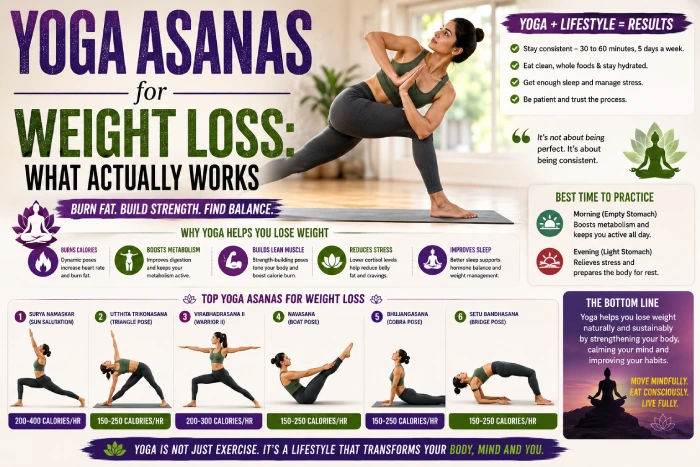
Yoga for weight loss is a nuanced topic — and most content gets it wrong in one of two directions: either claiming yoga is a complete weight loss solution, or dismissing it as “just stretching.”
The middle ground is where the truth lies and it‘s far more compelling than either side.
How Yoga Asanas Contribute to Weight Loss
Calories burned solely by doing the yoga: What styles of yoga burn the most calories? Yin/Restorative yoga burns approximately 150-200 calories per hour. Vinyasa/Power yoga burns approximately 300-450 calories per hour. Hot yoga burns approximately 400-600 calories per hour.
These figures are less than running or HIIT but that‘s not the whole story.
Indirect fat loss mechanisms:
- Stress and cortisol lowering: A study has shown that consistently high cortisol levels cause fat to be stored around the abdomen. Yoga alone has proved to bring cortisol levels down, which in itself will trigger off fat burn.
- Better sleep: one of the effects of hophfuffleence deprivation is the secretion of the hunger hormone and the reduction of the fullness hormone; yoga‘s sleep benefits are being used for improving hunger.
- Mindfulness and eating behavior. Mindful eating has been observed in more experienced yoga students (Chadwick et al 2005) where it is associated with eating more slowly, stopping in the satiety state and making healthier choices.
- Muscle building (active): Power and Vinyasa yoga boost resting metabolism by building lean muscle.
Best Yoga Styles for Weight Loss
| Style | Calorie Burn (60 min) | Intensity | Weight Loss Effectiveness |
| Power Yoga / Baptiste | 350–450 cal | High | High |
| Vinyasa Flow | 300–400 cal | Moderate–High | Moderate–High |
| Ashtanga | 350–500 cal | High | High |
| Hot Yoga (Bikram) | 400–600 cal | Moderate–High | Moderate–High |
| Hatha | 200–280 cal | Moderate | Moderate |
| Yin / Restorative | 150–200 cal | Low | Low (direct), Moderate (indirect) |
Best Individual Asanas That Support Weight Loss
- Boat Pose (Navasana) — intense core engagement, holds build endurance
- Chair Pose (Utkatasana) — sustained leg and glute engagement, significant calorie demand
- Warrior sequences (I, II, III) — lower body strength, transitions create cardio demand
- Plank and Chaturanga sequences — upper body and core strength
- Sun Salutations (Surya Namaskar) — fast-paced, full-body, 10 rounds burns approximately 150–200 calories
Mini Summary: Yoga asanas support weight loss most powerfully through stress reduction, sleep improvement, and mindful eating — with direct calorie burn from dynamic styles as an additional contribution.
Read More: The most effective yoga sequences for fat loss, best styles for burning calories, and a 30-day yoga weight loss plan — see our complete guide to yoga poses for weight loss.
Advanced Yoga Poses: Building Toward Complexity
Advanced yoga poses represent years — sometimes decades — of accumulated practice, not simply physical flexibility or strength. They call for deep internal focus, attention to alignment, breath awareness, and the basic strength and freedom of movement developed through the primary postures.
What Makes a Yoga Pose “Advanced”
A pose is advanced when it requires:
- Along with multi-directional flexibility, there is also multi-directional flexibility continuously (like for example splits in a backbend).
- A strength of upper body strength (with numerous arm balances, handstands)
- Complete spinal mobility in multiple directions
- High proprioceptive demand (one-arm balances, complex inversions)
- Years of foundational preparation — not months
The Most Common Advanced Asanas
| Pose | Prerequisite Skills | Category |
| Handstand (Adho Mukha Vrksasana) | Plank, Downward Dog strength, straight-body awareness | Inversion |
| Crow Pose (Bakasana) | Plank strength, hip flexibility, wrist conditioning | Arm Balance |
| King Pigeon (Raja Kapotasana) | Hip flexibility, deep backbend mobility | Backbend |
| Wheel Pose (Urdhva Dhanurasana) | Bridge, Cobra, flexible thoracic spine | Backbend |
| Hanumanasana (Full Splits) | Hamstring + hip flexor flexibility | Seated |
| Forearm Stand (Pincha Mayurasana) | Shoulder stability, core control | Inversion |
| Flying Pigeon (Eka Pada Galavasana) | Hip flexibility + Crow pose mastery | Arm Balance |
The honest timeline: Most people practicing 3–5 times per week reach intermediate poses comfortably in 6–12 months. True advanced poses typically require 2–5+ years of consistent, properly guided practice.
Mini Summary: Advanced yoga poses are not shortcuts to a better practice — they’re the natural outcome of years spent building foundations correctly. Patience and proper sequencing get you there far faster than rushing.
Read More: Step-by-step progressions, prerequisite strength and flexibility benchmarks, and safe pathways to advanced poses — see our complete guide to advanced yoga poses.
Common Yoga Asana Mistakes — And How to Fix Them
Even dedicated practitioners make these errors. Correcting bad habits and to protect your joints will significantly help your progress.
The 8 Most Common Yoga Asana Mistakes
Mistake 1: Forcing flexibility before creating stability The #1 mistake i see in yoga.
Flexibility without surrounding muscular stability creates hypermobility and joint vulnerability. Build active strength in the ranges you can already access before pushing further.
Mistake 2: Holding the breath Many beginners unconsciously hold their breath in challenging poses. This defeats a core purpose of asana practice — using breath to calm the nervous system and move deeper into poses. In the event you are unable to breathe, reduce the friction until you can breathe freely.
Error 3: Rounded spine when folding forward As you bend forward from the waist with a rounded back in standing or sitting forward bends, the lumbar discs are compressed.
Hinge from the hips instead — even if this means bending your knees significantly. A long spine with bent knees is always better than a rounded spine with straight legs.
Mistake 4: Knee tracking over the ankle in lunges and Warrior position The front knee should never fall at the second toe, resulting in a valgus knee collapsing inward. Conversely, the knees should never force pass the edge of the foot. An inward collapse puts pressure on the ACl and the medial knee tissues.
Mistake 5: Dumping into the lower back in backbends The lower lumbar collapses rather than the thoracic extending this leads to compression of the lumbar vertebrae. Light engagement of the core, small tuck of the pelvis and the focus of the bend from the mid-back.
6th Mistake: Skipping Savasana ( the Corpse Pose) Improperly leaving the classwill put you in a tough spotall of your hard work is wasted. The body needs it to bring the nervous system from the sympathetic overdrive that is our busy lives back into a parasympathetic state where the yoga practice can work its magic. Don‘t sneak out before Savasana. Do your five minutes.
Mistake 7: Comparing your pose to others in class. Every body is different. A hip socket, depth, bone structure, limb proportions and injury history will all affect what a pose ‘should’ look like in your body. The correct pose for you is the one that produces your target sensation- not the one that looks like the teacher‘s example.
Error 8: Groping without props:Blocks, straps, bolsters and blankets are exacting tools, not enabling devices. B.K.S. Iyengar(one of the best yoga teachers to come along in the twentieth century) invented props because they enable correct alignment the body is not yet trained to achieve on its own.
Using props is practicing yoga correctly.
How to Choose the Right Yoga Asana Style for Your Goal
| Goal | Best Yoga Style | Why |
| Flexibility | Yin Yoga, Hatha | Long holds, deep tissue release |
| Strength | Power Yoga, Ashtanga | Dynamic movement, arm balances |
| Stress relief | Restorative, Hatha, Yin | Nervous system calming, slow pace |
| Weight loss | Vinyasa, Power, Hot Yoga | Higher calorie burn, dynamic flow |
| Back pain | Iyengar, Therapeutic Hatha | Precision alignment, props |
| Beginners | Hatha, Slow Flow | Foundational poses, slower pace |
| Athletic performance | Vinyasa, Power | Functional strength, mobility |
| Seniors | Chair Yoga, Gentle Hatha | Modified poses, accessibility |
| Mental health | Any consistent style | Consistency > style for mental benefits |
For how many seconds should you maintain each yoga asana?
This really comes down to the yoga, and the function of the pose.
| Context | Hold Duration | Purpose |
| Vinyasa Flow | 1–5 breaths (5–25 seconds) | Warmth, flow, cardio demand |
| Hatha Yoga | 5–10 breaths (30–60 seconds) | Alignment, strength, awareness |
| Iyengar Yoga | 1–5 minutes | Precision alignment, therapeutic effect |
| Yin Yoga | 2–5 minutes (some up to 10) | Deep connective tissue release |
| Restorative Yoga | 5–20 minutes | Full nervous system release |
Basic beginner guidance: 3-5 full inhales/exhales per pose is a fine place to start. (an inhale/exhale is approx 4-6 sec so 5 inhales are 20-30 sec.) This is enough time to settle into the pose, get an idea of what your body is doing and then come out of the pose.
Building a Home Yoga Asana Practice: What You Actually Need
Essential (zero cost):
- Flat non slip surface (carpet or bare floor)
- Standard clothing, adaptable to all types of movement. (e.g. comfortable clothes that can be easily moved in)
- One wall (should be useful for supported inversion and balance work)
Highly recommended ($20–$80):
| Item | Cost | Why It Matters |
| Yoga mat | $20–$80 | Grip, joint cushioning, dedicated practice space |
| 2 yoga blocks | $15–$25 | Bring the floor to you — essential for tight hamstrings and hips |
| Yoga strap | $10–$20 | Extends reach in forward folds and shoulder openers |
Optional additions:
- Bolster ($30–$60): transforms restorative and Yin practice
- Blanket (any firm blanket): seated support, Savasana warmth
The honest minimum: A yoga mat and two blocks. Everything else helps but nothing else is truly necessary.
HIIT and Yoga Asanas: Can You Stance to Both?
Often asked: “which one is better: a yoga or something more extreme, like HIIT?”
The answer: they are very complementary.
| Dimension | HIIT | Yoga Asanas |
| Calorie burn per session | High | Low–Moderate (varies by style) |
| Flexibility | Minimal | High |
| Stress response | Activating (cortisol spike) | Calming (cortisol reduction) |
| Strength | Functional, muscular endurance | Isometric, body weight |
| Injury recovery | Can aggravate | Can rehabilitate |
| Mental health | Positive | Highly positive |
| Joint health | Depends on form | Strongly supportive |
Optimal combination: HIIT or strength training 2–3 days/week + yoga 2–3 days/week. The yoga practice supports recovery and has a joint maintenance effect. It also has the stress-relaxing effect which fatigued training erodes.
FAQs: Yoga Asanas
Q1: What is the definition of yoga asana?
Asana is a word borrowed from Sanskrit language and is translated as the ‘seat’ and “posture”. In regards to yoga, an asana is an physical posture used in yoga practice. They are established to have specific beneficial effects on the mind and body. Yoga includes hundreds of yoga asanas between traditional and modern yoga systems, from the most simple seated positions to the most complex arm balances and inversions.
Q2: How many asana yoga are?
Yoga stately publications speak of 84 traditional yoga asanas, although some estimates go as high as84,000. In contemporary contexts most styles of yoga preponderantly work within the parameters of 50-100 of the most commonly exercised postures, with Yoga beginners often becoming versatile and adept at perhaps 15-25 on a core level before broadening the breadth of their studies.
Q3: What are the good beginner yoga asanas?
Anasanas for beginners include: Mountain pose, Child‘s pose, Downward Dog, and Warrior II. These five asanas will guide you to building the basics of any good yoga practice: strength, flexibility and breath control.
Q4: Yes and substantially?
The American College of Physicians is calling for yoga as a primary approach to non-drug management of chronic lower back pain. The strengthening poses improve the deepest muscles supporting the spine; release the most common hypomobile structures that contribute to back pain (hip flexors, hamstrings); and increase mobility of the spinal tissues. A selection of targeted poses like Bridge, Cat-Cow, Supine Twist and Childs pose can be used both for immediate pain relief and to promote long-term ease and pain reduction.
Q5: Can Yoga Asanas aid in weight management?
Diverse Yoga asanas assist in controlling weight by burning calories (most efficiently in dynamic styles like Power Yoga and Vinyasa), reducing cortisol levels (which can cause obesity in response to stress), improving sound sleeping habits (which support regulation of ‘hunger’ hormones) and eating consciously. Dynamic Yoga styles burn 300-500 kcal/hr and build functional muscles to enable you to stay fit.
Q6: How many times should I do yoga asanas?
For general health and flexibility gains, 3 times a week; you will begin to see results of stretching and general health gains in around 4–6 weeks. For real flexibility gains and strength, you need to be doing yoga 4–5 times a week to see growth. Daily yoga practice is common among serious practitioners, where they do a quick 20–30-minute session on lighter days and a more comprehensive 60–90-minute practice on dedicated days.
Q7: Is yoga asana safe for the senior client?
A: Yes, with modifications. As one of the most researched exercise interventions among the aging, there is a wealth of supporting information on yoga improving balance, decreasing falls, easing flexibility, and emotional well-being. For those with diminished physical capacity chair yoga and gentle Hatha yoga are good choices. If dealing with medical problems check with doctor before starting.
Q8: What is the difference between yoga and yoga asanas?
Yoga is an entire philosophical and practical system that originated in ancient India and comprises of eight parts (called limbs) that include ethics, breath exercises, meditation and the study of philosophy. The yoga asanas pose practice are one of those eight limbs. What most people practice and refer to as yoga is mostly pose practice with an added component of some types of breathing exercises. The system in its entirety is much more comprehensive.