

Last Updated: July 2, 2026
If you‘ve hit the treadmill for an endless amount of time with little to show for it or, if you just can‘t find 60 minutes to spend in a gym, then high intensity interval training might be the most important form of training you haven‘t committed to yet.
HIIT (High Intensity Interval Training). HIIT refers to a workout that involves working in very high intensity for a specific period of time (usually 20-45 seconds) followed by a brief period of rest (15-30 seconds). Each workout session is usually only 15-30 minutes long but hits fat burning, cardiovascular and metabolism better than long duration, steady state cardio sessions.
That’s not fitness marketing hype. It’s the consistent finding of over two decades of exercise science research.
A landmark 2012 study published in the Journal of Obesity found that 12 weeks of HIIT significantly reduced total body fat, abdominal fat, and visceral fat — even without any dietary changes. Participants who did steady-state cardio showed no significant fat loss in the same period.
Whether you’re training for fat loss, athletic performance, general fitness, or just want to feel genuinely challenged in a short session — HIIT delivers. This guide is your complete starting point. Each major HIIT subject is addressed; for extra research, individual cluster guides are connected to the details.
How HIIT Workouts Actually Work: The Science in Plain English
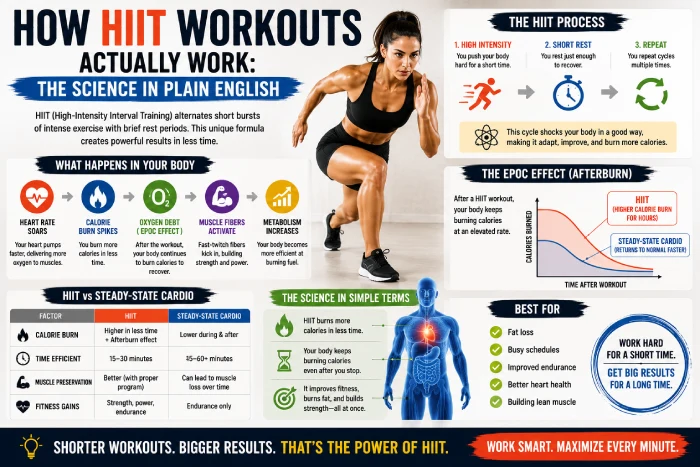
Most people know HIIT involves “going hard then resting.” But understanding why that structure produces such outsized results helps you train smarter — not just harder.
The Mechanism: EPOC
What makes HIIT so efficient at burning fat is something called EPOC or the “afterburn effect.”
When you‘re doing a single session of HIIT, your body is functioning at or close to its maximum. As a result, you experience an ‘oxygen debt’: Your body‘s metabolic systems have been so hard at work that they couldn‘t quite stay ahead of oxygen consumption as it was happening. Following your workout, your body then spends the next 14–48 hours bringing itself back into balance: rebuilding muscle tissue, flushing metabolic waste from your muscles, restoring glycogen and amino acid levels, et cetera.
That all that recovery work is burning calories. Big ones research indicates EPOC may contribute 6–15% more to overall calorie expenditure than during the workout itself.
In layman‘s terms: The 25 mins of HIIT not only burns calories during the 25 min, but will do so for the rest of the day and half the following day.
What Happens Inside Your Body During HIIT
| Phase | What’s Happening | Energy System |
| Work interval (all-out) | Anaerobic system activated, fast-twitch fibers firing | Phosphocreatine + glycolytic |
| Rest interval | Partial recovery, heart rate drops but stays elevated | Aerobic resynthesis |
| Post-workout (EPOC) | Oxygen debt repaid, muscle repair begins | Aerobic, oxidative |
Why HIIT Beats Steady-State Cardio for Fat Loss
| Factor | Steady-State Cardio | HIIT |
| Session duration for results | 45–60 min | 15–30 min |
| Calorie burn during session | Moderate | Moderate–High |
| EPOC / afterburn effect | Minimal | High (14–48 hours) |
| Effect on resting metabolism | Minimal | Elevates for hours |
| Muscle preservation | Poor (long sessions can be catabolic) | Good |
| Time efficiency | Low | Very High |
| Cardiovascular adaptation | Good | Excellent |
| Fat loss over 12 weeks | Moderate | Significantly higher |
Key Takeaway: HIIT’s advantage isn’t just what happens during the workout — it’s what keeps happening for hours afterward.
HIIT Protocols: Which One Is Right for You?
“HIIT” is an umbrella term. Underneath it are several specific training protocols, each with different work/rest ratios and intensity demands.
The Main HIIT Protocols Compared
| Protocol | Work | Rest | Rounds | Total Time | Best For |
| Classic HIIT | 30 sec | 30 sec | 8–10 | 12–15 min | General fitness, intermediate |
| Tabata | 20 sec | 10 sec | 8 | 4 min per exercise | Advanced, time-crunched |
| 40/20 | 40 sec | 20 sec | 6–8 | 18–24 min | Intermediate fat loss |
| 45/15 | 45 sec | 15 sec | 6–8 | 18–24 min | Advanced endurance |
| Sprint Intervals | 20–30 sec sprint | 60–90 sec walk | 8–10 | 20–25 min | Outdoor, treadmill |
| EMOM (Every Minute on the Minute) | Reps in 40–50 sec | Remaining seconds | 10–20 min | Variable | Structured, gym-based |
How to Know You’re Working at HIIT Intensity
The most common mistake people make calling something “HIIT” when it isn’t. True HIIT work intervals should be at 80–95% of your maximum heart rate.
Simple test: During a work interval, you should be completely unable to hold a conversation. So… if you can talk effortlessly, its not hig…its easy cardio with periods of rest.
Estimated Max Heart Rate: 220-your age
- If you‘re 30:Max HR ~ 190. HIIT work zone ~ 152–180 BPM
- If your 45: Max HR = 220 – 45 = 175. HIIT work zone = 140-165 BPM
- If you‘re 55: Max HR ≈ 165. HIIT work zone ≈ 132–156BPM
Benefits of HIIT Workouts: What the Research Says
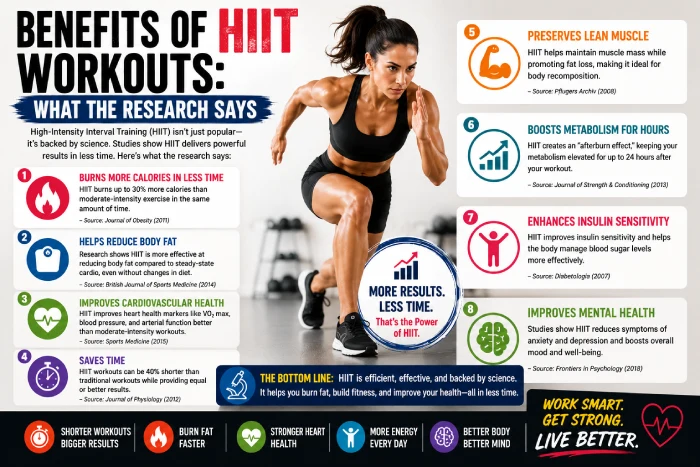
The advantages of HIIT are far more than fat loss. Here‘s what invariably pops up from the scientific session:
Fat Loss and Body Composition
Multimeta analysis showed for an equal number of calories burnt HIIT resulted in a much larger reduction in total body fat in several meta-analyses.
. Especially effective for* visceral fat (the very dangerous fat around the organs) a 2018 review published in Sports Medicine concluded that HIIT burn off 2cm (i.e., nearly ¾ inch) more waist circumference than the traditional steady-state cardio
– Maintains lean muscle mass while losing fat important for keeping up metabolic rate
Cardiovascular Health
- Existing guidelines state that it can the following are potential health benefits:
- Establishes baseline levels of blood pressure and blood volume, administered by the professional.
- enhances heart rate variability. This a marker of heart health and stress resilience.
- Some evidence to lower cardiovascular risk markers in those with type 2 diabetes, heart disease and metabolic syndrome
Metabolic Benefits
- Improves insulin sensitivity by 23–58% in studies on diabetic and pre-diabetic populations
- Elevates resting metabolic rate for 14–48 hours post-session
- Increases mitochondrial density in muscle cells — improving the body’s fat-burning efficiency at all intensity levels
Mental Health and Performance
– Associated with marked reductions in anxiety and depression (as found with moderate intensity exercise but in shorter sessions)
− Increases mood and mental performance immediately after exercise
. Associated with greater self-efficacy and workout satisfaction compared to steady-state cardio in adherence studies.
Mini Summary: HIIT elicits world class cardiovascular, metabolic and body composition results with session durations of 15–30 minutes. The data is among the strongest in all of exercise science.
HIIT Workout Equipment: What You Need (and What You Don‘t)
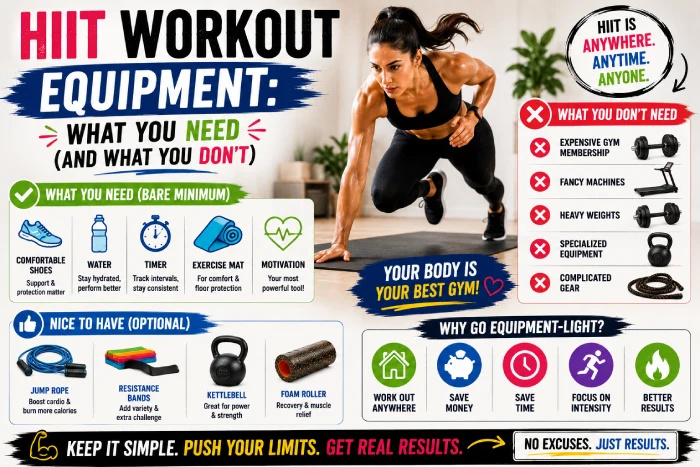
The single most important thing to know about HIIT equipment: you don‘t need it.
Bodyweight HIIT utilizing nothing but your own body as resistance delivers the same caloric and cardiovascular advantages as the resistance equipment-assisted mode. Equipment is simply an extra; variety, resistance, new training stimuli, Not a preference.
Equipment Levels for HIIT
Level 0 — No Equipment (Bodyweight Only)
Everything you need for effective HIIT is already with you. Burpees, high knees, jump squats, mountain climbers, plank jacks, and lateral shuffles — all requiring zero gear and 6×6 feet of floor space.
[Level 1 — Minimal Investment ($10–$40)]
| Equipment | Cost | What It Adds |
| Jump rope | $10–$25 | Highest calorie-burn cardio per minute, coordination |
| Resistance bands | $15–$30 | Add resistance to lower body moves, row variations |
| Yoga mat | $20–$40 | Floor comfort, joint protection on hard floors |
[L 2 — Mid-Range ($40–$150)]
| Equipment | Cost | What It Adds |
| Kettlebell (1–2) | $30–$80 | Swings, cleans, snatches — hybrid cardio/strength HIIT |
| Adjustable dumbbells | $80–$150 | Full resistance range for weighted HIIT circuits |
| Step platform | $25–$50 | Step-based intervals, incline push-ups, plyometrics |
[Level 3 Home gym setup ($150-$500)]
Pull-up bar, complete dumbbell set, plyo box, and battle ropes allow for the full spectrum of advanced HIIT programming. None of it is required to reach your goals, but should you want the widest variety…
Main Point: Get nothing your first year. Buy a jump rope as your one single best investment ($15) to get. All else is icing.
Sample HIIT Workouts: Routines for Every Level
Intermediate HIIT Workout (No Equipment, 25 Minutes)
Format: 40 seconds work / 20 seconds rest Series of 4, each consisting of 5 exercises
Warm-up (3 min): light jog on the spot→ dynamic leg swings→ arm swings.
| Exercise | Work | Rest |
| Burpees | 40 sec | 20 sec |
| High knees | 40 sec | 20 sec |
| Jump squats | 40 sec | 20 sec |
| Mountain climbers | 40 sec | 20 sec |
| Lateral shuffle | 40 sec | 20 sec |
Take a 60 second break between rounds. Complete 4 rounds.
Cool-down (3 min): walk>standing hip flexor stretch>seated hamstring stretch.
Calories burned: 250 370 + EPOC (the amount of oxygen consumed after exercising).
Advanced HIIT Workout (Tabata Format, 25 Minutes)
Format: 20 sec work / 10 sec rest for 8 rounds for each exercise 5 exercises all together
Exercises (8 rounds each, 4 min per exercise, 1 min rest between):
- Burpee with push-up
- Jump squat
- Speed skater jumps
- Plank to push-up
- Sprint in place (max speed)
Estimated calorie expenditure: 300–450 calories + EPOC
30-Minute HIIT Workout
For those seeking a comprehensive, organized workout all within a 30-minute time frame (including warm-up to cool down), this is where dedicated time efficiency exists.
A very effective 30-minute HIIT consists of 3 blocks (upper body, lower body and whole body), with the various exercises consisting of both long and short interval work and planned breaks.
This format maintains intensity without letting fatigue compound so severely that form breaks down.
Mini Summary: 30-minute HIIT is the sweet spot for most people — enough time to complete a serious, multi-block session without extended time commitment.
Read More: Complete 30-minute HIIT routines, interval structures, and printable workout plans — see our dedicated guide to the 30 minute HIIT workout.
Full Body HIIT Workouts: Train Everything, Every Session
Full-body HIIT workouts train every major muscle group — upper body, lower body, and core — within a single session. This is excellent for Fat Loss as it targets the largest muscle groups in each session, therefore providing the most stimulus i.e calorie expenditure and metabolic demand.
Why Full-Body HIIT Works So Well
More total muscle engagement = more calories burned per session
- Every session trains the whole body — no skipped muscle groups if you miss a session
- Works well with 3 sessions per week (enough recovery time between full-body sessions)
- Especially effective for beginners and intermediates who don’t yet need specialization
The Full-Body HIIT Exercise Matrix
| Movement Pattern | Exercise Options |
| Lower body push | Jump squat, squat, lunge jump, step-up |
| Lower body pull | Romanian deadlift jump, glute bridge, single-leg deadlift |
| Upper body push | Push-up, pike push-up, plyo push-up |
| Upper body pull | Inverted row, resistance band row, renegade row |
| Core | Mountain climber, plank jack, bicycle crunch |
| Full-body explosive | Burpee, bear crawl, squat thrust |
Mini Summary: Full-body HIIT is the most time-efficient format for simultaneous fat loss and total-body conditioning. It’s the format most beginners and intermediates should default to before moving to split-based programming.
Read More: Complete full-body HIIT routines, exercise substitutions, progression plans, and equipment-free versions — see our complete guide to full body HIIT workout.
HIIT Workouts for Women: What’s Different and What Isn’t
The fundamentals of HIIT are identical for men and women — the same protocols, the same progressive overload principles, the same recovery requirements. But there are meaningful differences in how women may want to structure HIIT training for optimal results.
What‘s Genuinely Different for Women in HIIT
Hormonal cycle – due to changes in circulating estrogen and progesterone throughout the menstrual cycle, a women may have altered availability of energy sources, recovery time and tolerance to exercise.
- Female: 14kg of body fat (16%) compared to male 15kg (12%): Better for weight management.22.00 weeks of high intensity cardio, female have 31.3 hours more to weight manage. Follicular phase (day 1-14):21.01(July.è15): Estrogen increases generally superior energy, endurance, recovery. Better suited for higher intensity HIIT.
- Luteal phase (days 15–28): Progesterone increases temperature higher, perceived effort also higher, recovery is slower. Cut back the HIIT when the luteal phase hits or substitute one session for low-impact cardio.
Body composition goals: Many women prefer to be toned and lean rather than at maximum strength. HIIT with bodyweight and light resistance aligns directly with this — building lean, defined muscle without adding bulk (which requires a caloric surplus and heavy resistance training that most HIIT programs don’t include).
Injury considerations: Women have a wider Q angle (the angle from hip to knee) which can increase ACL and knee injury risk in jumping-heavy HIIT. Including low-impact alternatives and landing mechanics practice is valuable.
What’s Not Different
- The work/rest ratios that produce results
- The importance of progressive overload
- The recovery requirements (48 hours between HIIT sessions)
- The nutritional support needed (protein, carbohydrates, total calories)
Mini Summary: Women can and should do HIIT with the same intensity and commitment as men. Adjusting session intensity around hormonal cycles is the key personalization that most generic HIIT programs miss.
Read More: Women-specific HIIT plans, hormonal cycle training advice, toning routines, and post-pregnancy modifications — see our complete guide to HIIT workouts for women.
HIIT Workouts for Men: Programming for Muscle, Power, and Fat Loss
Men typically enter HIIT with different baseline goals than most generic HIIT content addresses — many want to retain or build muscle mass while cutting fat, improve athletic performance, or build functional power.
This changes how HIIT should be structured.
Key Differences in Programming HIIT for Men
- Greater resistance focus: Men generally have a greater muscle mass and work-relevant testosterone environment which enables them to manage, and receive adaptation from, higher resistance loads for HIIT Circuits. Incorporating kettlebell swings, weighted burpees and dumbbell thrusters into the HIIT Circuit sessions maintains the necessary muscles triggers without losing the cardio effect.
- Power-based movements: Explosive movements (box jumps, clapping pushups, med ball slams, sprint intervals) develop fast-twitch muscle fibers and athletic power especially important for men who are training for sport or sport performance.
- Caloric factor: Men generally require greater daily caloric expenditure and can tolerate more dense volume of HIIT [4–5 sessions per week], if protein intake is equal between the sexes (1g per lb of body weight), without the same detriment to lean mass.
Men’s HIIT Focus Areas
| Goal | HIIT Approach | Intensity Focus |
| Fat loss | High-rep bodyweight + short rest | 85–95% max HR |
| Muscle retention while cutting | Weighted HIIT circuits | 75–85% max HR |
| Athletic performance | Sprint intervals + explosive moves | 90–100% max HR |
| General fitness | Mixed protocol rotation | 80–90% max HR |
Mini Summary: Men get the most from HIIT when it’s programmed to match their specific goal — not just copied from generic “lose weight fast” content. Adding resistance and power-based movements creates a training effect that pure bodyweight HIIT can’t replicate.
Read More: Men’s HIIT workout plans, weighted HIIT circuits, fat loss and muscle retention programming — see our complete guide to HIIT workouts for men.
Low Impact HIIT: All the Intensity, Zero Joint Stress
Low impact HIIT is one of the most underappreciated training formats in fitness, “Low impact” doesn’t mean easy — it means no jumping, no high-force landings, and no exercises that stress the knee, hip, or ankle joints unnecessarily.
You can still reach 85–95% of your maximum heart rate with zero jumping. It just requires smart exercise selection.
Who Needs Low Impact HIIT
- Anyone with knee pain, hip issues, or ankle injuries
- Beginners whose joints aren’t conditioned for plyometric loading
- Adults 50+ giving equal importance to the preservation of their joints as to cardiovascular fitness
- Pregnant (with medical clearance) and postpartum recovery
- Anyone in an apartment where jumping creates noise issues
- People significantly overweight where impact forces are multiplied
High-Intensity Low-Impact Exercises
| Exercise | Intensity Potential | Muscles Worked |
| Fast stepping in place | Moderate–High | Calves, hip flexors, cardio |
| Speed skater (no jump) | High | Glutes, outer thighs, core |
| Standing bicycle (fast) | Moderate–High | Core, hip flexors |
| Squat to kickback (fast) | Moderate–High | Glutes, quads, hamstrings |
| Low-impact burpee (step instead of jump) | High | Full body |
| Resistance band lateral walks (fast) | Moderate | Glutes, outer thighs |
| Fast boxing combinations | High | Shoulders, core, cardio |
| Swimming motions (standing, fast) | Moderate | Shoulders, core |
Mini Summary: Low impact HIIT makes intense cardiovascular training accessible to populations that high-impact workouts exclude. Heart rate targets remain the same — only the landing forces change.
Read More: Full low-impact HIIT routines, modifications for bad knees, senior-friendly programs, and apartment-safe workouts — see our complete guide to low impact HIIT workout.
The Best HIIT Workout: How to Choose What Works for You
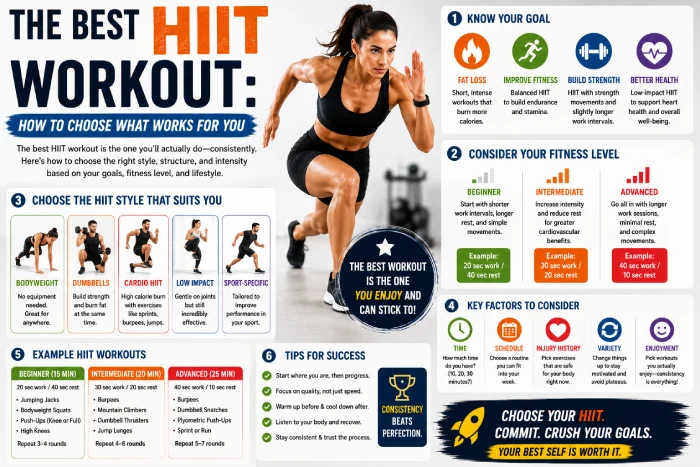
“Best” HIIT workout is the most searched but least useful framing in fitness content. The honest answer: the best HIIT workout is the one matched to your current fitness level, goal, equipment, and schedule — and the one you’ll do consistently.
The Decision Framework
By fitness level:
- Beginner → 30/30 intervals, 3 rounds, 3 days/week
- Intermediate → 40/20 intervals, 4 rounds, 3–4 days/week
- Advanced → Tabata or 45/15, 4–5 rounds, 4 days/week
By goal:
- Fat loss → Prioritize full-body, high-rep, minimal rest
- Athletic performance → Prioritize sprint intervals and explosive movements
- General fitness + time efficiency → 30-minute mixed-protocol sessions
- Joint health priorities → Low impact HIIT protocols
Mini Summary: The optimal HIIT workout for you isn‘t a defined workout – it‘s the format that fits where you are today and advances appropriately over 8 12 weeks.
Read More: Top-rated HIIT workout programs, expert-reviewed routines, and the most effective formats by goal — see our complete guide to the best HIIT workout.
HIIT Mistakes That Destroy Your Results
Even motivated, consistent people make these errors. Avoiding them separates people who get dramatic results from those who plateau or get hurt.
The 8 Most Damaging HIIT Mistakes
Mistake 1: Doing HIIT Every Day HIIT requires 48 hours of recovery between sessions. Doing it daily leads to overtraining syndrome — fatigue, plateau, increased injury risk, and hormonal disruption. Maximum effective frequency: 4–5 sessions per week for advanced athletes; 3 for most people.
Mistake 2: Not Actually Working Hard Enough If you’re having a nice time during your “HIIT” workout, it probably isn’t HIIT. Work intervals must reach 80–95% max heart rate. Many people do moderate circuit training and call it HIIT.
Mistake 3: Skipping the Warm-Up Cold muscles are injury-prone muscles. A 3–5 minute dynamic warm-up (not static stretching – decreases power output pre-workout) warms up the tissues, gets neural pathways going, and gets the joints ready.
Mistake 4: Bad Form when Fatigued The point of HIIT is to be tough. But when fatigues causes a squat to fall in, a to collapse when doing a burpee, or a safe landing to turn unsafe, injury is of no delay. Daintiness in intensity or with alternatives instead of form.
Mistake 5: No progressive overload. Performing the same HIIT routine repeatedly for month after month is not a training program, it will be like that forever in maintenance stage. Your body adapts between 2 to 4 weeks. Up the number of rounds, cut down rest time, or add resistance.
Mistake 6: Neglecting to eat while doing Nutrition: HIIT massively increases metabolic load. Under consumption of protein (30-40g within 2 hours post workout) prevents full recovery and muscle retention. Under consumption of calories limits performance of following sessions.
Mistake 7: Training only HIIT It is not enough for endurance. As it is not a hypertrophic message training, it will not help in producing muscle, and it has no impact on mobility or flexibility. So add 2 strength training a week.
Mistake 8: Moving onto advanced protocols prematurely Deconditioned individual leaps to a 45/15 or Tabata protocol before having a decent base of 4 weeks of 30/30 training. Such self-imposed early peaks in intensity are the surest way to create discouragement, injury, and downright exhaustion.
HIIT Workout Schedule: How to Structure Your Week
| Goal | Mon | Tue | Wed | Thu | Fri | Sat | Sun |
| Fat loss (intermediate) | HIIT | Rest | Low impact | HIIT | Rest | HIIT | Rest |
| Fat loss + muscle (advanced) | HIIT | Strength | HIIT | Strength | HIIT | Active recovery | Rest |
| Beginner | HIIT | Rest | Rest | HIIT | Rest | HIIT | Rest |
| Time-crunched (2–3x/week) | HIIT | Rest | Rest | HIIT | Rest | HIIT | Rest |
| Athletic performance | Sprint HIIT | Strength | HIIT | Strength | Sprint HIIT | Active recovery | Rest |
Universal Rules: No two HIIT off days should be consecutive days. Rest & adaptation can only occur within the 48 hour window,. The 48 hr window is not really a suggestion,.
Time Required for HIIT to Deliver Results
| Timeframe | What You’ll Notice |
| Days 1–7 | Increased energy post-workout, improved mood, initial muscle soreness |
| Weeks 2–3 | Cardiovascular adaptation begins — work intervals feel more manageable |
| Weeks 3–4 | Noticeable improvement in endurance and recovery between intervals |
| Month 2 | Visible changes in body composition, clothing fits differently |
| Month 3 | Significant fat loss, measurable fitness improvement, strong habit formed |
| Month 4–6 | Transformative results with consistent training + nutrition alignment |
Some important background: While HIIT boosts outcomes it doesn‘t ignore the biological clock. Those who anticipate visible change in 2 weeks are surely doomed to be disappointed. Those who stick with a habit for 90 days will generally be amazed.
HIIT and Nutrition: The Recovery Fuel You Can’t Skip
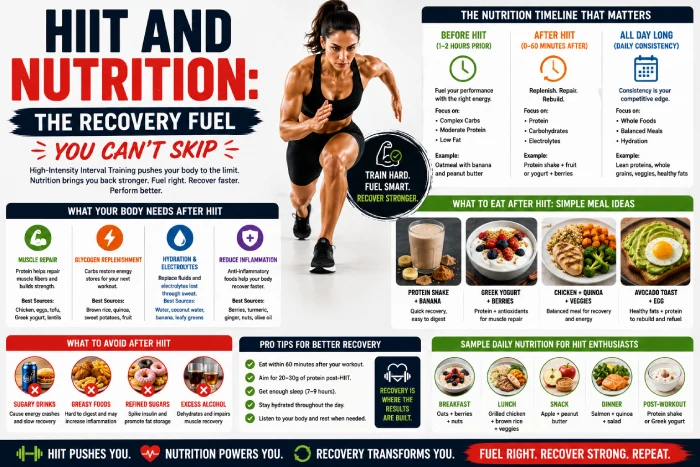
HIIT creates high metabolic demand. What you put in between your sessions will largely determine how quickly you recover, how much muscle you keep and how well future sessions go.
Pre-HIIT Nutrition
- Eat 1–2 hours before: complex carbs + moderate protein
- Examples: Oats + banana, brown rice + chicken, whole grain toast + eggs
- Avoid: Heavy fat-rich meals within 1 hour (slows digestion, causes GI discomfort during high-intensity work)
Post-HIIT Nutrition
- Eat within 30–60 minutes of completing the session
- Priority: 25–40g protein + moderate fast carbs
- Examples: Protein shake + banana, Greek yogurt + berries, chicken + white rice
Hydration
HIIT sessions produce significant sweat. Dehydration of just 2% of body weight reduces performance by 10–20% in high-intensity exercise. Drink 16–20 oz of water in the 2 hours before training, and replace fluids post-workout.
HIIT Myths — Busted
Myth vs. Fact
| Myth | Fact |
| “HIIT is only for fit people” | Beginners can do HIIT — they just need lower-intensity exercises and longer rest periods. The protocol adapts; the principles don’t. |
| “More HIIT = more results” | Frequency beyond 4–5 sessions/week leads to overtraining, not more fat loss. Recovery is where adaptation happens. |
| “HIIT burns muscle” | HIIT preserves muscle better than steady-state cardio. The key is adequate protein intake and not extreme calorie restriction. |
| “You need to feel destroyed after every HIIT session” | Effective HIIT is intense but shouldn’t leave you unable to function. Chronic excessive soreness is a sign of overtraining. |
| “HIIT is the same as circuit training” | Circuit training uses a series of strength exercises with minimal rest. HIIT specifically requires reaching near-maximum heart rate during work intervals. |
| “30 seconds of effort isn’t enough to make a difference” | 30-second all-out intervals at 90%+ max HR are physiologically demanding — vastly different from 30 seconds at a comfortable pace. |
| “HIIT burns belly fat specifically” | Fat loss is systemic — your body decides where it pulls stored energy from. HIIT creates the calorie deficit that drives total-body fat loss. |
FAQs: HIIT Workouts
Q1: What do I call/describe a HIIT workout?
A HIIT (High-Intensity Interval Training) workout involve sessions consisting of intervals. During these intervals the subject work during short episodes (15–45 seconds) of all-out exercise and rests shorter episodes (10–60 seconds). These sessions last from 15 to 30 minutes. Due to the effects of these alternating effort-rest periods, the heart rate is usually anaerobic and a “postburn” of increased calorie expenditure occurs for up to 48 hours post session.
Q2: Duration of a HIIT workout?
HIIT training sessions should last between 15 to 30 minutes (including warm-up and cool-down). The old adage never make the work session longer than 20 to 25 minutes does hold true here. By definition, you cannot sustain a true HIIT workout for longer than that. You‘ll be much better off with a 20-minute session of breathless work, than a 45-minute workout at a moderate pace.
Q3: How many days a week should I do high intensity?
Most individuals will respond best to 3 HIIT workout a week with recovery or very light activity day(s) between. The advanced athlete might react favourably to 4-5 (even up to 6) sessions a week. Don‘t have two consecutive days of HIIT, the 48 hours rest period is essential for muscular and cardiac/circulatory adaption.
Q4. Is there any indication that you can work out harder during the HIIT workouts than with just the regular cardio workouts in order to burn more fat?
For time, HIIT is still far superior to steady state cardio for 8–12 weeks of total fat loss. HIIT wins hands down for EPOC afterburn, hormonal response and impact on resting metabolic rate. Both are good choices when calorie deficits and CONSISTENCY are maintained. The solution: 3 x/week HIIT and any other type of cardio you want on your other days.
Q5: How many times can beginners perform Hiit?
Yes but you will want to adapt. Beginners should pause longer (45-60 sec), no impact to start with (no jumping), fewer rounds (2-3 rather than 4-5) and be sure to stick to at least 3 sessions per week. The intensity is fine, just needs to be scaled accordingly. Cardio will develop very quickly and most beginners can move on within 3-4 weeks.
Q6: Can HIIT help you gain muscle?
HIIT is muscular endurance training and create only mild hypertrophy for novice but not the best way to build muscles. If you want to build muscle while losing fat, have 2 separate strength training workouts also.
Q7: How a Tabata different from the other HIIT?
Tabata is a specific form of HIIT developed by Japanese scientist Dr. Izumi Tabata. In this version, exercises are conducted in a strict 20 seconds work / 10 seconds rest sessions over 8 sets (4 minutes). There are many formats that come under the umbrella term of ‘intervals’, but Tabata is one of the more intense regimes. Tabata is best suited to intermediate to advanced trainees, as it requires maximal effort.