


Mohd Arbaaz is an Editor and Writer at Fitnessison.com with 5 years of experience in SEO and digital content creation. He creates informative, reader-focused content covering fitness, workouts, nutrition, health, healthy lifestyle, technology, and computers.

Shashi Teja is a Reviewer at Fitnessison with over 6 years of experience in SEO, content strategy, digital publishing, and content optimization. He reviews content for clarity, research quality, topical relevance, readability, structure, and overall usefulness to readers.
Last Updated: September 20, 2026
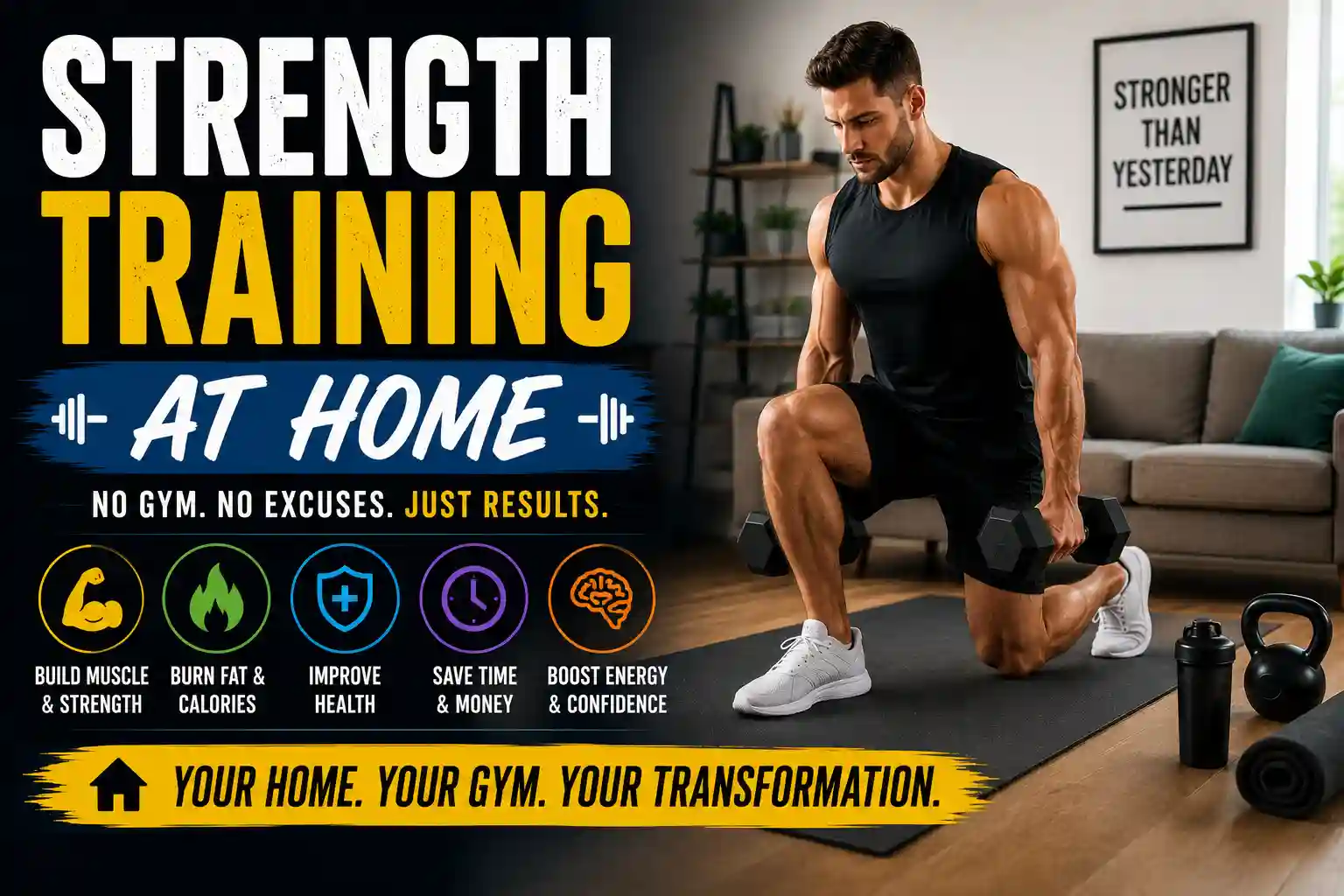
Strength Training at home is one of the simplest and most inexpensive ways to improve your fitness, develop muscle and build strength. You don’t need costly gym memberships or a large range of equipment to get excellent results. With the correct exercises, a sound workout schedule and dedication it is possible to strengthen your body at home.
If you are a beginner who want to get the ball rolling in nutrition and fitness or if you want to escape the clubbish atmosphere and boredom of the gym and get fit at home, then strength training at home can be just what you are looking for.
In this report, experience how home strength training can be useful to your condition; I will show some specific exercises with equipment possibilities and the most efficient strategies to implement your home strength program. Home strength training from our strength training guide.
Advantages of strength training at Home
Home workouts have grown in popularity due to being convenient, flexible and more economical.
Here are some of the biggest advantages of training at home:
- No gym membership fees
- Exercise at times that suit your timetable
- Save travel time
- Comfortable and private environment
- More appropriate for beginners and advanced lifters
- Easy to stay consistent
More interestingly, home strength training can have the same success as a training at the gym, if it is based on a progressive program.
Benefits of Strength Training at Home
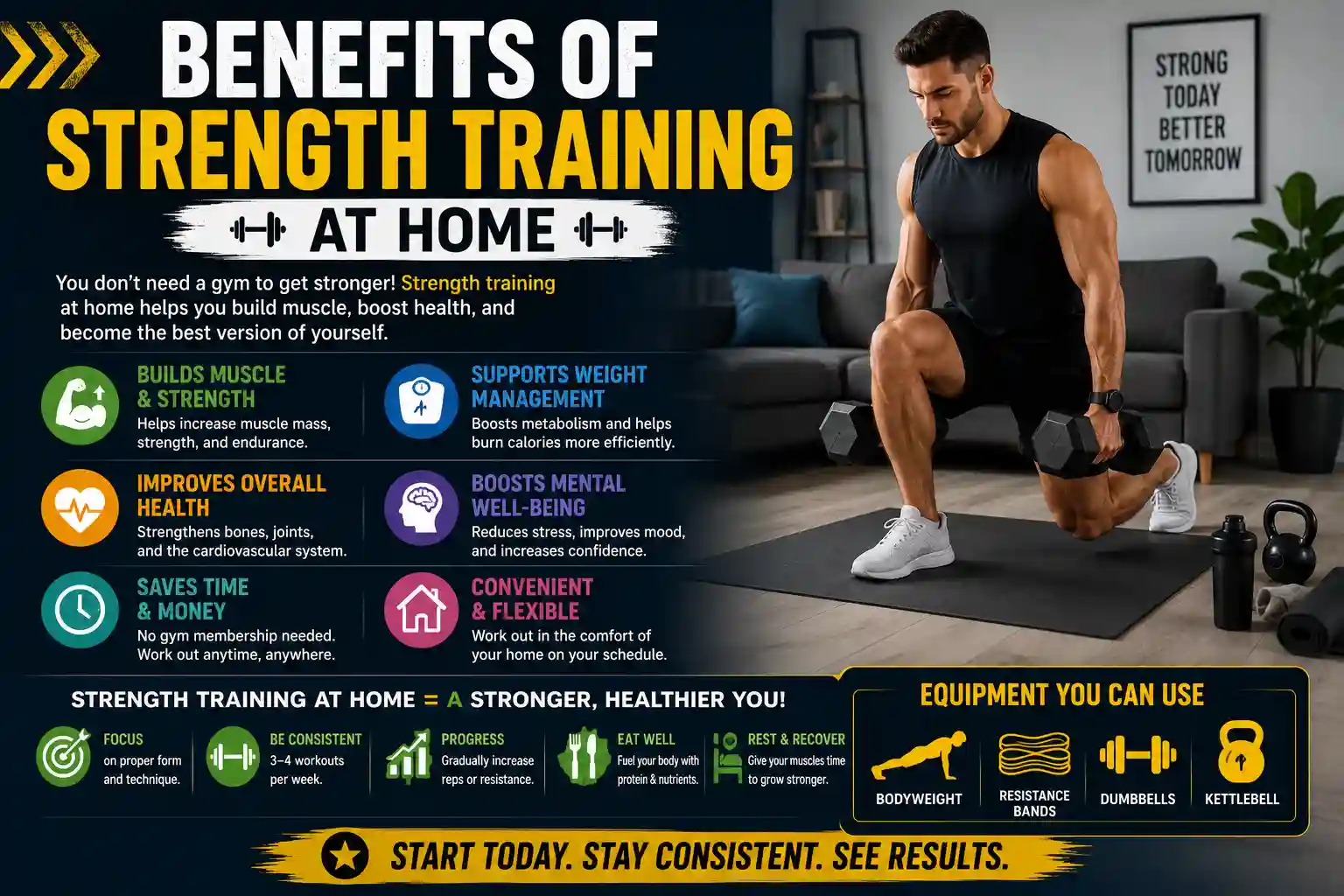
Builds Muscle and Strength
Works the muscles by creating a resistance that causes them to work harder as time progresses. Increase the resistance used, or the number of times you repeat a movement, and you‘ll notice a loss in size.
Improves Overall Fitness
Improves balance, co-ordination and flexibility and it will also make you more agile and simplify your day-to-day tasks.
Supports Weight Loss
Adding lean muscle increases your overall resting metabolic rate which means you‘ll be burning more calories between meals and when at rest.
Improves Bone Health
A weekly programme of resistance training can strengthen bones and may hold back the development of age related osteoporosis.
Boosts Mental Well-Being
Working out releases endorphins which help provide a much better state of mind, lessen the stress, and increase confidence.
Fits Any Lifestyle
Whatever your available time 20 minutes or an hour you can make your home workout flexible.
Do You Need Equipment?
The most beneficial aspect of strength training at home is there is no equipment required to begin.
Bodyweight Exercises
These require no equipment and are suitable for those who are new to the subject.
Examples include:
- Push-Ups
- Squats
- Lunges
- Glute Bridges
- Planks
- Mountain Climbers
Resistance Bands
Resistance bands are cheap, portable and a fabulous way to increase the intensity of a workout.
Dumbbells
With a set of adjustable dumbbells you can do dozens of good strength-building exercises.
Kettlebells
Kettlebells work all over the body making it great for strength and conditioning. For beginners, bodyweight workouts alone are sufficient to get strong and learn correct movement patterns.
Best Strength Training Exercises at Home
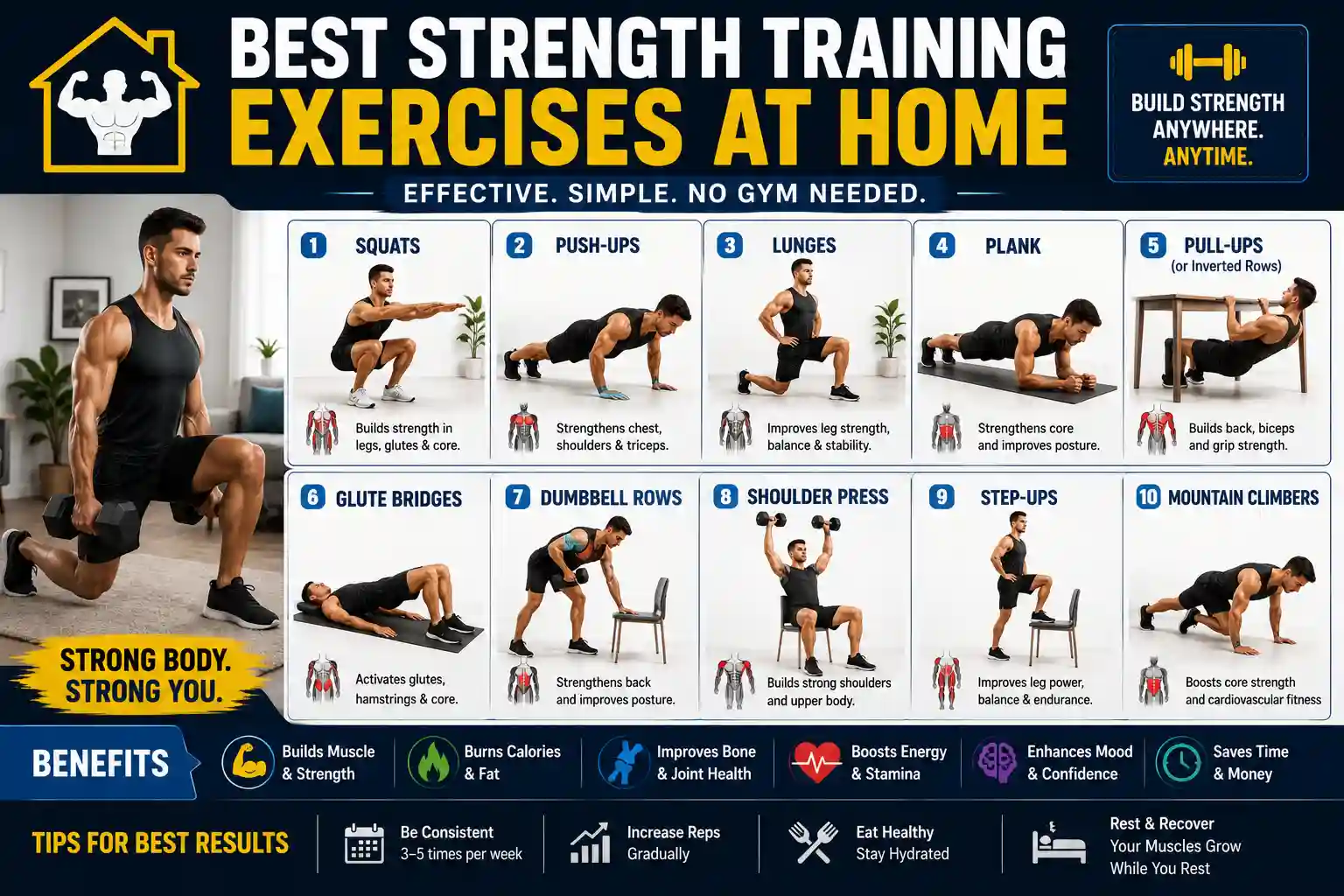
1. Bodyweight Squats
Sets provide a comprehensive workout for your core and lower body muscles, including your legs, glutes, and abs, and they also help to improve your balance and flexibility.
How to Perform
- Stand with your feet comfortably apart and keep your knees slightly bent.
- Sit your hips back until your thighs are nearly parallel to the floor.
- Sideways squat: Drive out of the side of your heels to extend your knees.
2. Push-Ups
Push-ups build up your chest, shoulders, triceps and stomach.
If normal push-ups are too hard, you may perform step-up push-ups or incline pushups.
3. Walking Lunges
Enhances strength of the muscles in the lower-body muscles and also enhances balance and coordination.
Switch legs, maintaining a fully straight posture.
4. Glute Bridges
Glute bridges will strengthen your glutes, hamstrings and lower back.
Come to a full stop at the top of each rep and pause for a fraction. This is critical for optimum muscle activation.
5. Dumbbell Rows
If you have dumbbells, rows are great for increasing back strength and posture.
Ensuring your back remains flat, bring the weight back to the hip.
6. Shoulder Press
Isometric core Strength- Lift is in a side hold, and lift weights over head with resistance bands or dumbbells.
7. Plank
The plank builds core stability and increases whole body strength. Hold for 20–60 seconds in a straight line.
Start with our strength training for beginners guide.
Beginner Strength Training at Home Workout
30 push ups. 80 jumping jacks and 30 crunches. Complete this circuit a minimum of 3 times a week on alternate days.
Exercise 1
Bodyweight Squats
3 Sets, 12 repetitions
Exercise 2
Push-Ups
3 Setsx 10 Reps
Exercise 3
Walking Lunges
3 sets x 10 repetitions (9) each leg
Exercise 4
Glute Bridges
3 way 15 deed.
Exercise 5
Plank
3 Sets×30–45 Sec
As you become stronger you can increase the number of repetitions, add resistance bands or bring in the dumb bells.
Weekly Home Strength Training Schedule
Monday
Full Body Strength Workout
Tuesday
Light Walking or Stretching
Wednesday
Full Body Strength Workout
Thursday
Mobility or Yoga
Friday
Full Body Strength Workout
Saturday
Light Cardio
Sunday
Complete Rest
This timetable gives sufficient rest time, without compromising on regular progress.
Tips for Getting Better Results at Home
Focus on Proper Form
Maintaining proper technique prevents injuries and means you are using the appropriate muscles.
Warm Up First
Warm up for five or ten minutes before every session with some light cardio or dynamic stretching.
Train Consistently
Try to get in a minimum of 3 strength workouts a week!
Use Progressive Overload
Continue challenging your muscles by:
- Increasing repetitions
- Adding weight
- Slowing movement tempo
- Using more challenging exercise variations
Prioritize Recovery
Eat a healthy diet and sleep at least 7–8 hours every night allowing your muscles to recover.
Eat Enough Protein
Protein what helps repair and grown muscles after training.
Good protein sources include:
- Chicken
- Fish
- Eggs
- Greek Yogurt
- Beans
- Lentils
- Tofu
Common Mistakes to Avoid
Skipping Warm-Ups
Muscles cold are more susceptible to injury.
Training Every Day
Muscles are made while you‘re recovering, not while you‘re working out.
Poor Exercise Technique
A good rep is a good rep, no matter how much extra you might get by forcing yourself to do a little more.
Ignoring Lower Body
An effective workout should include a mixture of upper and lower body exercises.
Not Tracking Progress
By recording your workouts you make sure that you are constantly progressing.
Strength Training at Home vs Gym
| Strength Training at Home | Gym Strength Training |
| Lower cost | Membership required |
| Convenient | More equipment available |
| Flexible schedule | Fixed travel time |
| Great for beginners | Better for heavy lifting |
| Minimal equipment needed | Advanced machines available |
Both choices support your effort to develop strength. Your personal preference should take into consideration your available finances, time, and fitness goals.
Final Thoughts
Home strength training proves that you don‘t have to go to a gym to get all stronger,leaner and confident. Bodyweight exercises,Resistance bands or dumbbells can help you to develop muscle,lose fat and improve your fitness in your own sitting room.
Start with a few easy things, be mindful of your technique, and build up gradually as your body adapts. The three most important factors to long term success are continue doing the activities regularly, keep balanced in you diet and rest sufficiently.
No matter what your fitness level is, doing a strength training workout at home will make you stronger and healthier. Eat right with our strength training nutrition guide.
Frequently Asked Questions
Q1) Can you build muscle mass working out at home?
Yes. If you pregressively overload your muscles, when you eat good and stay committed for your workouts, the muscle I will give you is good even if you are at home.
Q2) How frequently should I perform my home strength training workouts?
In most cases one can train three or four times each week and separate training sessions by enough rest so one does not overtrain.
Q3) Is there a way to do home strength training without equipment?
Yes, Bodyweight exercises are great for strength. I think this is the best way to start out. For strength the following are great: squats, pushups, planks, lunges.
Q4) What type of equipments are suitable for strength training at home?
Other inexpensive equipment, such as resistance bands, and adjustable dumbbells and kettlebells, will dramatically increase the variety and intensity of their programs.
Q5) Is it cardio or strength training that makes the difference?
Yes. If combined with medium cardio, do strength training, it can affect your cardiovascular health, your resistance and average fitness level and you can get weight benefit for this.