

Last Updated: September 10, 2026
Introduction
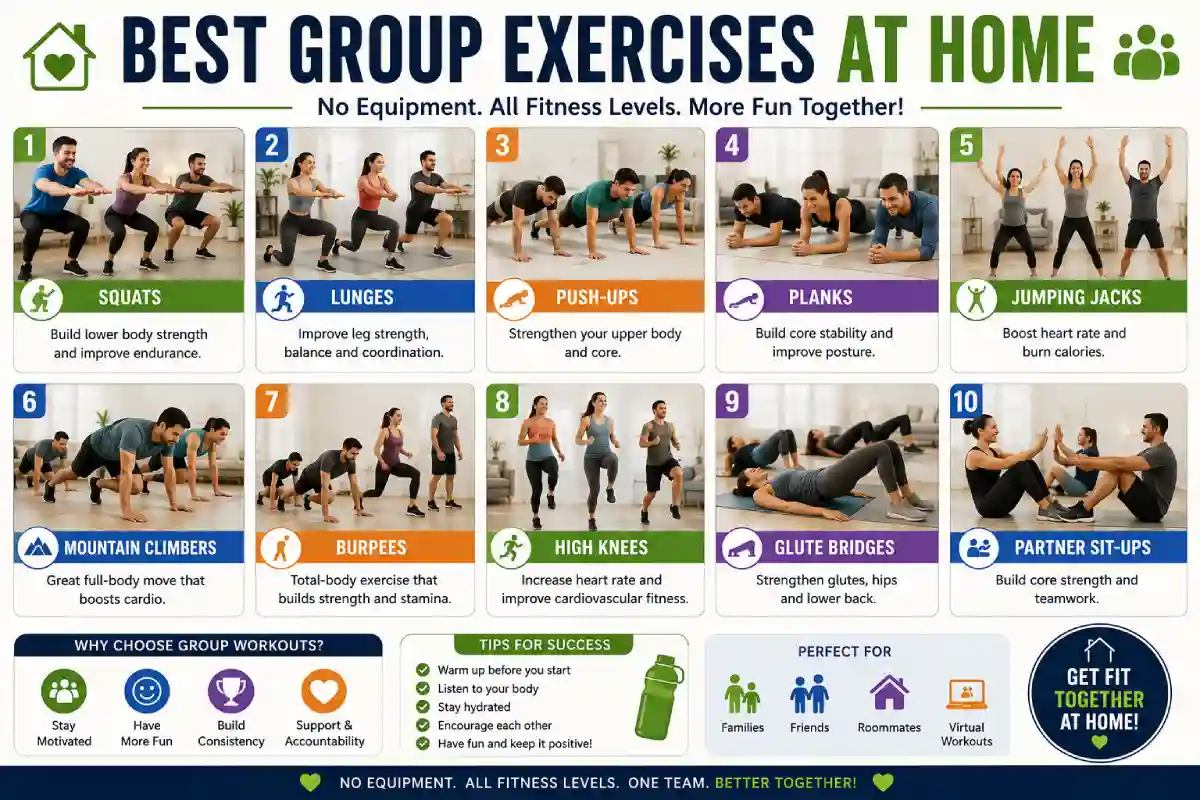
Finding the best group exercises to do at home is not around making a list of things to do. It is about making something that people will want to keep responsibility every week. If you are planning a training with your partner on a Saturday or a fitness challenge with your family or if you exercise with your friends the right exercises can make a big difference.
The right exercises can gentle people want to keep doing them. Most of the time people who write about fitness do not think about this. They think that exercising at home with a group is the same as going to a gym class.. It is not the same. Group exercises at home have their way of doing things. They are different from gym classes. They have their own good things, about them. When you do not have to go to the gym you do not have to pay money every month and you do not have to feel scared something good happens. People stop making excuses. They start exercising with the group exercises at home. Group exercises at home are a way to get people to exercise.
Expert Note — CPT Perspective
Research from the University of New England College of Osteopathic Medicine found that people who exercise in groups lower their stress levels by 26% compared to those who train solo — and that gap holds even when solo exercisers work harder. The social element isn’t a bonus. It’s a core part of the results.
This guide covers everything: the top-performing exercises complete in 2026, how to structure a complete session, what works for beginners vs advanced groups, appraisal tables, a ready-to-use 45-minute plan, and truthful troubleshooting for the problems most guides skip over entirely.
Group Exercises at Home Resource Center
Explore our complete collection of home group workout guides for beginners, cardio, strength training, HIIT, yoga, weight loss, seniors, and kids. Find the best exercises to stay active, motivated, and fit at home.
Why Group Home Workouts Win in 2026: The Data
Group fitness isn’t a trend — it’s a behavioural science advantage. The research is amazingly consistent, and the numbers under come from peer-reviewed studies and industry data current as of early 2026.
| 26% | 2× | 67% |
| More stress reduction vs solo workouts | Higher long-term adherence in group settings | Of active adults prefer working out at home |
| Journal of American Osteopathic Assoc. | NIH / PMC Research Review | Statista / GoodBody 2026 |
| $11.3B | 72% | |
| US home fitness market value (2026) | Prefer flexibility of home fitness classes | Projected annual growth, virtual fitness |
| Market Research Reports | GoodBody Fitness Statistics 2026 | Industry Projection to 2026 |
Group vs Solo Training: Key Outcome
Comparison (2026 Research)
Source: Journal of American Osteopathic Association · PMC Research Reviews · British Journal of Social Psychology 2026
| Stress Reduction (Group) | 78% |
| Stress Reduction (Solo) | 52% |
| 6-Month Adherence (Group) | 71% |
| 6-Month Adherence (Solo) | 38% |
| Quality of Life Score | 82% |
| Cognitive Benefit (Group) | Significant |
“The benefits of exercising with friends and colleagues are huge. When we work out together we encourage each other. Do something tough. This pays off in ways and its much better than exercising alone.”
— Dr. Dayna Yorks, University of New England College of Osteopathic Medicine
Top 12 Group Exercises at Home
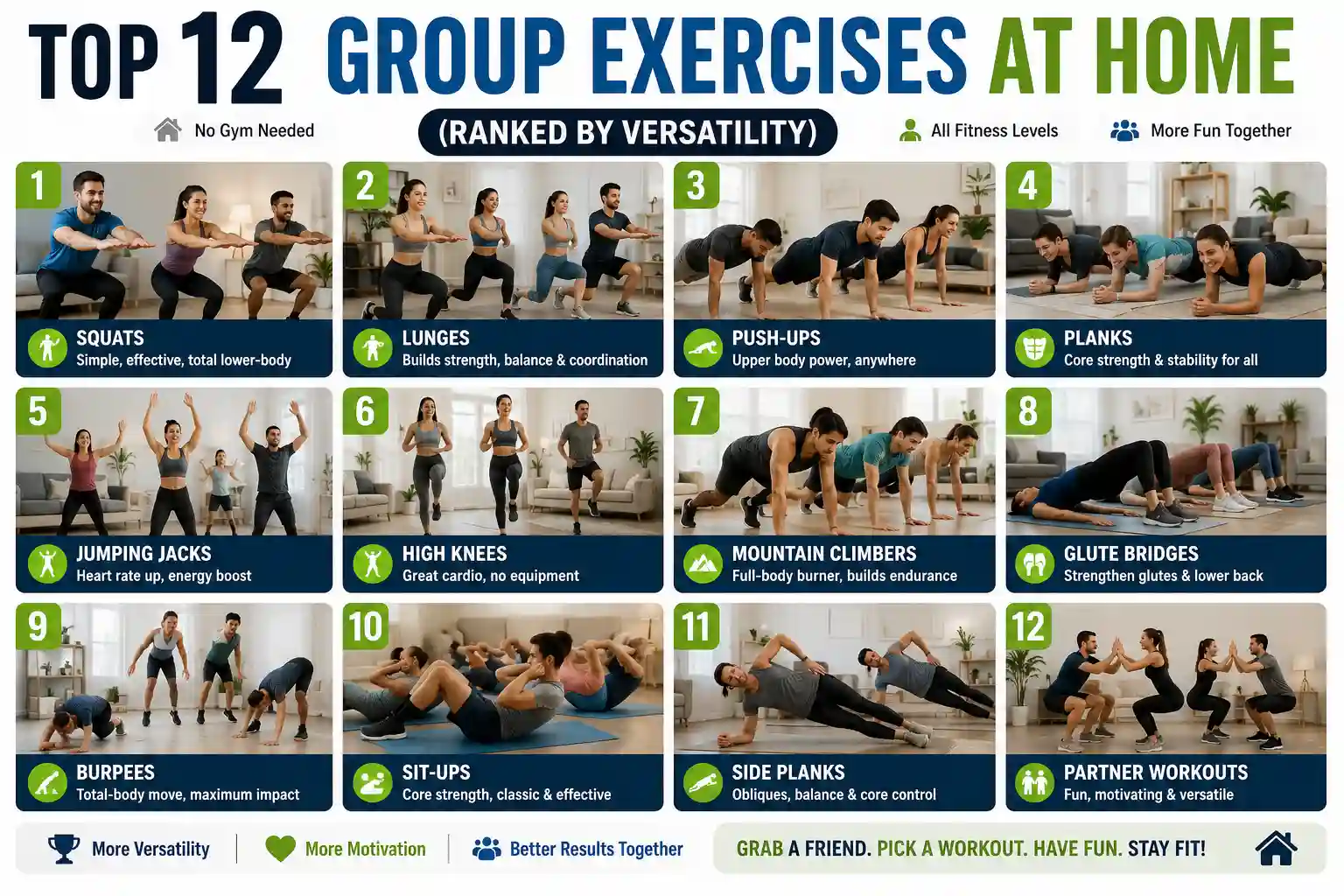
These exercises are ranked on four things: how well they work for groups how easy they are for novices how well they can be changed for fitness levels and how little space they need. You don’t need any equipment, for any of them. Though some optional extras are stated where they can help.
Tier 1: Best All-Round Group Exercises
Top Pick · Full Body
1. Synchronized Squats
Everyone counts aloud together. The shared cadence melodramatically improves form consistency and makes skipping reps expressively harder. Add a 2-second bottom hold on the last rep of each set for extra injury.
Targets: Quads | Glutes | Hamstrings | All Levels
Top Pick · Core
2. Group Plank Hold
Hold a plank simultaneously and try to outlast each other. Alternatively, do ‘plank parades’ where one person walks around tapping ankles to introduce chaos and engagement.
Targets: Core | Shoulders | Mental Grit | All Levels
Top Pick · Cardio
3. Burpee Relay
Person A does 5 burpees, then tags Person B. Keeps strength high while giving brief recovery. Can scale from 3 to 10 reps per round contingent on fitness level.
Targets: Full Body | Cardio | High Burn | Intermediate+
Top Pick · Upper Body
4. Partner Push-Up High-Fives
Face each other in push-up position. At the top of each rep, high-five with alternating hands. Forces stability, adds fun, and naturally syncs everyone’s pace.
Targets: Chest | Triceps | Core | Beginner OK
Tier 2: High-Fun, High-Burn Group Exercises
High Energy · Cardio
5. Dance Cardio Circuit
10-minute follow-the-leader dance sessions. Person in front picks the move for 30 seconds, then rotates. No skill needed — just movement and music.
Targets: Full Body | Cardio | Fun Factor | All Levels
Partner · Strength
6. Sit-Up Pass
Sit facing each other with feet interlaced. Concurrently sit up and high-five or pass a light object at the top. Works core while creating natural synchronization.
Targets: Abs | Hip Flexors | Core | Beginner
Group · HIIT
7. Mountain Climber Countdown
Group starts at 20 reps and counts down together. Last one to finish each round sits out one set — creates healthy competitive pressure without fully eliminating anyone.
Targets: Core | Shoulders | Cardio | Intermediate
Read more about: Best Group HIIT Workouts at Home
Team · Challenge
8. Squat Jump Relay
Relay format: jump squats until a target number is hit collectively. The group total matters, not individual scores — this team-scoring format dramatically boosts effort levels.
Targets: Legs | Power | Cardio | Intermediate
Tier 3: Cool-Down & Flexibility Group Exercises
Cool-Down · Stretch
9. Partner-Assisted Hamstring Stretch
Sit on the floor with legs lengthy. Partner gently applies light heaviness on your shoulders as you fold forward. Hold 30 seconds, change. Far deeper than solo stretching.
Targets: Hamstrings | Lower Back | Recovery | All Levels
Cool-Down · Yoga
10. Group Yoga Flow
Mirror-format yoga: one person leads a 5-minute order while others follow. Rotate leaders each session. Low-pressure, high-benefit way to close any group workout.
Targets: Flexibility | Mindfulness | Balance | All Levels
Here is complete guide on: Best Group Yoga Exercises at Home
Active Recovery · Core
11. Dead Bug Sync
Everyone performs dead bugs in parallel, breathing together on the extension. Surprisingly hard to keep synchronized — which makes it oddly compelling and excellent for deep core activation.
Targets: Deep Core | Lower Back | Stability | Beginner+
Full Body · Balance
12. Tandem Lunge Circuit
All face the same direction and lunge in sync. Add a torso twist at the bottom for oblique engagement. Optional: pass a pillow across the row for coordination.
Targets: Quads | Glutes | Balance | All Levels
2026 Comparison Tables
Table 1: Exercise-by-Exercise Comparison
| Exercise | Difficulty | Min Group | Space/Person | Cal/30 Min | Equipment | Beginner? |
| Synchronized Squats | Easy | 2 | 4×4 ft | 180–220 | None | Yes |
| Group Plank Hold | Easy–Moderate | 2 | 6×3 ft | 120–160 | None | Yes |
| Burpee Relay | Moderate–Hard | 2 | 5×5 ft | 280–360 | None | Modified |
| Partner Push-Up High Fives | Moderate | 2 | 6×3 ft | 160–200 | None | Yes |
| Dance Cardio Circuit | Easy | 2+ | 6×6 ft | 200–300 | Speaker | Yes |
| Sit-Up Pass | Easy | 2 | 5×4 ft | 100–140 | None (opt.) | Yes |
| Mountain Climber Countdown | Moderate | 2+ | 4×3 ft | 240–300 | None | Modified |
| Squat Jump Relay | Hard | 2+ | 4×4 ft | 300–400 | None | Not ideal |
| Partner Hamstring Stretch | Easy | 2 | 5×3 ft | 30–50 | None | Yes |
| Group Yoga Flow | Easy–Moderate | 2+ | 6×3 ft | 60–120 | Mats (opt.) | Yes |
| Dead Bug Sync | Easy | 2+ | 6×3 ft | 80–110 | None | Yes |
| Tandem Lunge Circuit | Easy–Moderate | 2+ | 4×6 ft | 150–200 | None | Yes |
Table 2: Group Workout Format Comparison |
||||||
| Format | Best For | Duration | Intensity | Equipment | Social Factor | Fat Burn |
| AMRAP Circuit | Competitive groups | 20–30 min | High | None | 3 | High |
| EMOM | Structured athletes | 20–40 min | Mod–High | None | 2 | High |
| Tabata Group | Short on time | 4–20 min | Very High | None | 2 | Very High |
| Partner Supersets | Couples & pairs | 25–40 min | Moderate | Optional | 3 | Moderate |
| Relay Races | Families with kids | 15–30 min | Mod–High | None | 4 | High |
| Yoga/Stretch Flow | Recovery days | 20–45 min | Low | Mats (opt.) | 3 | Low |
| Dance Cardio | Beginners, fun seekers | 20–30 min | Low–Mod | Speaker | 4 | Moderate |
Table 3: Top Group Fitness Apps (2026 Comparison) |
||||||
| App | Free Tier | Group Features | No-Equipment | Live Classes | Price/Month | Best For |
| Peloton App | No | Group challenges | Yes | Yes | $12.99 | Structured programs |
| Nike Training Club | Yes | Limited | Yes | No | Free / $14.99 | Beginners |
| FitOn | Yes | Friend workouts | Yes | No | Free / $29.99/yr | Social fitness |
| Beachbody (BODi) | No | Yes | Yes | Yes | $19.99 | Family programs |
| YouTube | Yes | No | Yes | No | Free | Budget-conscious |
The 45-Minute Beginner Group Workout Plan
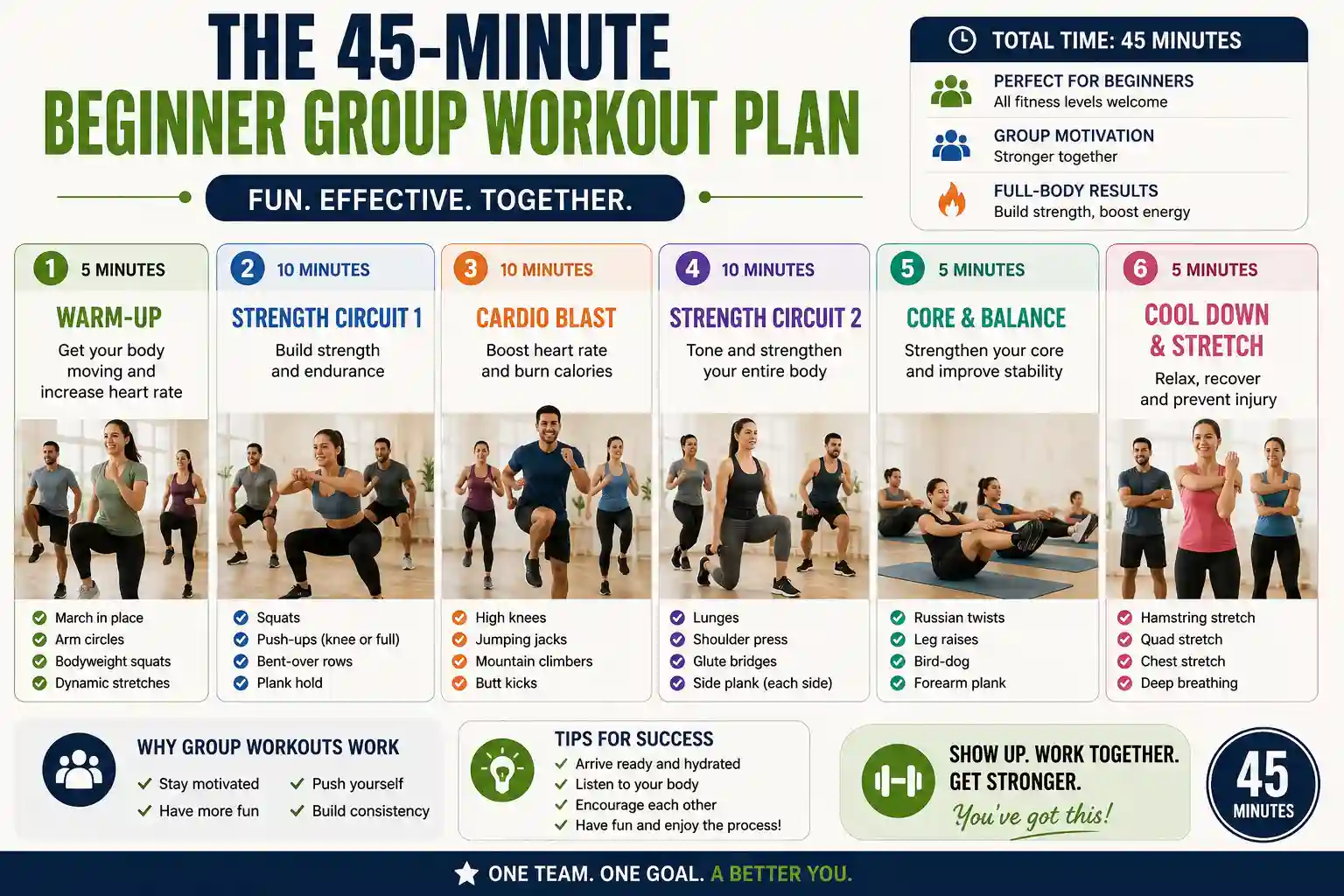
This is a complete, ready-to-run session designed for groups of 2–5 people with mixed fitness levels. No equipment needed. Use a free interval timer app on your phone to manage the phases.
| Phase | Exercises & Instructions |
| Warm-Up | Sync Squats ×10, Jumping Jacks ×20, Hip Circles, Arm Swings — do these together, count aloud |
| Block 1 | 3 rounds: Group Plank Hold (30s) → Dead Bug Sync (10 reps) → Partner Push-Up High Fives (8 reps) |
| Block 2 | 3 rounds: Synchronized Squats ×15 → Tandem Lunges ×10/leg → Mountain Climbers ×20 (synchronized) |
| Cardio | Dance Cardio Circuit: Follow-the-leader format, 30s per person as leader, rotate through group 2× |
| Challenge | Group Burpee Relay: Collectively hit 50 burpees — split however the group decides. Track time to beat! |
| Cool-Down | Partner Hamstring Stretch (30s each) → Group Yoga Flow (child’s pose, cat-cow) → Group breathing: 4 in, 6 out |
Pro Tip: Track Your Group Score
Track your group’s collective burpee relay time each session on a visible whiteboard or phone note. Within 4 weeks, most groups cut their time by 30–40% — and that visible progress is one of the most powerful motivators in group fitness.
Difficulty Scaling Guide
| Level | Description | Adjustment |
| Complete Beginner | Never exercised regularly | Start with 2 rounds, skip the burpee relay |
| Some Experience | Occasional exercise | Follow plan as written |
| Intermediate | 3+ months consistent training | Add a 4th round to each block |
| Advanced | 6+ months training | Use Tabata timing (20s on / 10s off) |
| Elite | 1+ year consistent training | Add resistance bands and weighted vest |
Group Exercises for Couples & Friends
Couples’ workouts and friend-group sessions have subtly different dynamics. Couples tend to be more comfortable with physical contact exercises, while friend groups often thrive on competitive formats.
Research on family fitness activities shows that exercising together can improve long-term adherence to healthy habits.
Best Exercises for Couples at Home
Research published in 2026 confirms that couples who work out together see significantly higher long-term consistency than those training solo — but only when the workouts feel like quality time rather than performance tests.
Couples · Contact
1. Mirror Squats
Face each other and squat in perfect sync. Hold hands for balance or add a light resistance band between you for a shared challenge.
Targets: Connection | Quads | Glutes
Couples · Strength
2. Plank Row (Partner)
In push-up position facing each other, alternate reaching forward to touch the other’s shoulder at the top of each plank hold. Builds trust and core stability.
Targets: Core | Shoulders | Balance
Couples · Recovery
3. Back-to-Back Breathing
Sit back-to-back and practice diaphragmatic breathing together. This cool-down technique reduces cortisol and is genuinely relaxing — a perfect session closer.
Targets: Mindfulness | Stress Relief | Bonding
Best Exercises for Friend Groups (3–6 People)
Friend groups do best with a competitive edge and clear team scoring. The moment there is a shared target to hit — a total rep count, a time to beat, a group leaderboard — effort levels rise noticeably.
| Exercise | Group Size | Competitive Format | Why It Works |
| Burpee Relay | 3–6 | Collective time target | No one wants to be the slow link |
| Plank-Off | 2–6 | Last one holding wins | Pure psychological battle |
| AMRAP Squat Challenge | 2–5 | Who hits 100 squats first? | Simple, visible, scoreable |
| Fitness Bingo | 3–8 | Card-based random exercises | Every session is unpredictable |
| Dance Cardio Battle | 3+ | Voted best dancer each round | Laughter = sustained effort |
No Equipment Group Exercises: Zero Gear, Zero Excuses
The biggest myth in home fitness is that you need equipment to get a serious workout. For group settings specifically, equipment often gets in the way — it creates wait times, uneven skill gaps, and setup headaches. These no-equipment routines are deliberately stripped-down and highly effective.
Calorie Burn: No-Equipment Group Exercises (30 Min, 75kg Person)
Source: Metabolic Equivalent (MET) calculations, American Council on Exercise 2026 Data
| Burpee Relay | 320–400 kcal |
| Squat Jump Relay | 300–360 kcal |
| Dance Cardio | 200–280 kcal |
| Mountain Climbers | 240–300 kcal |
| Synchronized Squats | 180–220 kcal |
| Partner Push-Ups | 160–200 kcal |
| Group Yoga Flow | 60–120 kcal |
10-Minute No-Equipment Emergency Workout
Short on time? Do this with any group: 60 seconds each of jumping jacks → squats → push-ups → plank → mountain climbers. Rest 60s. Repeat twice. Total: ~10 minutes, ~150–200 calories. Perfect for a small apartment living room.
Home Space Setup Guide for Group Workouts
One of the most underrated parts of a successful group home workout is space. Not square footage — configuration. Here is exactly how to set up different rooms for different group sizes.
| Group Size | Ideal Room | Min Space | Setup Tips | Optional Equipment |
| 2 People (Couples) | Bedroom / Lounge | 8×8 ft | Push bed to wall, roll back rug, clear coffee table | 2 yoga mats |
| 3–4 People | Living room / Garage | 12×12 ft | Arrange in a square, rotate positions between sets | Resistance bands, Bluetooth speaker |
| 5–6 People | Garage / Large lounge | 16×16 ft | Line format (side by side) works better than circle for 5+ | Timer, whiteboard, music system |
| 7–10 People | Garden / Backyard / Hall | 20×20 ft+ | Use relay-lane format — one active lane, one recovery lane | Cones, agility ladder, speakers |
Safety First
Always check the floor surface before jumping exercises. Hardwood floors without mats are slipping hazards, especially with socks. Ensure at least 18 inches of clearance above the tallest person’s raised hands for any jump movements.
Troubleshooting: 6 Common Group Workout Problems (Solved)
The majority of group home workouts are unsuccessful not because of the exercises, but because of logistics and social problems. Here are the most in-your-face problems and how you can solve them.
| Problem | Fix |
| Fitness Level Mismatch | Do relay circuits so the quicker group rests while slower group works hard to catch up. Or even give out individual goals advanced member does 15 squats while beginner does 8 then the group moves together. |
| Scheduling Conflicts | Agree on 2 (fixed) weekly sessions instead of juggling four. Two regular meetings beat four irregular ones every time. Use Google Calendar to share scheduling. |
| Phone Distractions | Select one of the phones as the group timer/music device. Prepare all other phones off facing up, place in a pile prior to beginning. The ‘phone jail’ adds an element of fun instead of making it a gripe. |
| Running Out of Ideas | Maintain a ‘workout jar’- pieces of paper in origami folds carrying exercises and repetitions. Take out 8-10 a session. No planning. No boredom. New papers added to the jar by different people weekly. |
| Losing Motivation After Week 3 | Introduce a 4-week group challenge that is a visual tracker. Record group total weekly burpees, cumulative plank times, or step count. The ability to track and see progress maintains motivation far longer than willpower. |
| Injury Risk in Cramped Spaces | Mark out the designated workout zones with masking tape on the floor prior to instructing. Participants remain in their zone for the floor exercises. When navigating through the general space, remain only during the relay parts. |
Frequently Asked Questions
Q1: Which group exercises are ideal to perform at home without usingany equipment?
The top no-equipment group exercises include synchronized squat holds, group plank holds, partner push-up high fives, burpee relays, mountain climbers and dance cardio circuits, all of which can be done on a cleared floor and with two or more people. To make it a full 45 minute workout, use 3–4 along with a partner stretch cool-down.
Q2: How much room is necessary for group home exercise?
6×6 is recommended as an absolute minimum for most cardio movements. An cleared area of 8×8 is sufficient for two people. 12×12 is suggested for groups of 3–4 people in a semi-private setting such as a living room or garage. Use masking tape to define individual circles so that collisions can be avoided.
Q3: Can life groups help us in our beginners workouts?
Yes and they‘re really great for absolute beginners because of the social accountability effect. Studies show that group exercisers are about twice as likely to stick with their programs as individuals. Exercises are simple to modify (less reps, tougher variations) so novices can work out with long-time experts without feeling lost.
Q4: How many times per week is a group exercise at home?
The golden rule for most groups is 3–4 sessions a week. For those new to exercise they should aim for 2 sessions a week for about 4 weeks as this is enough to develop the habit without causing fatigue. 20–45min sessions are sufficient to develop strength, endurance and mood; consistency will always win over intensity.
Q5: Are there benefits of group exercises at home for weight reduction?
100 percent. High-intensity during group circuits burpee relay races, dance cardio, squat jump relay races Can burn between 300–400 calories in 30 minutes for a 75kg individual. But crucially the social aspect allows the sessions to be sustainable over the long term, which is the most important factor in maintaining weight management.
Q6: Which is the most effective exercise for the group of participants with mixed fitness levels?
Relay types work great for combined levels of fitness. All maintain individual speed on an exercise and compromise on group total meaning a novice willing to do 5 burpees and a pro willing to do 15 are both equally challenged. Synchronized movements and group yoga are good, too, since everyone improvises individually while remaining visually cohesive with the rest of the group.
Final Thoughts: Building a Group Habit That Actually Sticks
The best group workout program you will ever follow will be the one you actually do as a group week after week for months not the more scientifically perfect program you give up on by week four. Keep it simple. Two days a week. Four exercises per session. Have a timer on your phone and the one person in the group willing to lead the warm-up. That‘s it.
The truth is, these exercises are designed to be as accessible as possible. Synched-upcrate squats aren t even coach certified, partner push-up high-fives, no need for a spotter, dance-cardio, no dance choreography necessary. What they do require is people, two or more of them who want to come into the room and move together, and the research is astonishingly consistent that when that happens, everything great happens for every single person in that room.
Begin today.Choose three exercise motions from this guide. Find a space about 10×10 feet. Turn on a 30-minute timer. See what develops.
Disclaimer & Sources
This article is intended for educational and informational use only. You should always seek the advice of a licensed healthcare professional before beginning any new exercise regimen especially if you have a current or pre-existing medical condition or injury. Calorie calculations are represented as an approximation depending on your body weight, intensity, and fitness level.
Sources: Journal of American Osteopathic Association (2017, accessed 2026) · British Journal of Social Psychology (2026) · PMC/NIHGroup Exercise Research Reviews · StatistaHome Fitness Market Data 2026 · American Council on ExerciseMET Values · GoodBody Fitness Statistics 2026 · MileHigh Fitness & Wellness (2026).